TV Diary is by far the least read of our columns. It seems wise to ask ourselves then why we think it’s important to continue with it. It also seems important to define it. Obviously, it’s meant to as a space to discuss TV work that is interesting to us. But, frankly, in practice, it’s probably a place for one particular editor to write about his fascination with J-Drama. What is J-Drama? Succinctly, it is Japanese live-action television. Usually, these are shows that run for about 9 to 11 episodes, and are then replaced on the schedule by another new show. Each episode is generally around 40 minutes long (except the first and last which are typically longer). There are also variants of this format, with some shows only being around 30 minutes long. And there are the asadoras, otherwise known as morning dramas, that air everyday and are around 15 minutes long per episode and can last for more than 100 installments. In this text, we also touch a bit on The K-Drama which is, of course, the Korean variant and currently much, much more popular for a host of reasons (primarily, I would say because it’s much more accessible). The K-Drama series are generally longer (16 to 20 episodes, if not more) and each episode is around 1 hour long. It’s a much more intensive commitment. I have not delved much into Chinese series, but perhaps one day I will report back! For a long time, I also had an ambition to revisit some classic telenovelas (we’ll see if something ever comes from that). This column will probably ignore much of what the world classifies as great television. So much the better. It’s time to bring back some risk.
Let’s put some ideas at play. In J-Drama, we have a space that still allows for certain gestures. We can believe in romance, we can invest in a romantic fantasy. And this fantasy is not undercut by tired self-aware humor, but rather respected and cherished. We are allowed to believe in the device (those series exist too, but they don’t take up too much room in my experience). This idea is important because it makes the world around the characters true, it dignifies our emotions as genuine, it honors our investment. In a show like Our Sister’s Soulmate, for example, the small connection between the ex-con warehouse worker and the chipper department store employee is immediately understood – the show invests itself into nourishing that fragile connection and developing it, extending that connection outward, to their friends and families, to the outside world. We spend nine episodes with these characters – the daily rituals at the breakfast table, the beers outside the convenience store, the small look of joy seeing your loved one hard at work. The romance is not very overt, but it is always there, always understood.
Something else which is important is the idea of “small subjects.” Everything is modest, everything is pitched at a human scale. A show like Freeter, ie wo kau, for example, sees its main character join a construction company in order to try to buy his mother a house (as a balm to her depression). In Story of my Family, the oldest son is forced to move in with his father who is struggling with dementia. Even in shows with more high-concept hooks, everything remains fairly modest, to the ground as it were. These type of “small subjects” are missing far too often. If we look at the shows that streaming companies are currently investing in, it is almost always Intellectual Property, a videogame, a book series, a giant world that must be created via hundreds of millions of dollars! But why is this necessary? A show like Full Time Wife Escapist has a few sets (the apartment where almost of all the show’s emotional pirouettes take place, the office where one of the characters works), and some location work on the streets of Tokyo – it doesn’t need much more than that to conjure up an entire universe. This is because if we go back to the idea of taking Romance seriously, then really we don’t need much at all. All we need are two characters and a space enough for them to create something. Perhaps love simply begins from one person’s imagination reaching out to another.
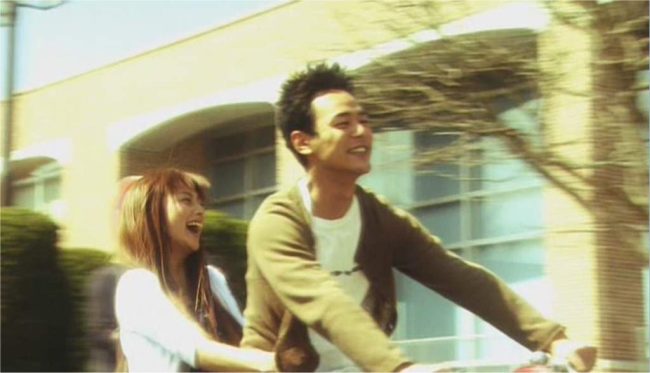
The important thing to understand is that the ideas that the shows discussed in this column propose are not limited to television. Through TV Diary, we continue to explore issues that are important to our cinephilia, such as the importance of genres like the romantic comedy, the work of actors in shaping a work’s meaning, ideas of gesture and mise en scène. After watching a great show like the one in the featured image above, the immense masterpiece Orange Days (2004), now available on Netflix, we return to cinema with a renewed commitment to our ideas. This is why we continue with this column. The shows discussed in this entry allow for some of these ideas to come to the surface. Let’s play a little bit.

Perhaps to begin with, we can address the idea of pleasure. In a show like Hungry! (2012), we are asked to forget realistic gestures, verisimilitude, plausible psychology. An instant love connection is forged when Miori Takimoto’s Chie tastes the cooking of Osamu Mukai’s failed rockstar. She returns over and over to his restaurant, to fill her belly, to fall in love, to squeal excitedly, like a cartoon. If pleasure exists then it exists in small moments like this. The look of excitement as she eats, the noises she emits unexpectedly and without caution. The idea is not too far away from a traditional American TV sitcom – there is a comfort in this type of setup. The universe of the series is filled out with nothing but stock types: the haughty and queer-coded restaurateur, the cocky playboy singer, the brash tattooed drummer. And then there’s the offhanded nature of Mukai’s performance. He plays an idiot who misses most of the things around him (such as love confessions), curses up a storm whenever he’s frustrated, and will usually make any given situation worse. What makes it work is Mukai’s casualness with acting, with affect, which is mirrored in the series – nothing is ever too serious, too considered, or even too artistic. And we draw a perverse pleasure from this rejection of ambition! The characters reject the stuffy French restaurants with its traditional rules, in favor of friends joining together, cooking a good meal, and having some fun. There’s a scene early on that features a gang of roustabout musicians pigging out at the restaurant and playing rock music loudly while Mukai’s father does magic and entertains a table. Mukai looks up at his friends working with him in the kitchen, the smiles of the people he’s cooking for, and continues to work. A life worth living should be filled with small moments like this: the pleasure of hard work, enjoying momentarily what you’ve done before going back for more.

Let’s discuss the sole Korean drama in this lineup, My Love From Another Star (2013-2014). Twelve years after delivering one of the great recent comedic performances in My Sassy Girl (true madness!), Jun Ji-hyun makes her way to the small screen. The plot is ridiculous: an alien (Kim Soo-hyun) has been stuck in South Korea for the last 400 years, staying the same age, amassing wealth and knowledge, waiting for his chance to go home. Right before he is due to go home, he gets a new neighbor, a famous actress, oblivious and dumb, who will somehow break through all his defenses. These dramas are still a space where the romantic comedy can flourish, where it can act as a stage for performance, where its mere existence isn’t treated like a novelty that needs a self-referential layer to justify itself (see the way critics treated the recent film Anyone But You). No excuses need to be made, no ironic poses need to be struck. If the romantic comedy is a powerful genre, it is because it is a useful one. It allows for shortcuts around dramatic problems – we can accept so much because the performers charm us, because they move fluidly through their beats, bringing life to cliches, flesh to desire. In this case, Jun Ji-hyun’s committed performance leaves nothing in its wake. Her comedic style is definitely not subtle. The character’s self-absorption and vanity demands brash gestures, outrageous faces, squeals, and high-pitched words in English (the way she says “Sorry~” is undefeated). The journey is from comedy to romance, from vanity to something resembling grace. What makes this a special proposition is the absolute chaos of the scenario! The handsome alien becomes her professor, her manager, her lawyer, boyfriend, bodyguard and more; a deranged CEO volunteers at an animal shelter in order to put down puppies (!) and tries to kill our couple in a series of increasingly ludicrous assassination attempts; and the acting career of our main character is resurrected as public opinion turns favorably towards her (a running strand throughout the series is how vicious online commenters are toward celebrities). This quixotic blend of melodrama and comedy, often without modulation or restraint in either direction, is what allows Jun Ji-hyun to shine. It is a vehicle for her talents, for her laughs, for her tears. The romantic comedy is thus a container that allows for many different things inside it, some of which push against the boundaries of what the genre allows, some of which rest comfortably inside its definition. It is the net below the performers which will catch them if they fall – the risk of failure is tied into the beauty of their gesture.

If the romantic comedy can be a space where chaos can somehow be controlled, then it also a space to film what can happen between two people (perhaps nothing is nobler). The collision between two people, their worldviews, their desires – what can be more beautiful? To begin, how to film a romance in the age of the influencer? An age where self-expression and identity are intertwined with one’s taste in consumer products? In 2021’s Why I Dress Up For Love, Haruna Kawaguchi works for a home goods company, but she also has a dedicated social media account where she highlights products/clothes/etc. Her opposite, Ryūsei Yokohama, is the young food truck owner who strives for simplicity in his life. Everything in her life is the product of hard work: she has an extensive schedule of social media posts to maintain, she dresses herself immaculately in bright and beautiful outfits, she has made herself indispensable to her boss at work. While he will regularly ditch his food truck to go fishing, and usually wears the same thing every day. How to be in the world?
In a romantic comedy, what is paramount? The chemistry of the performers allows for everything to manifest itself; if there is chemistry, then there is desire, attraction, ideas – everything flows from this. As these two characters discover each other, the chemistry between them is undeniable. Each interaction between them is an exploratory dance; desires are hidden, then expressed, then backed away from again. Small furtive kisses, expressions of comfort, clashes of point of view… It’s through Haruna Kawaguchi’s incredible performance that the show reframes fashion and social media – they are not expressions of capitalist ascension or girlboss self-determination, but rather of a lust for life. Each of her outfits is an affirmation of intent, to work hard, to chase your dreams. Social media is therefore not a space of narcissism, but rather one where you can share your dreams and desires with others. Quite optimistic! All of this is quite theoretical and would be nothing without the chemistry of the actors. Kawaguchi, in particular, carries the show with a mixture of vulnerability, curiosity and vibrancy. Her intelligence is always felt in her choices, in the small shifts in her expression, in her eyes, which communicate everything. More than anything else, a show like this takes it upon itself to renew romance in our world, as something worth striving for, as something to honor in our art! We have forgotten so much – what is greater than two characters in love, holding back tears, eating curry together by a food truck?
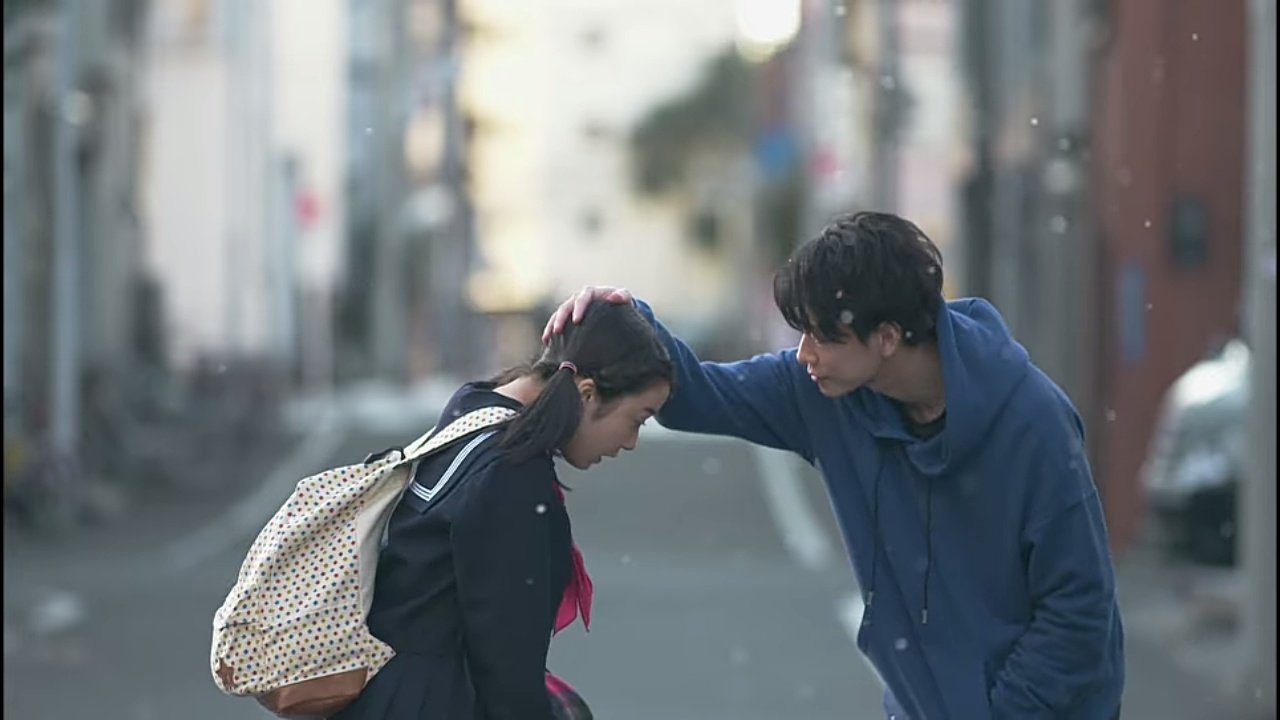
Pure fantasy. A show like An Incurable Case of Love (2021) allows us to address certain theories of Japanese acting. Takeru Sato in this drama is the pure ideal of channeling the qualities of a character as drawn in the manga panels – adapting the gestures, the cadence of dialogue, the physicality of his body, the pitch of his voice, all to bring flesh to a drawing. And Mone Kamishiraishi is not far behind. Let us say that the adaptation of manga/anime properties to live-action presents an actor which certain choices – depending on the work, they can reject the exaggeration of this comic world and bring it down to earth, or they can embrace those qualities and try to capture the cartoon logic of the world. Sato manages to appear down to earth, even while totally embodying the logic of his character. And Kamishiraishi goes the other way – she’s all shoujo enthusiasm, love at first sight, never giving up! The cliches of a work like this are completely visible, not once taken for granted; in fact, they are embraced as the Text. Thus, the Demon doctor calls the main character an idiot throughout the series before showing his vulnerability later on, and giving himself to her in surprisingly sultry kisses. It’s complete fantasy, made real enough by the performers that we can invest into it. But it’s the brilliance of the actors’ performances that makes this possible. Any miscalculation in their approach and this could be unwatchable.

To bastardize Michel Mourlet, Kimura Takuya is an axiom. The show itself doesn’t matter. It is always just an opportunity to follow his gaze, his reactions, his quietness, his aloofness. He is both at once the narrative itself, and apart from it, looking at it askance, as if he deciding if he wants to get involved. In 10 Count to the Future (2022), he plays a retired boxer who gets guilted into coaching at his old high school. Therefore, the freshness of the young actors is contrasted against Kimura’s aging visage. Each of the young actors gets a moment to showcase their chops (not all of them do well!) and Kimura ends up getting quite involved. If the formulas are tired, Kimura never lets on. He is a consummate professional who will honor the character, honor the emotion he’s in search for – he is never at war with the material. He is always the material. In this particular show, he has maybe the best partner he’s had since the days of Takako Matsu (Love Generation), Takako Tokiwa (Beautiful Life) and Tomoko Yamaguchi (Long Vacation). Hikari Mitsushima plays the advisor of the boxing club. Her enthusiasm is also contrasted against Kimura’s lifelessness – when she dons the boxing gloves and spars against Kimura, what else to do but go back towards life? These are the small glories of these shows. They give an opportunity for a serious dramatic actress like Matsushima to give us different sides of herself (the glasses, the explosions of giddy joy when she successfully jabs…) We at Lucky Star can only celebrate such moments.

Let’s end this entry with a look at one final show, Silent (2022). This is a patient melodrama that deals with the aftermath of the decision of a young high school graduate to abandon all his friends after he starts to go deaf. Years go by when they finally reconnect in Tokyo. This is probably the most tasteful j-drama I’ve seen. Perhaps tasteful and melodrama do not get along very well, but there’s no other combination that quite makes sense. It is tasteful in its choices (wardrobe, acting, pacing), and it is melodramatic in that underlying all these choices is a love story which remains unspoken, which remains silent, which yearns to burst forth to assert itself but can’t. The first episode of Silent ends with a scene that’s powerful and shocking. Haruna Kawaguchi (another incredible performance) catches up to her old high school boyfriend, Ren Meguro, and begins to talk to him. He, in turn, breaks down in tears, and begins to sign about everything that’s been inside of him for the last 8 years. The melodrama here is sudden and violent, the gesture of the sign language is not used here for communication (she can’t understand), but rather to draw a line in the sand, separating them. Later on, the fact that he used to be able to hear her voice but has forgotten it becomes a major dramatic point. Their shared love of music (the band Spitz is mentioned throughout) becomes a painful memory. Silent is then a melodrama of building new ways of communication between the couple (not just sign language, but rather the gesture of writing a note on a chalkboard, or holding hands while walking). This is why the show must move slowly through its developments. We must see the gradual accumulation of detail, the shared glances, the halting process of communication. In Silent, we must see every shift in the couple, each step forward, each step backward, each conversation, we will not skip any steps in the process. The final episodes, when all cards are on the table, are a necessary negotiation between what we wish life could be and what it is, right in front of us. Kawaguchi refuses to make a single noise, a complete self-negation, offered at first through sticky notes, and then through that classroom chalkboard. If we can still believe in the power of melodrama, the power of romance, it’s in moments like these – where the images demand we give ourselves to a vision, a dream. It is not submission, but rather an acknowledgement of the necessity of these things in our life. If we at Lucky Star are after anything with this TV Diary column, it’s to search for moments like these, to claim them as ours.

 Lucky Star
2 comments