Four Leaf Clover
To be a cinephile does not mean to be anti-television. To be anti-television is a rather outdated position and simply ahistorical. The landscape of European film would be completely different without taking into consideration the films made for television (see Fassbinder, for example). But, on the whole, I remain suspicious of the American Golden Age of Television, with its brooding anti-heroes and emptyheaded provocations. Perhaps it is an irredeemably contrarian position, but I’ve felt more at home within the worlds of Asian television. It is a fascination, a relationship, that goes back to childhood when I watched Spanish-dubbed versions of various anime works such as Saint Seiya, Ranma ½, and Captain Tsubasa. I remain committed to a vision of the current landscape of cinema and television that is inclusive – to be engaged with contemporary cinephilia means to address the latest releases of someone like Ryoo seung-wan, to pick just one example, who shows up on American screens without the benefits of heralded festival runs; and to be engaged with the world of television means to pay attention to the latest Takuya Kimura drama (an axiom for the last 25 years). Of course, this is an unfashionable proposition. It has very little to do with HBO or the streaming platforms (though Netflix now must be regarded as a figure in this space thanks to their relationship to various auteurs such as Masaaki Yuasa). But then there are projects that feel rather very distant from everything I just mentioned – they seem to exist on a separate universe from my cinephilia, or from auteurism in general. Cross Game is one such property.

How to explain Cross Game? It is a simple question, but a complicated answer. It is a TV anime that aired from 2009 to 2010 for 50 episodes. It tells the story of a few baseball-obsessed teens and their romantic entanglements. So, a sports anime. But we are very, very far away from the shounen pyrotechnics of a Kuroko’s Basketball, or Haikyuu!! where absolutely everything is subsumed to sport (everything happens inside the games). And this is because Cross Game is adapted from a manga by Adachi Mitsuru. For more than four decades, Adachi has drawn stories of high school kids playing baseball, falling in love, and striving to play in the Koshien (the national high school baseball championship which occupies, roughly, a similar space that March Madness does in the American consciousness). Sometimes he changes up the sport (Rough takes place in the world of high school swimmers, Katsu! deals with boxers, etc.) but what remains the same is the sensibility, the emotional universe. It is impossible to capture Adachi’s ability as a cartoonist in an anime adaptation – how he moves the reader’s eyes across the page, the isolated details breaking down action (the speed of a pitch, the force of the bat), his use of stillness – but part of the success of Cross Game as an adaptation has to do with understanding and executing Adachi’s narrative and emotional strategies.
Tragedy, then time
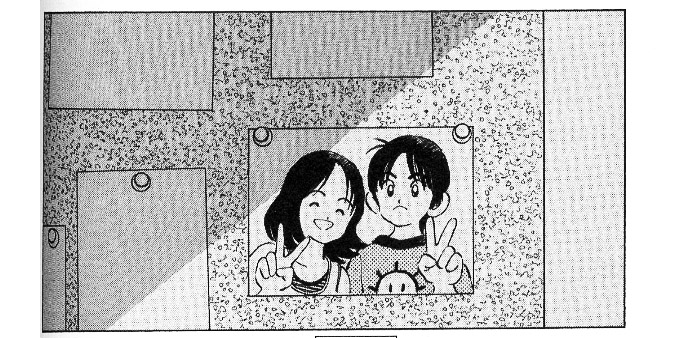
The first episode of Cross Game is a masterpiece and the basis for everything that will follow. The events of this episode reverberate across the entire series. The characters are linked by death but it is not death that lingers, but rather the life that is lost. The characters continue their journeys, but they are shaped by this death. It haunts them, and they carry it with them. The objects around them tell the story (a pair of matching alarm clocks, a list of birthday gifts on the wall) which goes unsaid by the characters. Time is essential. Time dulls the emotions. It makes mundane the fact of death. But time does not make death go away. It simply teaches how to manage a new reality. Another year passes, another trip to the cemetery, another birthday present: the memory of our loved ones becomes a small personal routine, private, only for ourselves.
But it’s not a total immersion into the process of grieving or anything close to this. Cross game is roomy enough to be able to work in multiple modes, while still retaining a remarkable coherency. Mitsuru Adachi is a popular artist addressing a broad audience, and as such there is a reliance on the comfort of a series of stock characters that he can employ for a quick laugh, or a random comment. Some characters remain one-note villains who never learn anything (the interim principal, the varsity team coach), while others are shaded with detail, growing emotionally throughout the series. There is pleasure in both approaches. Even a character like Senda, a total loudball goof whose sole purpose seems to be the butt of everyone’s jokes, is redeemed due to his total and all-consuming idiocy, an innocent fool (witness the final moments of the series where every single character understands what’s happening except him). Even amidst all the baseball and the comedic hijinks surrounding the characters, there’s even room for total risk – a leap into the fantastic.
Late in the series there is a development which threatens to derail everything. There is a new character introduced who looks exactly like an older version of the deceased. It externalizes all the anxieties present in the protagonists. Everyone asks themselves “can ghosts grow older?” and ponders their feelings. It adds a metaphysical dimension to the drama – the dead existed solely in flashback, and now they are made flesh before the characters. This development demands a reckoning with the past. Each character must make peace with themselves. And yet such a ridiculous proposition remains grounded in the world of the characters. The characters don’t overreact, they process the development gradually, and even this character seems to be generally okay with embodying the ghost of another!

Time is necessary in another sense. The dream is to go to the Koshien, but it is not something that can be achieved right away. Indeed, the characters completely waste away their first year of their high school baseball career because they’re unable to play in official games. And just because they’re able to play does not guarantee that they’re going to win. Every other high school in Japan also wants to play in Koshien and there are powerful rivals along the way. A rival Tokyo high school becomes major characters in their own right – only one of them can represent Tokyo in the Koshien tournament. Three full years of high school are required for Adachi’s characters to get to where they need to go. Even with a main character who is seemingly a perfect pitcher the losses are unexpected and crushing. Disappointment is part of the journey.
The Youthful Path
Baseball in Cross Game becomes a space where the characters wish to fulfill the dreams of the dead, to communicate, to exorcise. But, because this is Adachi, this is not done through dialogue, through melodramatic overwrought declarations, or emotional outbursts. The characters have a complex interior life that is revealed through action. One of the strengths of Adachi’s work is that his characters are completely aware of themselves. Sure, they might not want to admit what they’re feeling (let alone verbalize it), but at every point they’re acutely aware of what they’re doing and why. Compare the protagonists of Cross Game to any similar work and the level of self-knowledge is staggering. These characters aren’t confused or lost; they’re remarkably self-assured. In Adachi’s work, his characters always hold back. They do not reveal easily what is on their minds. We are provided with a simple image of a side-long glance, or an almost blank reaction shot.
Most of Adachi’s series take place in high school. Adachi has stated that he likes to draw adolescence because this is “a period of life when all feelings are exacerbated. Something that seems trivial to an adult can be poignant for a teenager.” So it is in Cross Game. The process of mourning is seen through the eyes of our teenage protagonists. Sadness is almost never acknowledged, it is carried privately, and the emotions which sometimes threaten to overflow are sublimated into action – luckily, one of the characters owns the neighborhood batting center. Romance is also not usually dealt with head-on by the characters either. The main protagonists deal with rumors that they’re dating throughout the series, but never do anything to dispel them. The side characters later in the series do become more forthright about their romantic inclinations, but this never becomes a source of drama. Those sentiments are acknowledged, but they never upset the dramatic fabric of this universe – these revelations are not nonsensical complications (here comes another rival! as it would be in a lesser work) but rather a deepening of the world. The desires of the secondary characters are given weight; they are allowed to express themselves. Everything is done with a lightness, keeping the emotions in check.

The private drive which fuels our characters is expressed through baseball. The episodes are shaped by the routines of the characters, and what they place importance in: we are rarely inside classrooms; we spend most of the episodes shuffling from practices to games. Outside of the games, we spend time with family (helping out at the restaurant) and engaging in the normal teenage rituals (first dates, holidays). Adachi’s universe is built of these simple and familiar building blocks (if it weren’t for the cell phones present, the story could take place 30 years ago, like Touch). There are no supernatural shocks; nothing is placed in a dramatic overdrive. Cross Game takes its cues from the temperament of its characters – they are cool, confident and controlled. The melodrama is built into the baseball games, informed by episode after episode of subtle visual information and cues, so that when the final declarations are made, they are quite simply overwhelming. The youthful barriers around the heart are shattered, for at least one moment. That’s all it takes.
Adachi’s World
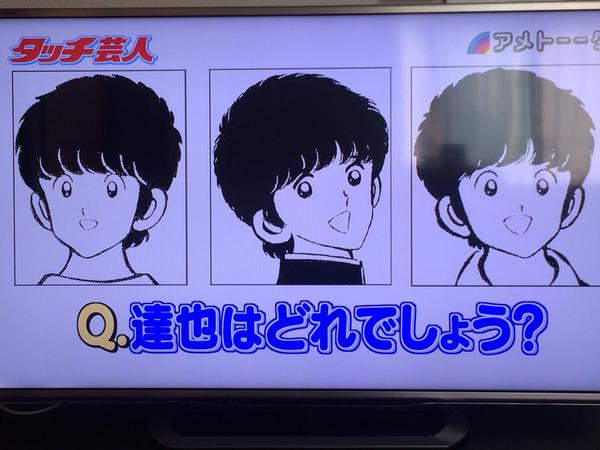
Cross Game is an anomaly in the anime world for several reasons. First, we must address the character designs. Adachi is notorious for featuring the same basic character designs across all his works. In a humorous segment for a variety TV show, Adachi was challenged to identify the main characters in his series; he couldn’t do it. This consistency and lack of variation in his designs is a point of contention for manga fans. In essence, there has not been any meaningful evolution in his character designs since the early 80’s, which make them stand out quite a bit in the current landscape (compare these designs to K-On!, to name another TV series which also debuted in 2009, and the differences are clear). It is a simple design, beholden to no trends, or any such cute moe fascination. The animation itself is never more than serviceable – it’s not a show meant for those animation hounds, posting sakuga clips on social media, who know which specific animator was responsible for each scene. But what the film absolutely gets right is the construction, how each frame flows into the next, the rhythm of the scenes – it is not the most dynamic thing in the world. And yet there is a comforting quality, a predictability even, in how it approaches each scene from an animation perspective.
Second, the usual brouhaha regarding sports anime must be acknowledged. Cross Game belongs to the sports anime genre (critics who pretend otherwise are being dishonest). Frankly, this is undeniable. Even though I am sympathetic to the impulse to claim that the series is not really all about baseball, that it’s a romantic comedy, etc., it would still be a mistake to pretend otherwise. Baseball dominates the world of the characters – it takes up their free time, it makes up the substance of their conversations, it is the essence of their dreams and aspirations. And as viewers we become invested in the mechanics and strategies of the game (I detest baseball, I must admit, and yet I found the action thrilling due to the patient immersion into this world). But the difference must be stressed when compared to other sports shows, such as Ace of the Diamond (to stick to baseball). There are no cliffhangers, or really any type of villains. Episodes end on small private thoughts, small revelations, with almost no sense of dramatic propulsion; we move through often humorous vignettes about the characters, shading in some key detail, making comparisons, illuminating the connections between people (a repeated comment, “you two are alike,” lingers in the air, and gains emotional resonance throughout the series). With Adachi, the genre becomes irrelevant, he bends the sports formula to his needs, and we follow him wherever he leads us – Cross Game belongs to the genre of Mitsuru Adachi, and everything else recedes to the background.
Third, and finally, we must deal with poetry and delicacy. It is in the handling of emotions, of course, but mainly in the storytelling approach. Adachi himself acknowledges this: “I have a reputation in Japan for being a very elliptical author, in the sense that I don’t explain everything. I play a lot with the unsaid. This makes certain messages perhaps more difficult to read, to receive, even for the Japanese public.” In the manga, the gaps are felt between the panels; we must read between these gaps. The anime version follows the narrative gaps; we do not see events which we think we will see. Everything is done to keep the developments of the story fresh. Thus, we avoid the expected rivals (easily brushed aside), clichés of romance (it is suppressed and kept as a subterranean force), and there are jumps through time that shock. And, of course, the characters themselves deflect all attempts at possible drama; they remain both consistent (you always understand their reactions, or rather their non-reactions) and somehow mysterious and unexpected. Adachi’s endings make this explicit – the resolutions find a poetic grace, always. Once Adachi resolves the emotional crux of the material, it doesn’t matter what else is left up in the air (who cares if they win the final game?). The storytelling decisions are made in service to the characters, not to fulfill the sports genre requirements. I still remember the final images of Rough (my pick for Adachi’s masterpiece): the logic of the romantic comedy and the emotions of the characters supersede every other concern, the communication between the characters is concluded so there is no need for even one more extraneous panel. The narrative development is touched by poetry, but always modest – it is never weighty or pretentious. Thus Cross Game achieves something beautiful: it builds to a superlative catharsis but on a minor scale. In the grand scheme of things, two characters holding hands is a small gesture, insignificant, but it is an image that is thoroughly earned in emotional, thematic and aesthetic terms. It is a resolution, but it is also a leap into the unknown.

Mitsuru Adachi is something of a titan in Japan. He occupies a privileged a space due to his success (there are not many manga artists who can claim to be a peer to Rumiko Takahashi). His popularity exploded in the 80’s due to the anime adaptations of Touch (his most iconic series) and Miyuki. Indeed, he’s still publishing today; his latest series, Mix, received an anime adaptation recently as well. But Cross Game remains the most significant exposure he has had in the west: the manga was published in its entirety, and the anime was simulcast in subtitled form when it came out (however, it is not available to stream legally as of this writing). When reading the comments on various anime websites, it is always referred to as a fairly underrated or unknown series. This is a shame because it is a beautiful show: it shows us the world of an unique popular artist, an emotional universe full of subtle, romantic energy. The world of anime is a youthful one, always full of high school students, often annoying and cloying. Mitsuru Adachi presents an alternative vision of adolescence. In his works, we step into a more optimistic, knowing, and ultimately, beautiful version of our world: Cross Game captures the unique spirit of Adachi’s characters, his world. The TV world is poorer for ignoring a series like Cross Game. And it is the aim of this column to bring such TV shows greater attention.


 Lucky Star