What Price Freedom?
There are certain films where what fascinates us is the relationship between shots, between a camera movement, a pause, a cut, a new angle… It can be overwhelming and confusing. But also each movement in the sequence is a step taken towards an emotion, an idea, a psychological state – in short, it is the art of directing. The orchestration of the camera, its pauses, its advances, its reticence, its flamboyance… A film like Una donna libera, a melodrama from 1954 directed by Vittorio Cottafavi, fascinates me on these terms. Perhaps there are other ways to approach a film like this one, but I keep coming back to the mystery of Cottafavi’s direction.
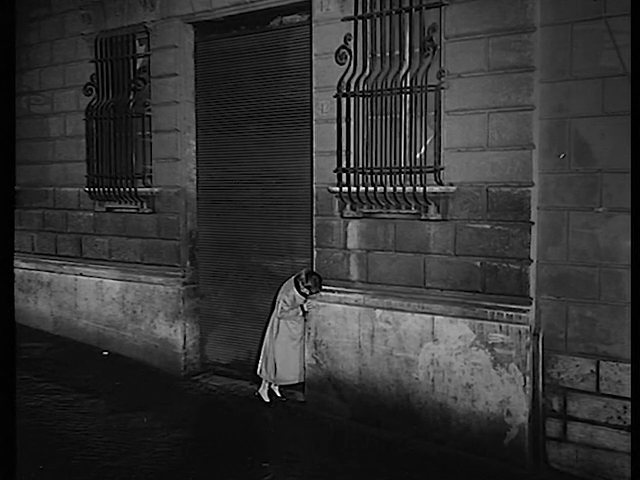
This is how Una donna libera opens: Liana (Françoise Christophe) runs through the empty streets at night. She is seen from a distance as she stops suddenly in front of a shop. We then see her in a medium shot as she catches her breath. She looks up and begins to move toward the shop window where she sees a mirror. The camera follows her movements closely and shifts to the right to focus on the reflection in the mirror and then keeps going to a tighter shot which shows us her upper body. “This is not what I wanted…” says the voiceover, and the shot holds on Liana as she regards her reflection.
Does the camera pull Liana toward the reflection of the mirror? Does her gaze trigger the camera movement? Cottafavi moves the camera at first as a reaction to the movement of Liana’s body. But when he moves toward the mirror, he is no longer interested in her body. The camera moves to leave it behind and instead focus on the reflection. “Look at yourself, Liana,” says the voiceover. And, while the camera does not strictly assume the point of view of the character, the movement itself reflects a break from the identification of the body towards a contemplation of the soul. “Such a short time has passed since you felt young, ready to fight, determined to protect your freedom…”

We then flash back to see Liana as a young architectural graduate and will follow her through the years until we catch up to her again at that mirror (the film will be split in two parts). But the very first image we see of Liana in the flashback is that of a painting her friend Sergio has made. He later says that this painting finds a Liana “who has opened her wings, ready to face all the trials of life.” What does it mean to protect your freedom? Early on, she confesses to her friends that she wants to be free and to have no keeper. Perhaps this could mean freedom from her fiancée, Fernando, an engineer who takes her to a house he is planning to build for them, and who is a bit boring; or freedom from the strictures of her father whose house she lives in and whose rules she must follow (or not). Liana has an awareness of middle-class bourgeois mores and a certain need to push against them, but the way this manifests itself is at points contradictory. When Liana first meets Gerardo (Pierre Cressoy), a playboy orchestra conductor, she says to him that she’s “afraid of nothing,” trying to keep up with him, puffing up her chest. When she gets home after an exhibition, much later than planned due to her rendezvous with the conductor, her younger sister tells her she wants to be like her. After all, isn’t Liana free in a way that she is not?
Does freedom require destruction, as Gerardo suggests? Liana must blow up her life, chase after the man who has seduced her, and leave everything behind, all for this idea of freedom that she barely seems to grasp. The second time we see Gerardo is in a shot as he enters the orchestra hall and begins to conduct. The camera follows his movement as he enters and greets the audience before facing the players. The audience settles and the orchestra begins to play. What is the point of view of this shot? At first, we assume it is a somewhat objective shot of the performance, but as soon as the music starts to play we track closer to Gerardo, coming around to his left profile as he conducts, then circling all around to face him, with the audience behind him. Once we see the audience we begin to understand Cottafavi’s purpose. The camera begins to track past Gerardo to head toward the audience, to Liana. The camera stops at her side before a sudden fade to black takes us to a very dramatic shot which looks upward at Gerardo as he conducts. Then it cuts back immediately to Liana at the audience, before pulling back all the way, reversing the original camera movement and taking us back to Gerardo.
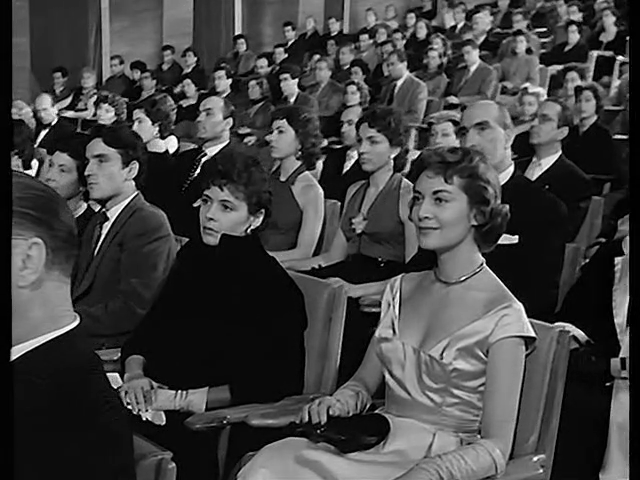
The movement of the camera suggests to us that we are inside of Liana’s consciousness. It seems to transport us inside of her desire. Does the music activate her desire, and thus the movement? Or are we inside of her desire the entire time? Cottafavi’s camera approaches Gerardo and as the camera nears him, we feel the intensity of Liana’s gaze. Freedom and desire as illusory dream concepts, playing upon our feelings, seducing us, as Gerardo has seduced Liana. Before a single line of dialogue has been delivered, we understand that Liana has given herself entirely to her fascination with Gerardo. It is fait accompli.
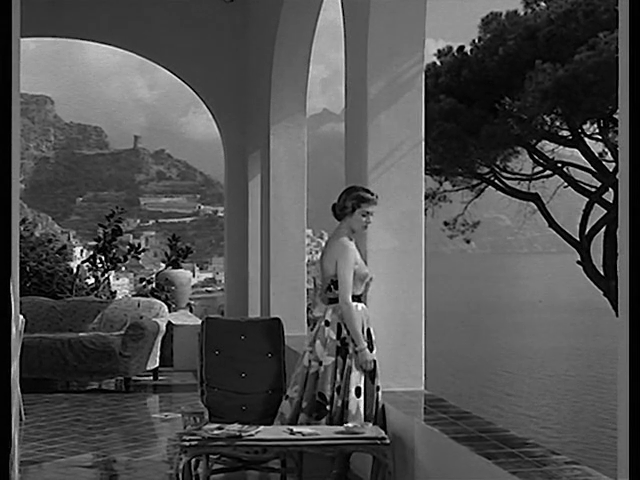
Later, when she is in her room, she will fight this feeling. But when her head hits the pillow back in her room, there’s a shocking dissolve to the blackness of the Amalfi coast where Gerardo has invited her, before the camera gazes up the villa where Gerardo is staying. Liana seems to materialize there. She’s seen coming in from the outside and Cottafavi tracks toward her face. What is the meaning behind this camera movement, which is both terrifyingly simple and endlessly mysterious? Cottafavi honors the storm raging inside Liana’s heart and mind. She’s at once asserting ownership of her erotic destiny, leaving behind the strictures of the quotidian world (fiancée, overbearing father, career), and expressing her desire for freedom. When Gerardo recognizes Liana’s presence, Cottafavi also tracks toward his face. But the meaning is different. The conquest is set to take place. The music swells on the soundtrack as they kiss, but the ambivalence is undeniable.
There’s something to the idea that a film is sometimes best suited to depict the exuberance of erotic abandon (its own freedom) rather than the repressed reality of the everyday, which is somewhat the journey of the film. Are there shots more beautiful than when Cottafavi takes his camera underwater and loses itself to the chaos of the bodies of Gerardo and Liana? When they get out of the water, Liana splays her body on the deck of their small boat. Gerardo hovers over her. “Are you happy?” she asks. “I love you,” he responds. Cottafavi’s images allow us to lose ourselves in the passion of Liana’s sexual ecstasy (the images themselves represent her awakening). We want to honor this feeling, no matter how fleeting it may be.
The first part of the film takes us up to the aftermath of this Amalfi rendezvous, which must end with disappointment. Did Liana really envision a typical bourgeois marriage with Gerardo after their affair? The playboy seducer with a fraudulent pick-up artist attitude toward love (only for seven days), despairing from his own impostor syndrome? The second part of the film finds Liana trying to redefine her own idea of freedom by moving to Paris, away from all she knows, working at an architectural film for little pay. But freedom is an elusive and ill-defined thing which haunts us… Liana soon picks up attachments, a new job, a husband, familial duties she must honor (what good was all this freedom she chased if it landed her right back in her father’s house, taking care of him?).
In the film’s ending we return to Gerardo’s apartment, perhaps the site where her need for freedom was first felt. “We’re completely inside a melodrama!” says Gerardo as we near the climax. He’s correct. The same piece of music which accompanied the ultimate freedom Liana has experienced in Amalfi (Tchaikovsky’s Piano Concerto No. 1) once again plays. And yet the meaning is diametrically opposed. Liana’s journey back to this apartment is due to a series of obligations and attachments (she needs to protect her sister from the same playboy conductor’s seduction, in a perverse reflection of the film’s first half, due to the promise she made to her dying mother – the shape of the narrative, broken in two parts, erotic freedom in the first, societal/filial obligation in the second). The music perverts Liana’s agency, as Gerardo reveals that the music is diegetic. He stops the recording and he offers to give the scene an accompaniment at the piano, mocking her. Cottafavi frames Gerardo in the foreground with Liana in the background, out of focus, barely holding up her gun. Gerardo’s commentary is insulting and demeaning. But we must to stop to discuss the camera movement that happens next. The camera careens rapidly toward Liana’s face, and then just as suddenly darts back, running the length of her outstretched arm as she fires the gun and kills Gerardo. Is Cottafavi’s camera, and the logic of his decoupage, shaping this melodramatic outcome? Or, to be clearer, is Liana free when she shoots the gun? Or is the camera guiding her to shoot it? The genius of the film is that both answers enrich the experience. The melodrama of the film, its beauty, is found in this movement. Cottafavi asserts himself at this moment, just like Liana does. But he also follows through on the melodrama of the moment. He’s bound to do it.
The final images are frankly incredible. Liana’s shadow against the rain-soaked streets is a marvel. Cottafavi abstracts her before letting us see her visage, halting and unsure. Her gaze focuses on something off-screen. Cottafavi then cuts to a shot behind her, the camera moving slowly downward from the top of her head to reveal what she has seen in front of her. The camera follows her halting steps until they gain confidence, moving more surely toward her destiny, toward her freedom (the destination itself is another of the film’s ironies). Una donna libera is a movement toward this freedom, to owning it, to seeing the logic of a camera movement from Point A to Point B, and knowing the emotion that this will embody, in the soul of the character and in the viewer.

Thanks to the work of Gabriel Carvalho for the fan-made edit he’s put together which combines two pre-existing releases into one.

 Lucky Star
1 comment