
Alejo Moguillansky’s slim 2020 feature La noche submarina, released on a streaming platform that no longer exists in the first bleak winter of the Covid lockdowns, opens by announcing its memorial status with two headstones, one written, the other spoken –
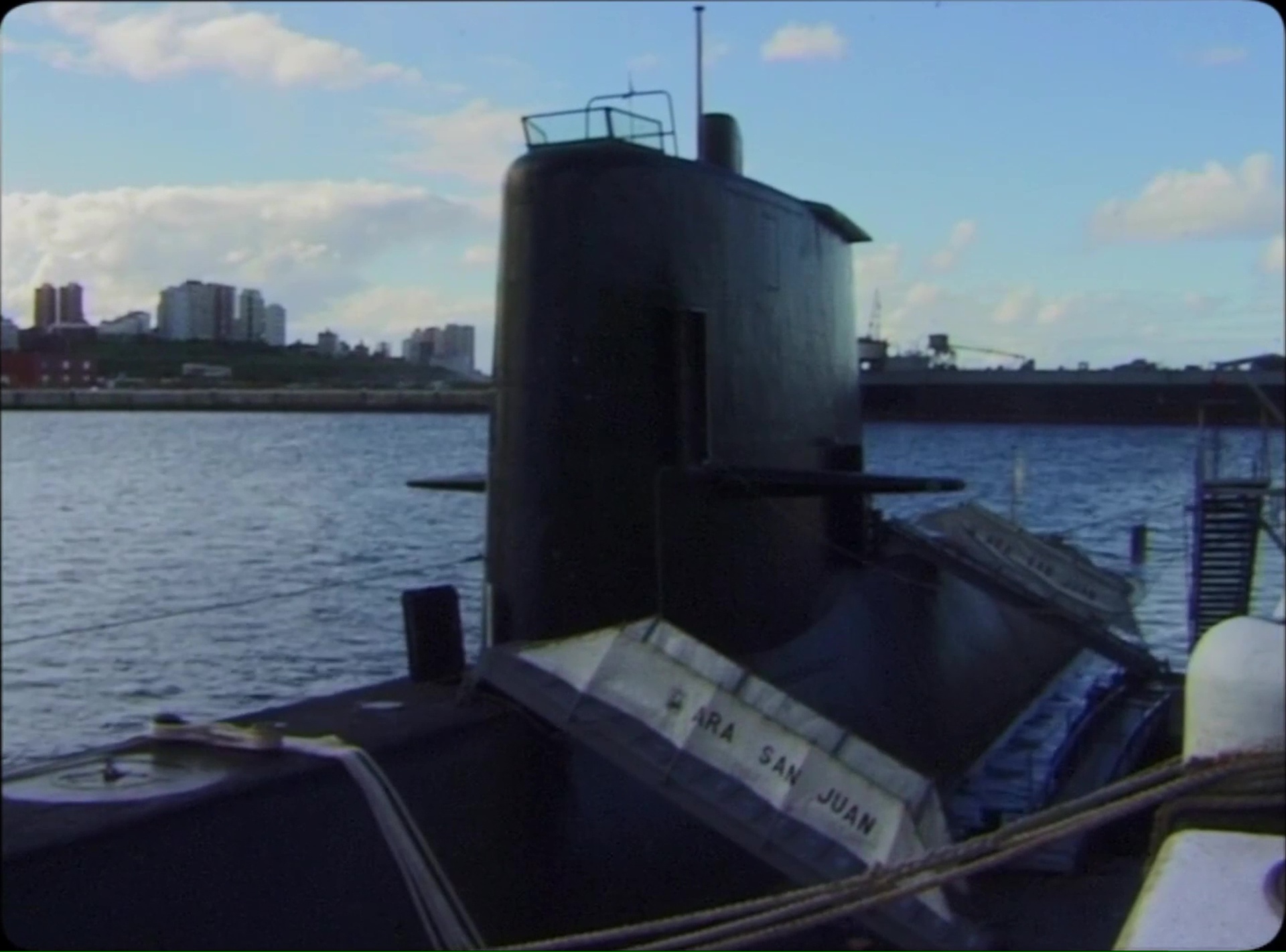
In memory of the forty-four sailors aboard the ARA San Juan, sons of Neptune, friends of those that navigate under the surface of the sea.
And –
This is what’s left of a film.
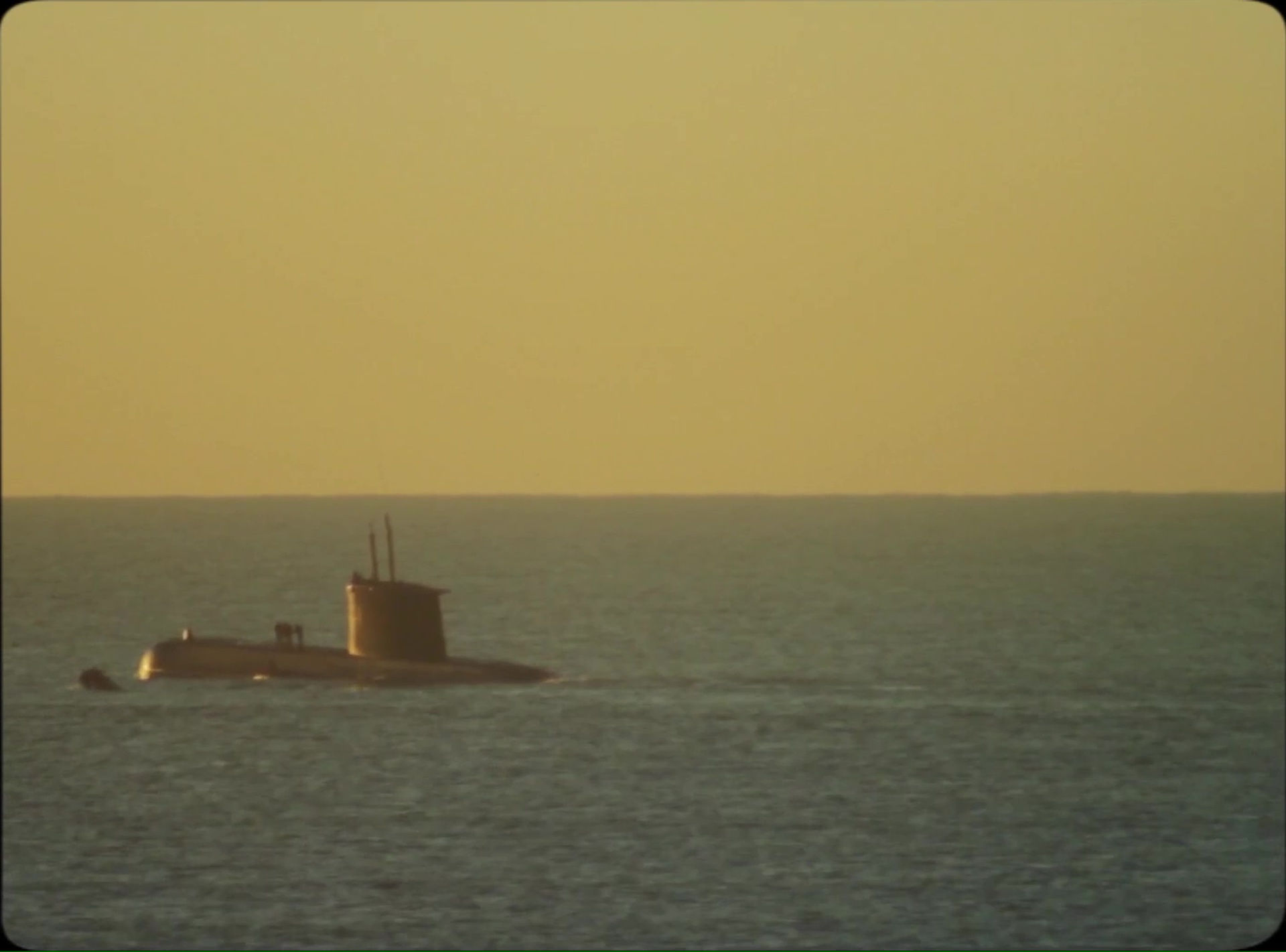
The first headstone, written in purple text on an electric purple screen, is for the crew of the ARA San Juan, an Argentine submarine that went missing in 2017 and became the focus of a year of wild conspiracy theories and political acrimony before its remains were finally discovered and the affair reduced to nothing more than cataclysmic technical failure; an eight part documentary series, running nearly four hours long, premiered on Netflix in 2024, as is the way of things. The second is for the never completed movie that supplies La noche submarina with the bulk of its images, a project that Moguillansky and two collaborators (Domingo H. Flores and Fermín Villanueva, credited as co-directors here) spent three days filming on board the ARA San Juan before abandoning so totally that its existence was all but forgotten, a failure that La noche submarina recounts with weary regret.
The idea of the submarine, at least as recalled by Moguillansky’s narrator, first emerged during the filming of La prisionera, the stubbornly impossible to see debut feature he directed with Fermín Villaneuva, just a background detail in the movie’s dilapidated Mar del Plata setting (“inevitably corrupt, inevitably cursed”). Moguillansky’s narrator describes it as “one of those films some were doing in those times,” an off-hand phrase that suggests, in a certain mythology of Argentine cinema, the long decade between Martin Rejtman’s Rapado and Mariano Llinás’ Balnearios, which is to say the possibility of El Pampero Cine. Two young people walking towards the camera, talking in the highly composed ramble familiar from a modern slacker cinema that transcends region and language about the ridiculous dream of being a “submarinist” on one of the two useless submarines of the Mar del Plata port, already obsolete from the moment they were purchased from the Nazis, now good for nothing more than “phony practices.” A nighttime traveling shot from the inside of a car, a young woman’s face pressed against the glass – the narrator tells us that the submarines are in the background, and the archival footage is dark enough that we have to take him at his word.
A hint of an idea, the obsolete submarines of Mar del Plata, that evidently took root enough that a proposal for a documentary project was drafted, submitted, and (somewhat improbably) accepted by the submarine force. The voyage was to be for just three days, a series of those phony practices carried out amidst the incomprehensible chatter of routine and ritual on an aging piece of military hardware destined to never see battle, Three days of tedium interrupted only occasionally by anything that could be constructed as “an event.” A hazing ritual, mentioned by the sailors in menacing tones, turns out to be nothing more than a brief and half-hearted spanking.
Military and emergency drills amount to nothing but sailors milling about speaking technical jargon, bored actors with no reason to invest their fiction with conviction, a reminder of how conditional the relationship between location or set and mise en scene can be. The submarine breaks its own depth record but while filming from within there is nothing to see beyond needles on gauges moving back and forth, a few drops of water falling from the ceiling. A torpedo is launched and once again “it’s all invisible.” The ARA San Juan arranges a meeting with a superior officer, his ship meeting with the submarine in the middle of the night, but on camera there is nothing but interminable waiting and inky blackness.“Filmmaking, he discovers, can be unfair. Ungrateful. A ship and a submarine have made a rendezvous late at night, and when you shoot it, nothing happens.”
The movie, then, becomes a monument to a type of failure all but unique to filmmaking, a type of failure no less heartbreaking for being so commonplace. One in which a filmmaker heads out into the world with a camera, maybe they have a script or maybe not, returns to review their footage on the editing bed or a non-linear editing system, and realizes that they have failed to establish a relationship between themself, the camera, and the subject on the other side of the camera, which is to say the world. The filmmaker may have had an inkling of this failure while on set, or the extent of the failure may only become clear once they have started to move the footage around like tetronimoes on the edit timeline, hoping the right combination will allow some breath of life into the material. A pre-written script can hide this failure, at least for some time. A filmmaker working without a script can simply shoot more, always more. For access that can be granted once, or for an event that cannot be repeated (putting same theriver twice metaphysics aside, there are some events that are more unrepeatable than others), the failure is sealed and final. “They simply thought that getting inside the submarine was enough for everything to turn cinematographic.”
It is tempting to contrast Moguillansky’s movie with Paul Grivas’ Film catastrophe from 2018, in which images shot during the making of Godard’s Film Socialisme gain even stranger layers of resonance after the Costa Concordia cruise ship’s very public sinking, even while acknowledging the uniquely destabilizing effect of Godard’s presence, or that even the work of a crew as non-traditional as Godard’s (the real subject of Grivas’ movie) appears almost industrial when viewed alongside these three young men with minimal equipment and no plans to speak of, no project beyond the space and the duration of time they have access to it. But what does become clearer in the comparison is the curious extent to which neither the tragedy of the ARA San Juan nor the distance from the original conception of the images bestow the patina of age, tragedy or even meaning – for all of the narration’s repeated refrain of “I was there,” for the reminders that the submarine is still a weapon, for the gestures towards metaphor (“A ship is a stage, I think. A Submarine, however, is this projection booth in a movie theater…”) the archival images stubbornly refuse to transform, to become anything other than a record of some men in a boat going about their job, a record of a barely conceived film project, and of the melancholy attempt to salvage it. An editor’s drama, which is to say, a lonely one.
The Argentine critic Roger Koza, in his brief notes on Moguillansky’s 2022 lockdown movie La Edad Media, co-directed with his wife and frequent collaborator Luciana Acuña, supplied a kind of formula for the “Moguillansky method” –
An event takes place, a real situation that can be filmed, even for reasons unrelated to what will later be part of the film in question. Fiction is born from what is defined as real. The desire for fiction, moreover, is always tinged with comedy. It could be a music concert, a strike, a request to make a movie, a theater tour; what sets fiction in motion is secondary. The film is built on fragments of reality that are re-written and staged as fiction, conjuring the obtuse contemporary mania of not establishing distinctions between fiction and reality. Moguillansky’s films have nothing to do with hybrid cinema. Fiction commands the frames.
I find this formula pleasing in its almost algebraic simplicity; the two points of contention I have might be considered nothing more than matters of emphasis, but they are points that I think lie close to the heart of how these movies work, and what it is that they are doing.
The first is not so much in describing the process through which reality, or the “real situation,” is transformed into fiction in the vague terms of birth or motion (this is perhaps a necessity when approaching the work of a filmmaker who has, over a number of movies and many collaborations, employed a variety of heterogenous strategies), but in obscuring the the degree to which the frictions of this transformative process often provide the central drama of the work itself. In this way El loro y el cisne, a romance born from the boredom and waste of otherwise unrelated film shoots, achieves an almost miraculous air from, not despite, the visible seams inherent to the process through which it was created. Conversely, the very good La edad media becomes one of the only Covid-19 lockdown era movies to suffer not from the unusual restrictions under which it was produced, but from the fact that, for just this once, history supplied a framework in which the working methods in which Moguillansky (and, significantly, his family) had been developing over the course of more than a decade in fact became the ideal approach to making a movie, a set of external circumstances in which you never wonder (as any viewer of Por el dinero or El Escarabajo de oro certainly does) how, or more significantly why, anyone would go about making movies like this?
The other point might be the positioning of comedy, which in Moguillansky’s work seems less an accent on an overall desire for fiction than an end point, the transformation itself. The autobiographical material, the real situations that provide the seeds for Moguillansky’s fictions, are notable for their tedium, banality, frustration. He is a working artist, as is his wife and creative partner, and so these situations increasingly, in fact at this point almost exclusively, revolve around making and exhibiting art, or the mundane activities requited to survive in that world – the endless business of grants and funding, the considerable labor of documentation and the generation of alternative revenue streams. This becomes the filming of the dance performances that leads to the film crew’s work in El loro y el cisne, the television “documentary” needed to make the theatrical tour in Por el dinero financially solvent, the arcane stipulations of international festival financing that give El escarabajo de oro its peculiar form, the fussy mechanisms of celebrity and wealth that in Ai Wei Wei in Buenos Aires take the foreground over the making and exhibiting of art itself. There is something compelling, almost romantic, about this self-contained system of waste and reclamation, a very 21st century answer to the question of day jobs and Sunday painting, even as the threat of suffocating insularity remains precariously close at hand. That these movies are genuinely funny rather than notionally comedic in the contemporary art house fashion is essential to their effect, which at its peak carries a cathartic force. This catharsis comes with more and more qualification the more the movies are ensnared in the concerns of a mid-career artist (at what point is this indistinguishable from the generic mid-life crisis?); there is a chasm between the (very real) birth that brings El loro y el cisne to its close and the Moguillansky family selling off their worldly goods and renouncing their old ways of making art in favor of life as roving motorcycle bandits in La edad media, although both gesture towards new horizons, new possibilities.
Was it the specter of those forty-four dead sailors, or the morbid circumstances it was created and released under? La noche submarina remains almost unique in Moguillansky’s body of work for its refusal to transform into comedy or even fiction, the engine that usually drives the work never so much as warms up. It was probably too perfect a project to resist – the cache of unused footage that happened to coincide with a news story of national interest and an international crisis that precluded most traditional filmmaking practice. Moguillansky’s El Pampero Cine compatriot Mariano Llinás was reduced to filming images of furniture and his toddler dancing in the living room; La noche submarina feels close to a fully realized gesture in comparison.
In the movie’s most developed section Moguillansky settles in on the sailor’s lounge, where the small film crew watches the sailors play chess and smoke endless cigarettes in a cocoon of tedium made remarkable only by the odd fact of being under the sea. One sailor, with gentle and naive care, plays CDs on the ship’s stereo – first Pink Floyd’s The Wall, Roger Waters’ orphaned child vocals from “Mother” repeating throughout the movie, then U2’s The Joshua Tree, Moguillansky reciting a Spanish translation of the lyrics to “Where the Streets Have No Name.” The “DJ Sailor,” with his earnest desire to play music for his companions, to share a passion for the music in the face of their evident disinterest, reminds Moguillansky of a younger version of himself, even younger than the one we see at the edges of the submarine footage, the young man who the sailors jokingly refer to as “Brad Pitt,” a version who would similarly subject his friends to his musical enthusiasms for however long he could manage before they turned the volume down and drifted back into conversation. No transformation, perhaps, but a moment where the heart of the project is revealed – a chance to send time with a self that’s already been shed, whose hopes and plans now seem as opaque as the jargon of these (potentially) dead submariners, a self viewed with more rueful distance than affection.
At some point around the creation of La noche submarina Moguillansky began working on a short feature, just over an hour, called Un Andantino, a kind of reclamation of material that could not fit into his 2017 feature La vendedora de fósforos, my perhaps unintuitive pick for the most essential Pampero project after Historias Extraordinarias. That movie is the most precarious, and therefore the most exciting, of Moguillansky’s exercises in vertical construction, a family comedy of creative and financial frustration where all the layers of art and history converge around very clear, even simple encounters between nonperformers – the aging pianist Margarita Fernández, the German composer Helmut Lachenmann, Moguillansky’s young daughter Cleo. The excised footage in Un Andantino suggests that any additional weight, even the weight of very good ideas, might have caused that project to collapse. Like La noche submarina it is neither fiction nor comedy. Emotional concerns that form moving undercurrents in Vendedora, notably Moguillansky’s complicated relationship to capturing his child’s image as she grows older, move to the center of the canvas; a sequence where a gentle cover of the Tom Waits song “Hold On,” used so effectively in La Edad Media, plays over home movie footage of children walking along a country road is so nakedly mawkish that it approaches kitsch. It is, like La noche submarina, a movie where the drama comes from the filmmaker alone in front of non-linear editing software, but the anxieties are polar opposites, the loneliness of being alone in a dark room with an endless expanse of footage (a hateful word) that refuses to come to life as opposed to endless possibility, the temptation to fuss, to layer, to work over the material until it suffocates. A small feature called Montage, documenting a performance of Helmut Lachenmann’s work by Margarita Fernandez and a conversation around that performance, preceded La vendedora by four years; Un Andantino followed La vendedora six years later. The prologue is easier to make sense of – it establishes relationships that will be developed later, it functions (in Koza’s formulation) as the one version of the real situation that, after a series of elaborate transformations, become the fiction of La vendedora. The postscript, Un Andantino, is harder to understand; it seems doomed to the margins even in relation to this form of auteur cinema, even a cinema (that in El Pampero’s case) seems proud of its own relationship to the margins. What seems clear is that it feels necessary to the artist, that creating this work, and of releasing it in public, is a vital process.
To refer to both La noche submarina and the never completed documentary shot for three days on board the submarine that used to be the ARA San Juan as failures is to be a bit rhetorically loose, and not only because one exists and the other does not. An autobiographical element, however loosely fictionalized, has gradually risen to prominence in Moguillansky’s work over the course of the last decade. It is there just off to the center of El loro, but can still be read as subtextual, even tangential. By Por el dinero it is inescapable, fully centered within the fiction. This relationship, once established, colors everything, and it works retroactively. JLG/JLG, a movie that means a lot to Moguillansky, changes our relationship to all of Godard’s late work – the Histoire(s) become more tactile, we can see the man in his studio, we can imagine the walks he takes between bouts of work. La edad media isn’t JLG/JLG, and La noche submarina isn’t Histoire(s) du cinéma, but there’s a similar effect. It is not, as Koza pointed out, “hybrid cinema,” or its dreaded literary corollary “auto-fiction;” we are closer to Aira’s Cumpleaños or Artforum than we are to Piglia’s Renzi diaries.
There are dangers here – the danger of insularity, of suffocation. There is the risk of a kind of flattening, where each work becomes subsumed into the undifferentiated mass of a larger project or portfolio – some of Aira’s work later work falls into this trap, as much as it pains me to admit this, just as painful as it is to admit that playing this kind of Football Manager game with the scope of an artist’s career is beneath contempt.
What it guarantees is that there can be no chance of the same kind of failure that doomed those three young men who spent three days on board a doomed submarine – the relationship to the world has been established a priori, even as this fixity has doomed what the possible interaction to the world can be. This was not, in the funereal late months of 2020, a liability.
 Lucky Star