
This is not an essay on the year in cinema. Don’t worry. We are ill-equipped to do something like that. Instead it would be good to end the year with an act of self-criticism. To start, we’ve done a good job in defining certain areas of interest in our texts, but only as it relates to contemporary cinema. We have begun to establish a relationship to certain directors (Axelle Ropert), national cinemas (Argentina), and otherwise peripheral concerns (East Asian television!), but we have not explored so far one of our biggest passions (the Indian film industries), and we have not turned to the past very much in our texts.
Thinking about this idea of passions is critical. Every text is a portrait of a passion. If we begin with this idea, then each text tries to take this passion to its limit. Lucky Star started publishing in 2023, but it was the product of several years of discussions on how to best approach the creation of a film journal.
When we thought about how to address the year 2023 it only made sense to approach those who helped us along the way and contributed to our texts (by either providing editing support, providing texts in their original language, or more) and sharing their voices as well. Their passions join ours, and our world expands. We loved receiving the lists and seeing what our friends watched this year. We can’t claim any larger significance than this one. We just hope the exercise is beneficial for you as well.

Jhon Hernandez (Lucky Star editor)
Top 2023
Fragments of the Last Will + Tonbi (Takahisa Zeze, Japan)
The Daughters of Fire (Pedro Costa, Portugal)
About Thirty (Martín Shanly, Argentina)
Un pincement au coeur (Guillaume Brac, France)
A Brighter Tomorrow (Nanni Moretti, Italy)
I’ve written a little something else on Tonbi and the Guillaume Brac (which will hopefully be published soon) so I’d like to focus this writeup on Zeze’s other melodrama, Fragments of the Last Will. When is melodrama too much? When does the world of a film threaten to overwhelm our critical faculties and leave all reason behind? Zeze’s conception of melodrama is a push-pull between excess and restraint. On its face what happens in this film is too much, over and over, but Zeze’s handling of the actors keeps things relatively grounded. The ‘container’ of the WWII POW drama keeps things on a straightforward dramatic path, yes, but it’s in the small moments when the film grows silent, when we approach the characters with a touch of reserve, that Zeze’s genius becomes evident. What pushes this film forward in my estimation is how it must necessarily deconstructs its own melodrama in its denouement. In essence, the melodrama is interrupted and, yes, fragmented – we are not allowed one transcendent sequence, but rather several smaller ones. The final catharsis comes to us, not like punches landing on our body, but rather like waves washing over us, giving us a break as the tide pulls back. The final leap toward the future, unnecessary and thus visionary, is when we finally abandon all taste, all restraint. To receive the gift of tears, a little tastelessness seems required. It seems to me exactly the film that Lucky Star was created to defend.
Top Discoveries
Misunderstood (Luigi Comencini, 1966, Italy)
The Sentimental Swordsman (Chor Yuen, 1977, Hong Kong)
The Magnificent Ambersons (Orson Welles, 1942, USA)
P.P. Rider (Shinji Somai, 1983, Japan)
One Hundred Children Waiting for a Train (Ignacio Agüero, 1988, Chile)

Seema Pai (Lucky Star editor)
Top 2023
Nanpakal Nerathu Mayakkam (Lijo Jose Pellissery, India)
Rocky aur Rani Kii Prem Kahani (Karan Johar, India)
Rapito (Marco Bellocchio, Italy)
Mein Falke (Dominik Graf, Germany)
All That Breathes (Shaunak Sen, India)
In one of my many past lives, as a student and teacher of economics, I learnt to identify structural breaks – sudden changes to a series over time that make future predictions misleading. That is how I feel about this list (including films I have very reluctantly had to leave off) – my entire conception of what I would be drawn to in terms of cinema in 2023 changed midway through the year.
2023 was already a deviation from the past few years in that I spent the first half mostly watching new releases in the cinema (often with friends) and, perhaps most surprisingly, the same films repeatedly. Marked mostly by the one-two punch of Rocky Aur Rani and Jawan where random strangers sitting next to me felt liberated to clasp my hand in the dark cinema hall in a shared feeling of “our movies are back!“. I was convinced that my year end list would reflect this feeling and have me championing some of the biggest hits of the year.
Barely a week after my third viewing of Jawan I, who considered myself invincible and everlasting (much like SRK), ended up in the hospital for over 10 days, where every major organ in my body was prodded, tested and scanned with a dizzying array of potential diagnoses being dangled in front of me by an ever-changing group of specialists. I finally came home with a good dose of fear and a prescription for huge lifestyle change. The structural break.
The rest of the year was therefore me mostly watching movies at home as one of the few medically approved indulgences I had access to. As I was making this list, I found that the cinema that had brought me comfort and excitement during this bleak period in my life was more personal and intimate, films that raised questions about morality, mortality and faith.
Perhaps the film that best embodies everything I am referring to here is one that just missed making my list. In Rodrigo Moreno’s Los delincuentes (a boldly shape-shifting film that deserves a longer writeup), bank employee Morán, after years at a monotonous office job, attempts to wield control of the rest of his life through some morally questionable choices, including roping in an unwilling accomplice into his criminal endeavor. He finds some semblance of moral justification for this act by only planning a modest crime that would earn him (and his accomplice) the equivalent of their salaries for their remaining years of employment. In Morán’s mind, this is the only feasible path ahead. As in any “heist” film, things of course do not go the way the men imagine they will and it is when the two men are thrown into the unknown and unfamiliar that there seems to emerge some sort of real shot at happiness and freedom. Moreno’s camera shoots all the indoor spaces in Buenos Aires like a prison and contrasts it with the mountains of Cordoba where we encounter a group of free spirited artists that seem to have no clear plans except in the moment working on a film that they declare is unlike the old cinema as we know it, which is dead.
As I slowly attempt to dig myself out from the bizarre nightmare (both personal and otherwise) that was parts of 2023 and find myself thinking about my favorite films from the year, I take comfort that maybe I too shall find my wounded falcon or get possessed by a friendly ghost and find a path forward. I don’t dare address the state of cinema and its health. On the one hand, I found myself ambivalent to highly regarded films by some of my favorite filmmakers (Michael Mann, Todd Haynes, Mari Selvaraj) and yet here I am having started my year with Sriram Raghavan’s delightful Merry Xmas, booking my tickets to the new Lijo Jose Pellissery playing this weekend and looking forward to what some of our Lucky Star friends are planning as programmers.
As I said at the very top, structural breaks – they make a series far more unpredictable. But they are also what makes cinema a constantly pleasurable pursuit for me. While I am not sure I want big fissures in my personal life anytime soon, I find nothing more invigorating than having my perceptions and even my ranked lists scrambled and shifted constantly, and isn’t that ultimately the essence of cinephilia?
Top Discoveries / Rediscoveries
Vas-tu renoncer? (Pascale Bodet, 2021, France)
Raam (Ameer Sultan, 2005, India)
Étoile violette / The Apple of My Eye / Petite Solange (Axelle Ropert, 2005 / 2016 / 2021)
Thunderbolt (Josef von Sternberg, 1929, USA)
Subramaniapuram (M. Sasikumar, 2008, India)
Nathan Rogers Hancock (Lucky Star editor)
Top 2023
Mein Falke (Dominik Graf, Germany)
Mad Fate (Soi Cheang, Hong Kong)
Thuramukham (Rajeev Ravi, India)
The Beast in the Jungle (Patric Chiha, France)
Purusha Pretham (Krishand, India)
No movie haunts this list for me quite like Thuramukham, Rajeev Ravi’s mournful epic of a family dissolving and destroyed, set against the backdrop of a violently suppressed labor movement in 1950s Kochi. But then the movie has been a haunting presence for years. The first look poster was released in January of 2020, and although COVID delayed an attempted premiere at IFFR, it still appeared in Olaf Möller’s annual Senses of Cinema best of list in January 2021. More COVID delays, another cancelled IFFR premiere, financial issues with the producers, a theatrical release pulled so close to deadline that posters were up, theatrical screenings available for booking; by the time the movie snuck into a limited release in March 2023, to limited audience interest and a decidedly mixed critical reception, there was real concern that this would become a lost movie, endlessly delayed after completion and never released. Streaming rights went to SonyLiv, one of many “India Exclusive” OTT platforms that have emerged as the streaming economy continues to mutate and fragment, and which is available in North America only through yet another service, a convoluted and barely functioning affair called “Sling TV.”
It should not come as a surprise that whatever gentle increase of interest in Indian popular cinema in the Anglophone West after the peculiar euphoria surrounding Rajamouli’s RRR would not extend to Thuramukham; already neglected, if not outright orphaned, at home, what help can it expect from abroad? It is ridiculous to prognosticate about a movie’s fate less than a year after its release, as ridiculous as the tradition of releasing best of lists in January, but such an odd position suits a movie that treats the question of how to read success or failure into the arc of history with such ambivalence Rajeev Ravi, in an interview around the time of the movie’s release, reminds us that the lives of the dock workers did not improve all that much after the martyrdom of their colleagues, and that “slavery continues in a sugar-coated form for the common man;” one of its central ironies is that the most exploitive systems practiced by the harbour bosses continue unchanged after India’s independence. Ravi is a director with a 19th century novelist’s love of social texture and procedural detail, and one of the great pleasures of movies like Njan Steve Lopez or Kuttavum Shikshayum (conceived, filmed and released within the years Thuramukham spent in limbo) is how simple narrative goals become excuses to catalogue the world and the processes that make it work. Thuramukham is at its most vital and unsettling when it evokes the feeling of being in the midst of history and struggling to comprehend the forces working on you, your family and your community. If Marco Bellocchio’s great Rapito from the same year covered similar thematic territory this year by placing the audience in the position of a child encased in a tomb, the permanent night of his best work after The Prince of Homburg in 1995 hardened into sepulchral form, then Thurumukham’s form by contrast is porous, elliptical, the forward march of event filtered through the haze of Nivin Pauly’s alcoholic class traitor, doing all he can to avoid so much as a moment of recognition.
Thurumakhum stands out as the only movie on my list apart from Mad Fate to receive North American distribution, albeit in the limited circuit of suburban strip mall theaters that constitutes a release for those Indian movie whose distributors can’t manage to secure a space in larger urban centers, something that has, in recent years, been blessedly helped by Hollywood’s decline. How much weight, if any, can critical writing, let alone the ceremonial year end list, assume in any of this? Lucky Star editorial is under no illusion, even if our published track record may suggest otherwise. But in the hours before our self-imposed deadline, hoping to fit in just one more film, I found myself scanning Olaf Möller’s Senses of Cinema list from this year, and settled on Krishand’s Purusha Pretham, marooned on SonyLiv like Thuramukham, although without even the cursory theatrical release. It turned out to be a scabrous comedy of social collapse, a small army of character actors careening against each other in the orbit of an unidentified corpse, buried and misplaced, reminiscent in its bleak moral landscape and nearly pedantic attention to local financial and legal realities of nightmarish late period Hong Kong comedies like Life Without Principle or A Home with a View, eccentric not-quite classics made years after international attention had moved on from that industry. If Rajeev Ravi manages to support his directing career with his work as a cinematographer, Krishand (who also acted as his own cinematographer for Purusha Pretham, stating that “a very symmetric and beautiful style was out of the question,” a line of thinking that might well apply to Dominic Graf’s Mein Falke, the year’s other great movie about the exhuming of human remains) works as an adjunct associate professor at IIT, Mumbai; the next movie is already in pre-production. What can we hope for, besides a good movie, one that builds on this personal language and energy? A few notes in obscure publications like this one, a slot at an IFFR sidebar, a quiet release on a streaming service. And then the ability to look back and wonder, was that enough?
Top Discoveries
Ultraman Season 01, Episode 35: The Monster Graveyard (Akio Jissoji, 1967)
Vas-tu renoncer? (Pascale Bodet, 2021)
The Apple of My Eye (Axelle Ropert, 2016)
Miami Vice Season 01, Episodes 13 & 14, The Golden Triangle pt. 1 & pt. 2 (Georg Stanford Brown & David Anspaugh, 1985)
Kadal (Mani Ratnam, 2013)

Graham L. Carter (Filmmaker and Distributor)
Top 2023
Colette and Justin (Alain Kassandra, Congo/France/Belgium)
In Our Day (Hong Sangsoo, South Korea)
Close Your Eyes (Victor Erice, Spain)
Hayat (Zeki Demirkubuz, Turkey)
Rocky aur Rani Kii Prem Kahani (Karan Johar, India)
Top Discoveries
Camp de Thiaroye (Ousmane Sembène + Thierno Faty Sow, 1988, Senegal)
Drugstore Romance (Paul Vecchiali, 1979, France)
Gentleman Jim (Raoul Walsh, 1942, USA)
A Rustling of Leaves (Nettie Wild, 1988, Canada)
Love Jones (Theodore Witcher, 1997, USA)

dadafi (amateur)
Top 2023
In Our Day (Hong Sangsoo, South Korea)
The Fire Within: Requiem for Katia and Maurice Krafft (Werner Herzog, USA/Germany)
Cinema Palavra Prostituta (Andrew Olejnik + Christofer Pallu, Brazil)
The Caine Mutiny Court-Martial (William Friedkin, USA)
We salute you, soldier Billy.
Top Discoveries & (Re)discoveries
The Woman Who Invented Love (Jean Garrett, 1980, Brazil)
Jean Garrett is the man who invented sublime pornochanchadas.
New Love in Tokyo (Banmei Takahashi, 1994, Japan)
Women in Revolt (Paul Morrissey, 1971, USA)
Ridiculous/deranged. Morrissey’s rigorous material ages well. Also ridiculous the guy that produced some of the most beautiful / important movies of the 70/80s (Flesh, Forty Deuce, Mixed Blood, Spike of Bensonhurst) remains an obscure figure with a large amount of barely edited out of circulation stuff.
Las Chicas del Tanga (Jess Franco + Lina Romay, 1983, Spain)
“Late Style” Jess.

Lautaro García Candela (Filmmaker, Critic and Teacher)
Top 2023
Undefined Things (Maria Aparicio, Argentina)
O dia que te conheci (Andre Novas Oliveira, Brazil)
The Delinquents (Rodrigo Moreno, Argentina)
Vuelta a Riaño (Miriam Martín, Spain)
Open Your Eyes (Victor Erice, Spain) / Barbie (Greta Gerwig, USA)
Top Discoveries
Torre Bela (Thomas Harlan, 1975, Portugal)
La familia unida esperando la llegada de Hallewyn (Miguel Bejo, 1971, Argentina)
Aquello que amamos (Leopoldo Torres Ríos, 1959, Argentina)
The Song of Bernadette (Henry King, 1943, USA)*
Las aventuras de Juan Quin Quin (Julio García Espinosa, 1967, Cuba)The Blackout (Abel Ferrara, 1997, USA)
* Or, actually, all of Henry King’s work, seen at the semana mundial de la cinefilia, organized by La vida útil, at the Cineclub Municipal Hugo del Carril.
Jaime Grijalba (Critic and Translator)
Top 2023
Perfect Days (Wim Wenders, Japan/Germany)
Oppenheimer (Christopher Nolan, USA)
Killers of the Flower Moon (Martin Scorsese, USA)
El realismo socialista (Raúl Ruiz + Valeria Sarmiento, Chile)
Passing Time (Terence Davies, UK/Belgium)
Top Discoveries
Typhoon Club (Shinji Somai, 1985, Japan)
America America (Elia Kazan, 1963, USA)
Taste of Cherry (Abbas Kiarostami, 1997, Iran)
Carlito’s Way (Brian De Palma, 1993, USA)
Monster (Kazuhisa Oono + Masayuki Kojima, 2004-2005, Japan)
Read Jaime’s translations of The Raúl Ruiz Diaries and help him keep it going by donating at ko-fi.
Victor Guimarães (Critic, Programmer and Teacher)
Top 2023
The Urgency of Death (Lucia Seles, Argentina)
A poem written on a truck tire. To tear up the grammar of cinema while generously teaching us how to speak an alien language.
Music (Angela Schanelec, Germany)
An opera made of whispers instead of singing. A melodrama made of coughs instead of tears.
Mãri Hi – The Tree of Dream (Morzaniel Ɨramari, Brazil)
A documentary made with the matter of dreams. A reinvention of what experimental film can be in this century.
Fallen Leaves (Aki Kaurismäki, Finland)
A rom-com breathing ancient air. The most powerful sonic experience the narrative cinema has given us in a long time.
Mami Wata (C.J. Obasi, Nigeria)
A glimpse into what African cinema could be if it followed the path towards Touki Bouki. Ancestral and modern, radical and popular.
P.S. The most surprising film I’ve seen this year was Barbie (Greta Gerwig, USA). It was definitely the work that made me challenge my own ways of approaching a film. And it was also the film that prompted bad criticism everywhere.
Top Discoveries
La Mujer de Nadie (Adelia Sequeyro, 1937, Mexico)
A non-monogamist set of people trying to love each other in 1930s Mexico and banging their heads against a wall called society. Care, attention and desire flowing in all directions until they can’t.
Un Día Feriado (Lydia García Millán, 1951, Uruguay)
An experimental journey through the margins of a big city long before that gesture became a major source of masterpieces among us.
La Fórmula Secreta (Rubén Gámez, 1965, Mexico)
Ideological ethnography meets allegorical sur-realism.
El Otro Francisco (Sergio Giral, 1975, Cuba)
Wherever you want character development, Giral gives you distancing effects. Wherever you want sentimental music, Leo Brower gives you pieces of silence and noise. Wherever you want love, the film gives you means of production. A horror movie, but one that’s made of the economic reports of a plantation.
The Terror and the Time (The Victor Jara Collective, 1978, Guyana)
Counter-information and lyric poetry are not opposed, but rather contaminate each other. A cinematic tissue where rapid-fire montages of popular revolutions all around the Third World and slow-motion sur-real depictions of Guyanese faces and landscapes can harmoniously coexist. Not a historical lesson nor a political statement, but a material, living experience that swallows our whole body and makes us dream together. Not dreaming of changing the world. Dreaming to change the world.

Nicolas Leblanc (Cinephile)
Le Louvre est une morgue; on y va reconnaître ses amis. Jean Cocteau
I sometimes joke that the CoViD-19 epidemic was great for me: it was suddenly socially acceptable to be asocial. Wonderful, I get to stay home! But most everyone suffered greatly from this state of things and the ensuing loss of connection. Most of the noteworthy art that resulted from confinement, I feel, signaled a dread of isolation, and explored these feelings in depth. And because cinema ties to the idea of the movie theater, of individuals each with their peculiarities and problems focusing on a single artwork, it’s also possible to see all of these films as expressions of a striving towards community.
Top 2023
The Human Surge 3 (Eduardo Williams, Argentina/Portugal/Holland/Taiwan/Brazil/Hong Kong/Sri Lanka/Peru)
Of course, one can always do like Eduardo Williams, and just assume the community to exist from the word go! Operating from the assumption that they will be understood, his characters speak in their own language (without resorting to any such Sabirs as English), Williams tosses us headlong in the universe of HS3 without a buoy. Little by little, the film uncovers itself, revealing a picture of our world. It finds a middle ground of two hours between the plasticity of the online network and the materiality of IRL, a place where identities fluctuate. The beauty of it lays in its directness: we make it up as we go along, our human bonds are a praxis which is forever renewed. One doesn’t want the fun to end.
Asteroid City (Wes Anderson, USA)
Everyone comments on the overbearing style, few ever ask why he appears to have foregone emotion. Increasingly since he dabbled in animation, Anderson has covered, muffled, insulated much of the emotional content under layers of mummery. His art comes to us con sordino. It is possible that, one day, it will become too hard for him to make himself heard, too difficult for me to like him, and I have had reason to believe it might be any day now: The Grand Budapest Hotel and The French Dispatch don’t reach me, for instance. But this one struck. You need to navigate through a mise-en-abyme (another distancing effect) and dig deep under the innumerable plots (yet another) to find the subject: the loneliness of mankind when God is dead, and our search for someone in the heavens instead of among ourselves. These are the thoughts that Anderson couldn’t bear to utter aloud, just as he couldn’t show the violence in The Swan: we are loathsome to each other and have no one else.
A Brighter Tomorrow (Nanni Moretti, Italy)
As Europe drifts on rapidly away from him, his ideas and ideals, Nanni Moretti steels himself. The angry young man has become an old curmudgeon, equal parts irritable and droll, benign and sad. Sad, because he’s isolated in the world in the way only the old can be: in their daily lives, cultures and histories. That is reason enough to sink into despair, but Nanni doesn’t exactly end up there. Instead, he conceives a sophisticated hall of mirrors; of films within the film, films as they are being made, of people real and imagined, and where the ending mustn’t be apocalyptic, but only bear the promise of a renewal.
Totem (Lila Avilés, Mexico)
Lila Avilés made a film that could reasonably called El Cumpleaño del pensamiento magico. Every character is locked in their own little project. They try to get everything just right for a special occasion, a birthday party, and for a special dying someone. Who knows, it might just save that person? And then the whole enterprise would be redeemed, they would be vindicated! But no, no one is ever so deluded as to think that way, at least not past a certain age. There may be some form of denial in cobbling the best birthday party, or present, for the terminally ill, but it’s all coping: the next meeting will be a sad occasion. They are alone together at this party though, like you, dear audience.
In Water (Hong Sangsoo, South Korea)
Is it indeterminacy or impressionism, lack of focus or despair at loss of eyesight? These paths of interpretation aren’t given the edge; they are often barely suggested at all, yet all seem equally possible. There is a blur on-screen that contaminates the search for meaning, at least from my Western perspective, and the meta-idea of a film like water, blurry and where the possible readings all float, just adds to it. That’s all well and intellectual and good, and could sustain a few viewings, but is ultimately irrelevant as to why I find this film moving. Hong’s sincere attempts at communication have grown more direct outside of structural conceits; they have also grown more anguished since The Day After, gravitating more and more toward marginal figures (The Woman Who Ran, In Front of Your Face). The feeling in this film is of giving up in the face of a terrible unease, one that the lead can’t even find the way to communicate.
Top Discoveries
Surviving Desire (Hal Hartley, 1992, USA)
A film about a couple: a teacher and his student, give and take, question and answer. Hartley has the unhelpful questions to the classroom at the beginning (met with anger from the students) mirror with a different question at the end (met with indifference) offering help. I like that last picture. Trying to assist amid throngs of people, is Mary B. Ward a harbor or a siren (Till human voices wake us and we drown)?
Canyon Passage (Jacques Tourneur, 1946, USA)
There is nothing simple about the law, neither for the lawless nor for the lawful. Canyon Passage is a vibrant portrait of a community that may be seen under this legal prism. There are laws that seem to be written in books (property), others more internal to a character (those that make Dana Andrews’ character a standup guy and the ones that give Brian Donlevy’s his frailties). Others still are tacit and left to interpretation for every relationship under the sun. Everything gets more complex from this point on; it’s a busy game Tourneur is playing. Pity the loser: the outlaw (Ward Bond, great as a brute) casts himself out of society, where isolation can be deadly.
Chilly Scenes of Winter (Joann Micklin Silver, 1979, USA)
“No, Betty, I have nothing for you.” This curt expression comes somewhat late in the movie but defines John Heard’s character almost perfectly: an arrogant prick, crazed with obsession, so lonely in his wounded ego he has nothing to give. Silver’s film rivals Surviving Desire for the best portrayal of sentimental affairs gone wrong I have seen this year. But, as the title indicates, there is a flintiness here: Heard, with thin-lips and steely gaze, makes for an uncomfortable leading presence. True to his word, he won’t cede anything. And speaking of discomfort, most of the situations and spaces embody a sense that the characters were content to live with a nuisance to avoid facing their problems: putting up with your unemployed friend living with you, putting up with a boring job to avoid unemployment, living in a house with a husband you no longer love, sleeping on a mattress on the floor, living in painful memories, and having a generally miserable time. A pall of snow has damped down the world, and only a full transformation will bring forth springtime.
Tori & Lokita (Jean-Pierre & Luc Dardenne, 2022, Belgium)
As a general rule, the social drama comes in the declamatory style of the barrister or the priest, with little room for poetry. If we judge the Dardennes by this metric, and we find them poor orators. But if we remember the comparison of Matthias Claudius (“Master Arouet says: I weep/And Shakespeare weeps”) we find them superior artists. They, too, weep. Tori & Lokita is not a sermon; it is an orison for the lonely, the defenseless and downtrodden, those deprived many who fall short of becoming lumpenproletariat and face mostly malice and indifference on their paths. So outside of Tori’s companionship, Lokita has little; she is cruelly alone, and the world is cold. The brothers mostly stay back and watch their protagonists exist and work (and drug dealing is work). A few flourishes – such as rendering an official a faceless drone (reminiscent of the ending of Knock on Any Door) – are the only tributes they pay to the ordinary social film. It doesn’t make them uncaring – they are fuming, in fact; they just have a disinterested love for their protagonists.
Twin Peaks: Fire Walk With Me (David Lynch, 1992, USA)
While the show was entertaining in many ways, both the original and the Return sagged under the weight of its good vs. evil celestial mechanics, and cute plot developments. Meanwhile, the feature film is the saddest, most disenchanted thing. The trailer parks (seldom do we see these portrayed), the bully cops, the sad cafés: all of those have an aridity, a lack of charm you hardly ever find in the shows (save maybe at the very end of The Return). Coop is sidelined, the FBI in a different realm; most of the film devotes itself to the sinking of doomed Laura Palmer (a wonderful Sheryl Lee). Substance abuse can only help her cope so much, the love of James can only reach her so far, David Lynch can throw as much metaphysics as he wants: she will find out the horrid truth and it will bring her down. Her apotheosis is the start of the mourning period, for a shattered US self-image. The mourning will never end.
Elena Marino (Lucky Star contributor)
Top 2023
Bonjour la langue (Paul Vecchiali, France)
Are You There God? It’s Me, Margaret (Kelly Fremon Craig, USA)
Last Summer (Catherine Breillat, France)
Anatomy of a Fall (Justine Triet, France)
Call Me Chihiro (Rikiya Imaizumi, Japan)
I would like to talk a little about Triet’s film. It’s her most successful film by far in terms of acclaim, in terms of reach. A couple of things are at play that perhaps have contributed to this. There is a self-conscious move toward respectability. We have moved away from the absolute drunken and erotic abandon found in Sybil where a woman’s desires were followed all the way to their absolute self-destructive end. We go instead toward the life of the couple, its rules, how it presents itself, how it narrates itself (there is no hunger for flesh, satisfaction is sought outside the marriage). And even the setting has changed. If Triet’s first films focus on the life and work of her female characters, the battlefield was always the absolute chaos of daily life. If you look at the apartments of the characters found in Sibyl or Victoria, you will find them overrun with children’s toys, their screams, their tantrums. The arguments between women and men happen here. And in Age of Panic, she sets the confrontation between her characters in the middle of the chaos of the political celebrations – her characters were out in the street, lost in the crowd, barely able to hold on. But in Anatomy of a Fall Triet sets her characters in a high-class chalet in the Alps, and her investigations are plainly mapped out in the courtroom. The move from her first films to this one is one toward containment of that chaos that she casually orchestrated. But Triet perhaps recognizes this and seeks to let in some imperfections through in the image, to fight against this respectability. Perhaps emphasizing the chaos of a French courtroom is also part of this strategy. It all sounds like I don’t like the movie! But it’s important to understand this artist, who I find very important, and to recognize where the film finds itself. One thing that has not changed is Triet’s facility with actors and the way she writes beautifully realized and impossible characters for them. I remain very interested in her project.
Top Discoveries
Stella Dallas (King Vidor, 1937, USA)
Monpti (Helmut Käutner, 1957, W. Germany)
Sangam (Raj Kapoor, 1964, India)
Para Julia (Pablo García Canga, 2004, Spain)
Allied (Robert Zemeckis, 2016, USA)

Jorge Negrete (Critic and Programmer)
Top 2023
Le grand chariot (Phillipe Garrel, France)
No Hard Feelings (Gene Stupnistky, USA)
Man in Black (Wang Bing, China/France)
Xquipi (Juan Pablo Villalobos, Mexico)
The Taste of Things (Trahn Ahn Hung, France)
Special Mention: The Holdolvers (Alexander Payne, USA)
Top Discoveries
El as negro (René Cardona, 1944, Mexico)
Maria Zef (Vittorio Cottafavi, 1981, Italy)
Paradise Alley (Sylver Stallone, 1978, USA) / Daisy Miller (Peter Bogdanovich, 1974, USA)
Orders to Kill (Anthony Asquith, 1958, UK)
Angèle (Marcel Pagnol, 1934, France)
Special Mention: Schwechater (Peter Kubelka, 1958, Austria)
With the impoverishment of film discourse also comes a reception of films that for the most part tends to be obtuse and that allows itself to be overwhelmed first by discourses designed to divert attention from them rather than by addressing what remains, precisely, “cinematic.” No film is without virtues or deficiencies, the difference lies in how they use that combination to create a distinctive and singular work. The now late Jean-Luc Godard said that the history of cinema was confused with that of its “errors”: wanting to show ideas better than painting, or wanting to illustrate actions better than the novel, but that these errors became fascinating in a detective film, invigorating in a western, or seductive in a musical. Those “errors” are the premise under which some of the best films I saw last year (and in previous years) operate. They do not submit to an idea of technical or narrative perfection that many others, arbitrarily called “masterpieces” – a term that generates enormous suspicion in me – but rather they undertake a particular search from that error that Godard alludes to. Film genres continue to be the ideal spaces for that which we understand as cinematic can continue to exist, attending less to the fickle and capricious desires of the audience and more to a genuinely human sense of creation, be it in the melancholic reflection on a dying art form of Phillipe Garrel in The Plough and Trahn Ahn Hun in The Taste of Things, or in the critical revision of the times passed of Wang Bing in Man in Black and Gene Stupnitsky alongside Jennifer Lawrence in No Hard Feelings. In X’Piqui the Oaxacan filmmaker Juan Pablo Villalobos constructs in just a few minutes a story that, overflowing with melancholy, uses the tools that many new filmmakers already consider “obsolete” and “outdated,” obstacles to create audiovisual work that is increasingly more skeptical, transparent and hollow, retouched with aesthetic ornaments, and only the appearance of beauty and complexity. I think of the disenchantment that Frederick Winterbourne (Barry Brown) experiences with the beautiful Daisy Miller (Cybil Shepherd) in Peter Bogdanovich’s film of the same name: in the midst of darkness and ruins of the Roman Colosseum, Winterbourne realizes that for a long time he has pursued a mirage and it is only before the ominous powers of the ruins that he can realize it. Hopefully, both filmmakers and viewers will soon emerge from the paralyzing spell of perfection as well.
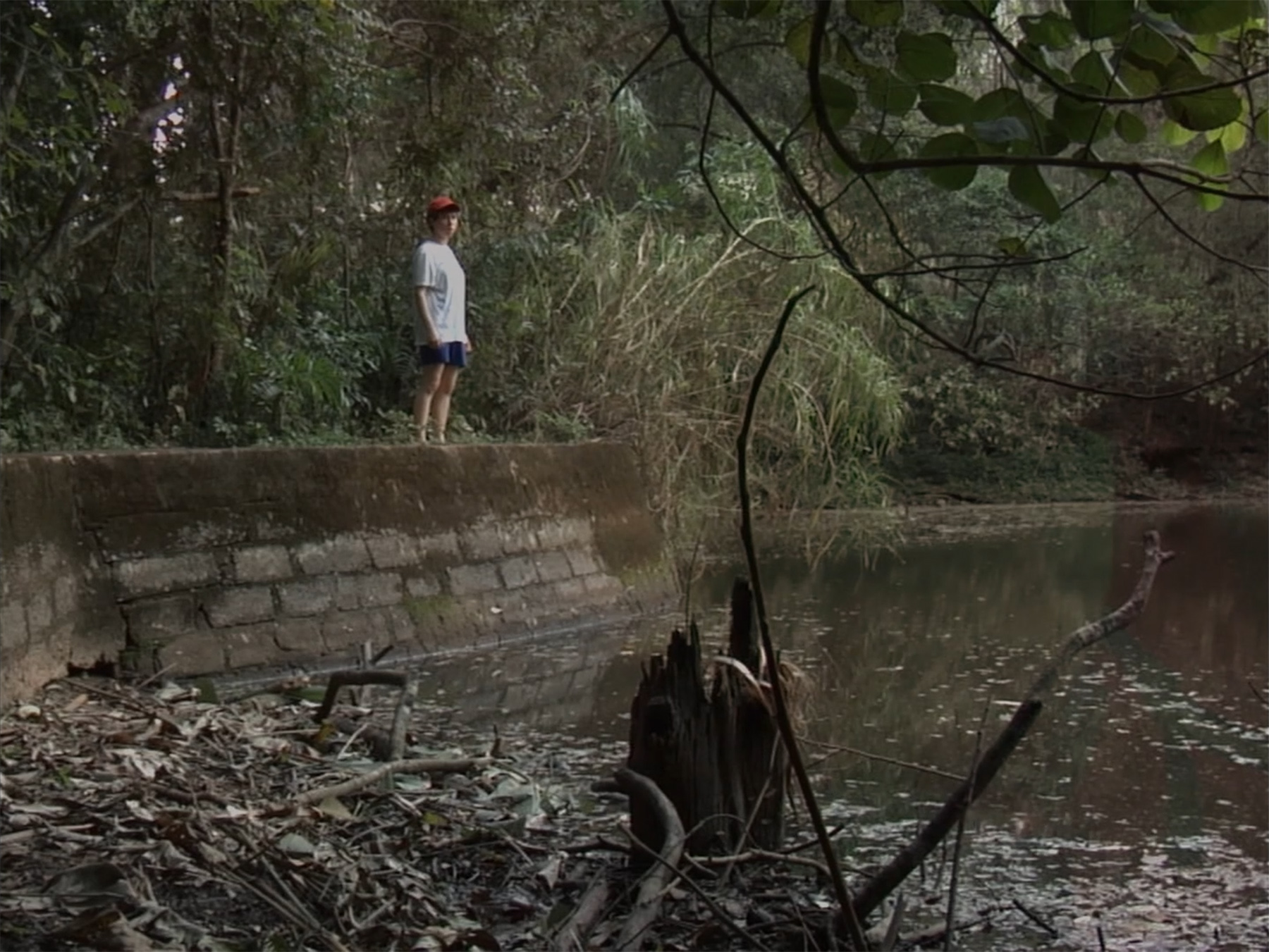
Roberta Pedrosa (Critic and Artist)
2023/ a small selection of my cinephile year
Roberta Pedrosa – São Paulo, Brazil
In Water (Hong Sangsoo, South Korea)
Having the chance to watch all three of Hong’s new films was quite lucky. Although Walk Up was probably my favorite, in water was absolutely captivating. His use of blurry imagery fell somewhere between a metaphorical, psychological, and formal statement, and yet at the same time it was none of those. It also opened my eyes to different degrees of blurriness in film and engendered a sensitivity to
the surface of images in narrative cinema.
Sofia Was (Pedro Geraldo, Brazil)
I have to say I always feel enthusiastic about films that use elements and landscapes from my day-to-day life to create fiction. This year I thought of Adirley Queiroz and Joana Pimenta’s Dry Ground Burning (Mato Seco em Chamas) every time I crossed the thoroughfare next to my house and a swarm of motorcycles rushed by, and by the same token I thought of Sofia Was everytime I went to the University of São Paulo campus (which was too many times). The mixture of concrete and nature, modern architecture and wild, uncontrollable vegetation was the proper mirror for the main character’s inner life.
The Shadowless Tower (Zhang Lu, China)
Huang Yao’s performance caught my attention first, she reminded me of Katherine Hepburn’s provocative characters. Along the loose, twin themes of parenting and aging, the film wanders through unpredictable human relationships without the intention of offering explanations or narrative purpose.
The Feeling the Time for Doing Someting has Passed (Joanna Arnow, USA)
Striking from the very first shot, not only for its content but also for its framing, lighting, and camera angle, which immediately brought to mind the compositions of baroque painting. As for the narrative, it elicits a feeling I love, felt especially strongly when the main character begins dating the cinephile: a complete lack of parameters to understand whether one’s actions are good or bad for themselves.
Thuë pihi kuuwi – A Woman Thinking (Aida Harika Yanomami, Edmar Tokorino Yanomami, Roseane Yariana Yanomami, Brazil)
A short film made by a group of filmmakers from the Yanomami indigenous group, shot on their land in Northern Brazil. A very delicate and direct portrait of a ritual from their community, narrated by a woman, that is at the same time a powerful and meaningful political statement and an open door to fiction.
Top Discoveries
Matinee (Jaime Hermosillo, 1977, Mexico)
I have a special appreciation for opening and closing scenes, and this film has one of my favorite last scenes ever. Hermosillo is definitely a director I want to explore more in 2024.
The Angel was Born (Júlio Bressane, 1969, Brazil)
A debt with Bressane’s early period finally fulfilled, his first efforts are among those I find most inspiring for life. It’s worth mentioning that he had three new films this year: Capitu and the Chapter
(Capitu e o Capítulo), which was distributed commercially in Brazil, and the festival premieres of The Long Voyage of the Yellow Bus (A Longa viagem do ônibus amarelo) and Rudder of Destiny (Leme do
Destino). I wasn’t brave enough to take the 7 hour bus ride, but I went to see Capitu and the Chapter and Rudder of Destiny and preferred the latter.
Haut Bas Fragile / Le Pont du nord (Jacques Rivette, 1995 / 1981, France)
This was, for sure, my Rivette year so I couldn’t leave him out. I reconnected with him profoundly. Haut Bas Fragile felt like something I always wanted to make but never knew and Le Pont du Nord is the closest a French filmmaker ever got to replicating the spirit of late 1960s Brazilian cinema, although I’m not even sure if any Brazilian filmmakers made an entire feature out of scenes shot
entirely on the streets.
Simon of the Desert (Luis Buñuel, 1965, Mexico)
A film based completely on one great visual idea, very moving. Although Mr. Buñuel’s more famous French films stopped being meaningful to me after I turned 18, this year I got better acquainted with his Mexican period and the change of scenery certainly brought out the best in his filmmaking.
The Men I Had (Teresa Trautman, Brazil, 1973)
Couldn’t help adding Trautman’s debut feature even though it wasn’t a discovery. I’ve watched it quite a few times in the past on the worst copy imaginable and this year it got a new restoration by Cinemateca Brasileira – a great gift and a new experience. It’s a film I hope to write about soon, if I find the time or get the opportunity to do so.

Robert Sweeney (Critic and Home Video Distributor)
Top 2023
Nanpakal Nerathu Mayakkam (Lijo Jose Pllissery, India)
Killers of the Flower Moon (Martin Scorsese, USA)
Trenque Lauquen (Laura Citarella, Argentina)
Mad Fate (Soi Cheang, Hong Kong)
The Other One (Henry Threadgill, USA)
Top Discoveries
Cannibal Corpse: Centuries of Torment (Nic Izzi + Denise Korycki + David Stuart, 2008, USA)
Kannathil Muthamittal (Mani Ratnam, 2002, India)
Evelyn Prentice (William K. Howard, 1934, USA)
The Crimson Pirate (Robert Siodmak, 1952, USA)
Chachi 420 (Kamal Haasan, 1997, India)

 Lucky Star