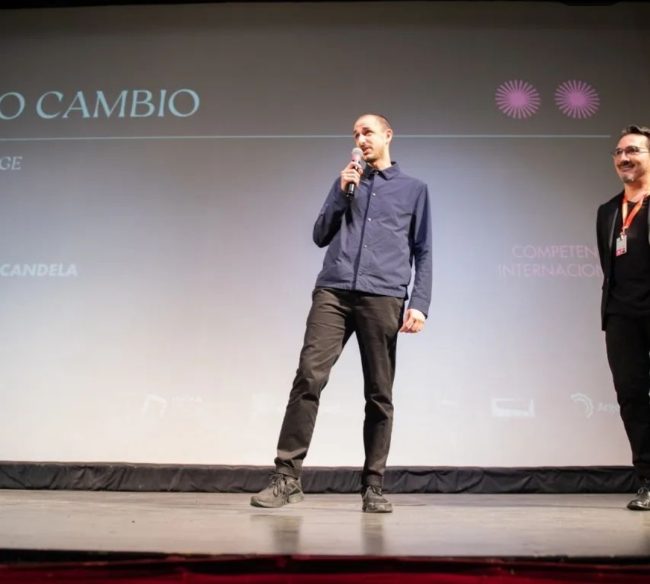
Here at Lucky Star, we are always on the lookout for points of contact with other cinephile cultures. We are hoping with this new column, Encounters, to establish a dialogue, a line of communication. We get to know interesting cinephiles, critics, directors, etc., all as a way to interrogate our own positions, our own cinephilia.
We start with the young critic and director, Lautaro García Candela, an editor of the inspiring film journal, La vida útil. In this conversation, we touch on his newest film, Cambio Cambio, which premiered last year at international competition of Mar Del Plata; his view of the unique nature of Argentine cinephilia; his work with La vida útil, and more.
I remember I read in an interview from a few years ago that you said your next film would be a new version of the Lubitsch film, The Merry Widow. Obviously, Cambio Cambio is not that film. Since those days, what has happened? Where did Cambio Cambio come from?
Well, that’s a film that I have filed away. The country’s economic fluctuations, beyond the fact that I also suffer from them, interest me greatly. The correlation between the economy and daily life interests me a lot. Above all because in Argentina we have a very close relationship with the economy. If you ask a taxi driver, he can tell you how many reserves the central bank has. The people who listen to the radio will know it. And this is not something that well-known in other countries. The amount of dollars that the central bank has is something that we pay attention to. The dollar is a number that is publicly circulated. The price of the dollar, both the official number and the parallel one, which is the illegal one, is a fact that can be given as commonly as the weather. Today you can get up in the morning, you go out, it’s 21 °C, it’s going to rain, and the dollar is 150 pesos. This relationship we have with the economy, which is something that is also at stake in everyday life, is something that particularly interests me because the political, the economic let’s say, coexists very well with the collective parts of a society, as well as with very personal matters. This interests me a lot, seeing the latest films of Adam McKay, seeing films that somewhat approach those issues.
The adaptation of Lubitsch, which I don’t know if I want to say is an adaptation of Lubitsch due to the rights, but the idea is that during the previous government, the government of the former president, Mauricio Macri, the head of the IMF came several times to Argentina, who was a woman named Kristalina Georgieva. And Macri said that we had to, as Argentines, make the president of the IMF fall in love with us. And that made me laugh a lot, what do you mean make her fall in love with us? What do we have to do? I am a great admirer of Lubitsch, his comedies above all seem incredible to me. It’s a bit of a mixture of The Merry Widow and The Smiling Lieutenant, which are very similar. Both have to do with the fate of a country depending on the skills of seduction of Maurice Chevalier. And now the whole society is waiting to see what happens with Chevalier. That was very funny to me. So it occurred to me that this might be a good movie. But it was a much bigger movie, much more expensive. It needed embassies, I needed the financial district, Puerto Madero. These are very expensive places. They appear in Cambio Cambio a little bit when the protagonist goes to a place where they have some information on what will happen with the dollar. What happened was I started to write this movie, which seemed more accessible to do, and which also combined my obsessions, or at least what interests me. And then I moved to the Microcentro – the house of the character in Cambio Cambio is my place, the places where he walks are the same ones that I walk every day. It seemed like a movie that was closer to me, so I said, well, if we have the opportunity to make it, let’s do this. We got some financial support and there we found a real possibility to do it.

Cambio Cambio is very different from Te quiero tanto que no sé (I Love You So Much That I Don’t Know), your first film. I was reading something you wrote about in the third issue of La vida útil, the one with Vitalina Varela on the cover. You wrote a bit there about the way you were taught about the screenplay in your university. They didn’t work with Syd Field, or McKee. The script was an instrument to find the film, and the film was really found during the production, the shooting. I can see that idea very clearly in Te quiero tanto que no sé. I imagine in Cambio Cambio you had to work with a more rigorous structure, a much more fixed script. What changed from that film to this one? What changed in your relationship to the script? How was the film found during the production? Or was it a different process?
Yes, I think due to the narrative needs of the film it needed to have a much more closed script. However, since I filmed it in two parts, one part in October 2021 and another part in January 2022, the film changed a lot from one stage to another. Seeing the movie come together, I changed many things. For example, her trip to France did not exist at the beginning of the film. I changed it between the stages of filming. And the final letter was also found in that hiatus. So I think although the film has a clearer and more closed narrative line, and the dialogues sometimes had to be more fixed, the instance of filming and writing became interspersed. And that made the film grow, and find more things. On the other hand, at the time of filming, I had great contributions from the different technicians. I’ve found a very good team, very good people to work with. They made many suggestions. There was always a dialogue. And the same with the actors. There was not as much improvisation because it’s a bigger film and it can lead you to lose productivity. The assistant director told me once, “look, there are a couple of days where we are not going to be able to think, that we are only going to be able to just execute, because we have a lot to film and not a lot of time.” I thought this was an interesting idea, execution. But in that execution you always find little freedoms, you always find alleys that you didn’t expect to see from the actors themselves. I am not a very perfectionist director when it comes to framing, when it comes to the directing the actors, but rather I try to be freer. So if there were many of instances of execution, pure and simple, at other times the community of the film, that gradually came together, could decide things almost by themselves. And that didn’t bother me at all. I was okay with that.
The thing about a screenplay, at least with a more Hollywood screenplay, is that the entire film is there, the entire film is condensed. And the screenplay for Cambio Cambio did not sum up the entire film. If you’re able to do that in your screenplay, it’s because of you’ve thought of everything beforehand. And I hadn’t really thought of everything beforehand. There are many things I had not thought about. It’s hard to compare my idea of the film with what it actually was. And I’m saying that is a good thing. There are a lot of expectations and desires… it’s something somewhat Buddhist. The Buddha said that desires and expectations are somewhat the enemy of happiness because it involves you all the time comparing your reality to your desires. Well, many times I had no particular desire for something. But I was watching how it emerged. And I think that makes one feel less frustrated.
In the United States, I don’t leave my house and think about the value of the dollar, or the yen or the euro (unless I’m going to take a vacation). So I didn’t know about this experience of the arbolitos, I didn’t know anything about what was happening…
Did you understand it?
I had to read a little afterwards, about the arbolitos, to see what is happening in Argentina. I read a little about the IMF… I could understand it, the broad strokes, just from watching the film. But what interested me was more the dynamic, more the microeconomy of that Calle Florida, how the characters manage that system. And also those glimpses of the Macro, of what is happening in Argentina, what is happening with the government, with money, the dollar. These characters are ordinary people. They will not be in those places of power where all the decisions are made. That relationship between the micro and the macro – what was the balance that you had to find, what things to explain or not explain. How did you think how the macroeconomic factors affected these characters in a more concrete way?
Two things. Regarding how to handle that relationship between the micro and the macro, I had written the film before the pandemic. And before the pandemic, I was very clear that the film took place at a specific time in Argentina, which was in mid-2018, when the value of the dollar went to 25.40 pesos, a devaluation of almost 40%, very brutal, in just two days. And that devaluation happened during the Macri government. I had thought about setting the film in the ambience of those days in 2018. I was even going to include the World Cup in Russia, which was a catastrophe for Argentina. There was just a very particular spirit in Argentina those days. But what happened? The pandemic came. And that’s when the face masks appeared. And with the face masks I couldn’t make the street look like 2018, it couldn’t be like that. It was very difficult. So I said, well, I’ll have to include many things that are a bit confusing. I tried to find a way to say, because it’s logical, this is something that happens to all governments, the problems with the dollar. So what I did was abstract it a bit, which is something that can have problems. There are many films by other filmmakers which abstract political issues, such as the films of Santiago Mitre, and that’s something I don’t like, to take politics as something abstract. For me, politics is something that always has concrete effects. I like to talk about politics, I’m very aware of it, and for me not all governments are the same. I tried to escape from that, but at the same time I didn’t want to use proper nouns that much. Well, I tried to find a midpoint, so to speak, between the specific names of politics, and a more general environment that could happen during any government.
Regarding the relationship that the characters of Cambio Cambio have with politics and the economy, it has to do with… I have my own political ideas about financial speculation, what place it occupies in our politics. But I don’t know if these characters have the same ideas I have. I mean, I didn’t want to place them in any particular way, because perhaps my own perspective could end up having a certain moralistic spirit. And I realized that these characters did not have the same viewpoint that I had. They lived much closer to the ground, so to speak. In Howard Hawks’ Scarface, there’s a sign that says “being a gangster is bad, don’t try it at home.” I feel like the movie could have had something like that, a sign that says financial speculation is bad, don’t try it at a home. But, truthfully, it would seem like trying to block out the sun with your hand. Because financial speculations of this type exist, and taking it from a moral perspective seemed less interesting to me than just putting it on the table and discussing it. My idea regarding the action that these characters have over their environment is that of agency. They understand what their world is like, they study about that world with second-hand materials, such as Youtube videos. And that they take action from that. That is to say, they’re not merely victims, but they can somehow exercise their agency – they take action in their world based on knowledge. And that seems to me a political proposal based on a sense of community, that is, acting as a group. These things can eventually change a person’s situation. So it didn’t seem interesting to say this or that is bad. But rather say well, under certain circumstances for those people who are the most precarious, who have bad jobs… that’s where I wanted to put things to discussion.
Talking about the politics of Argentina makes me think of the name Nicolás Prividera. He had a piece in response to the third issue of La vida útil, it was posted on the website of Roger Koza. I remember there were many, many comments on that post. You and all the other editors of La vida útil commented on it. This makes me reflect that the polemical energy found in Argentine cinephilia is very different from what I see in the United States. Everyone is doing something collectively, and taking that cinephile energy and doing something concrete, publishing magazines, creating something new. How would you define the cinephilia that you see in Argentina? How do you define it?
It seems to me that Argentine cinephilia and Argentine criticism is very active, very lively. Things are happening all the time. And there is a strong polemical tradition, of texts and responses to those texts, that comes from the intellectual field of literature. It’s something that I find very vitalizing, it’s something that compels me greatly. Because I’m interested in talking about films, I am interested in the receptions of films, what is said about them. For me, it’s something very interesting. It’s something I’m very into. I also feel that Argentine cinephilia, Argentine critics, exist under the influence of Nicolás Prividera, that is totally true. I’ve been reading him since I was very young, and I feel that he has been very important and has had a great influence in this sense of contrasting a film with reality and seeing how they work politically. Argentinian films are not read politically in the same way as they are in the United States, for example. In the United States it seems that all political discussion passes through a lens of political correctness, the representation of minorities, with representation in general, let’s say. In Argentina, the discussion is slightly different. I think it has to with a politics that… let’s say, it’s a discussion that clearly says the words Left and Right. And that has its good points and its bad points. On one hand, Prividera marks a path, let’s say, to continue with a political idea because we all make political films, we all think about politics from many points of view. But there is an idea of politics that Prividera has monopolized, and that we fight against this all the time. That doesn’t interest us at all. We try to see how politics manifests itself in other terms – which has to do with the relationship with the past, which has to do with ideas regarding cinephilia. Prividera speaks of cinephilia with a certain weight, like something dead. We think of cinephilia as a community, a way to revalue the past, a way to find a common space. Which doesn’t have that abusive gesture, like Prividera. So to a certain extent Prividera taught us many things, and now it’s time to find new ways of thinking about politics.
Something which is true is that the Argentine right, to say it quickly and badly, who are the followers of El Amante and who have their personification, for example, in Quintín, have had a very clear identification with the previous government, the Macri government, which was a right-wing government, and that makes everything that Quintín says doubtful. We believe that the first fight we had with Prividera was that we value what Quintín did as a critic. We were formed by him in some way, right? And suddenly the mere mention of him invalidates everything. I will continue saying it – he was a person who was fundamental in my training as a critic, in the same way as Prividera. And I think that the problem that Argentine criticism has is this idea of simple binaries. In that sense it is very annoying. It’s very annoying because at the moment a lot has to do with identification, everything has to do with how one identifies themselves against certain phenomena, how one positions oneself. In the end, this tells us more about the people than about the ideas. So Prividera is asking all the time, “but if you like Quintín, just say you’re from the right.” And that to me is a mistake because ideas can be redeemed. What was the saying of the philosopher, György Lukács? In a leftist world, even rocks will be redeemed. In a possible left communal life, everything can work for the good of communism. I am going somewhere completely different! But what I mean to say is that things do not correspond to such tight boxes. In that sense, we only have freedom. I value freedom in an individual sense, but also a collective one.
I feel that there is a lot of fear of being on the wrong side of history, and this makes everyone’s positions very careful. And when one is very delicate in their analysis, the positions which are absolute are left by the wayside. When you dedicate yourself a lot to your work and think about things in a deeper way, well, the categorizations remain a bit… you have to modify your characterizations and your own ideas all the time. In La vida útil we have our convictions, but we always let ourselves be surprised.
There is a literary critic who Prividera likes to quote named David Viñas. He was a controversial character, who sees politics everywhere, who was very paranoid, and who was an absolutely great character. He was a character that’s much larger than life. Viñas, for example, has a lot of texts, texts where even analyses the daily newspaper. There is a famous image of Viñas with his newspapers and he had them underlined and annotated like they were literature. In his most major book, Literatura Argentina y Realidad Política, he talked about the political position of Manuel Belgrano, who is a great writer of ours, who was a man of letters and did many things, and how it was seen in the use of words esdrújulas, which are accented on the third-to-last syllable; words graves, which are accented on the second-to-last syllable; and words agudas which are accented at the end. The accents of his words was always in the middle, and that made his speech very measured. That was his level of analysis. You go to the point of thinking about the accentuation of words that someone uses. It is a very detailed of analysis, it’s wonderful. And that’s so with all the writers he analyzed. Prividera has a very political idea of his readings, but he lacks that finer analysis in which his great truths cannot be applied.

There have been five issues since 2019. Originally the reason you started the printed issues was that the texts on the website were very long, and people are not reading them in the same way. That was the initial reason. Since that first issue, how has the way that La vida útil works changed? What has changed since that initial formulation to have the printed magazine?
I don’t know if La vida útil has a method. I think we write long texts because we’re enthusiastic. If there is any method, it is that it’s not just a critical text, but also the story of an investigation. We always investigate something for the texts, whatever it is, there is always something to investigate. In that sense, this research and writing method goes better with print because it implies a more spacious text. In any case, I am very interested in writing on the internet. For me, the internet has a potential and a reach that’s much larger. It is even a discussion that we have internally, about what do we do with our texts… Do we print them in an issue, in the magazine, publish them online? For example, I really like to write online about festivals, like writing a type of daily chronicle. It is basically the same distinction that one has when watching movies. In other words, the idea of watching movies on a big screen in a theater, in the dark, with a lot of people, is an experience that is almost vintage. And books can also be seen like this. We are interested in that distinction. It should have something ceremonial. Just as cinema has something a bit ceremonial, so should reading. Because reading texts online is very different. When you read on the internet, you have many tabs open. And you’re reading when you have less concentration. We saw that reflected in the site’s analytics. And from that, we obviously said that our writing is not made for this.
Well, the idea of long interviews and long texts also came to us from some magazines, such as Lumière in Spain. But we aspire to a certain periodicity that would allow us to have our own agenda, that we don’t have to comment on issues as soon as they arise. And that differentiates us from a certain idea of blogging, of blogs, in which there is always something to say about something. That is the logic of social media. There is a position, a conviction, that says that public conversation does not have to be that of social media, that it does not need to be immediate. The conversation can take its time. There are people in the magazine who use social media a lot, but there are those who don’t use them, who don’t have that logic of Twitter. So the idea of something happening and you have to tweet something immediately is very strange to me. In our discussions, we ask ourselves about this. We reflect on this – how to intervene in the public space. And, well, our way of intervening is evidently very slow.
Since you’ve started, you’ve expanded in a few different ways. You have an association with this new magazine, Outskirts, with Christopher Small and the other editors from Spain. You’ve also published a book about Argentine experimental cinema, Una luz revelada. And, this last week, you’ve published, along with Taipei and La tierra quema, this survey of Argentine cinema (Encuesta de Cine Argentino). Do you see this new survey as an opportunity to rethink the canon of Argentine cinema? What was the origin of the survey?
Yes, it has to do with reformulating the canon, definitely. It also has to do with highlighting Argentine cinema. But it’s not from a perspective of… if I say, Argentine cinema must be valued, I start to sound like a politician. As if Argentine cinema were everything. I’m not saying that all of Argentine cinema needs to be revalorized. Obviously there are films that I’m against. There are definitely movies that I’m against. But, at the very least, let’s put Argentine cinema up for discussion.
It had a very clear origin. We have many gaps in our knowledge of Argentine cinema. That is to say, the classic Argentine cinema. And I think we did the survey almost selfishly, so we could learn. To know what other people had been watching, and find those other movies that other people admire. We had this idea in mind, and we realized that Revista Taipei also had the same idea. So we said, let’s join forces. And the truth is that without the effort of each one of the magazines, both Taipei and La tierra quema, it would’ve been impossible to do the survey. Because it really is a titanic effort. I think that it revitalizes certain discussions, and it will definitely make people watch the movies because on the website we provide links to the movies. And now on twitter there is a drive circulating that has the entire top 100.
In some sense, this is something that we do in order to stage our own ignorance about what’s happened in Argentine cinema. Why are we ignorant of Argentine cinema? That’s another question. I think it’s perhaps because our universities do not teach it in the best way. I went to the Universidad del Cine and there are not many courses on Argentine cinema. And I think the same thing happens in other universities. And, this is the main thing, we don’t have a cinemateque. In other words, we don’t have a space for exhibition, we don’t have a politics of restoration which would allow us to see films from before the 1960’s in good quality. Faced with this void, we do something so this void is made manifest. And this is seen very well in the top ten of the survey, in which there are no films from before the sixties. And in the top 100, there are only a few. I think this happens not because the films are not good, but rather because they haven’t been seen. Because every excursion I make to the pre-60’s Argentine cinema I leave absolutely amazed. There are are a great number of styles and themes and sensibilities. I want to learn more, I want to know more. I think the main problem is precisely the quality of those copies. There’s something important there. Well, we are doing the survey to measure our tastes, to learn what people vote for, and also to make manifest the gap… well, it’s not that we did for that reason, but we knew it would happen that way. We wanted to see what other people thought about the movies. For me, it is an idea of community, creating a larger, more heterogeneous community. But to create it, a kind of community.

Looking at the results of the list, obviously, they are marked by the New Argentine Cinema. I believe three or four movies from the New Argentine Cinema of the 90’s and early 2000’s are in the top ten. Thinking about how such a result would be received in the United States, where the best American film of all time would be something from the year 2000, it strikes me as a little strange. I think if that happened in the United States, we would see look at that result as something to not take very seriously. Because there’s an idea that you have to vote for those classic films, Hitchcock or John Ford, something like that. I can understand choosing a film by Favio, it’s like choosing The Godfather. But it’s been only 20 years since La Ciénaga came out. It would be the same thing if tomorrow Sight and Sound said that Lynch’s Mulholland Dr. was the best film of all time. Do you think this result is interesting, in the way that the classic cinema seems to have been supplanted?
First, prepare yourself for the Sight and Sound list. I voted. I didn’t vote for The Godfather. But I think that a lot more new films will appear, because old films are seen less and less. I can download a copy of The Searchers, or Vertigo itself, I’m here looking at the last Sight and Sound top ten… These are two movies that you can download in a pristine 1080p quality. It is very easy to see these films in good quality, and they circulate – it’s easy to reach them. That does not happen in Argentina. It’s not easy to see the classics. It’s not easy and it’s not pleasurable, because the films look bad. They are bad copies. In fact, the films that look the best are those at the top of the list. Las aguas bajan turbias, Prisioneros de la Tierra, they are movies that are available in good quality, and that lets them be seen. I am sure that there are many films that appear at the top of the list that are not the best films by their directors, but rather that they are there because they could be seen.
In good quality.
Of course, yes. It seems logical to me. It’s bad, yes, but it’s logical. I think it has to do with that. That’s what the survey reveals. There’s more consensus and more things written about Vertigo, Citizen Kane, Tokyo Story, The Rules of the Game, than about our best filmmakers from the 40’s or 50’s, from the classical period. There are many texts written about those films in the top ten. Now, how to make those films that I think are the best get up there… Recommending them is very difficult. Because they’re in poor quality. They look bad. The truth is that I don’t wish it on anyone. I prefer to wait until they look better.
I understand completely. For me, that’s Edward Yang, whose final unreleased films are being restored. I think Mahjong is going to come out soon. And I’ve waited 15 years to see those movies. And I’m waiting because I don’t want to see them in that horrible quality. The top ten is dominated by those films from the late 90’s, those directors from the New Argentine Cinema. It’s a little bit like seeing, I don’t know, a film by Jarmusch, Ghost Dog, in the top ten films of all time. This relationship with Argentine cinema and its history is very different… and that’s why it interests me.
Do you know why? There is a much greater cultural weight. You can’t not vote for John Ford. Because he is a great figure. And in Argentina there’s no such thing. There’s Favio, Lucrecia Martel, and Aristarain if you want. But after them… it’s not that the movies themselves don’t allow it. But what happens is that that mythology has not been generated, let’s say. So I really believe that if there were documentaries, and more documentation, about Manuel Romero, like there is about John Ford, setting aside everything else, he would have much more votes. I’m sure.
I wanted to ask about the piece that you wrote a few years back and that Lucky Star has translated, 12 Years of Argentine Cinema. What inspired you to write it? Did anything surprise you?
What inspired me to write it was that the categories of analysis that were being used to think about Argentine cinema did not seem to me to be the most fruitful or current for the situation at that time. I wanted to offer a new vision: it is a personal text, arbitrary at times, but I consider this valid to rethink certain issues. At the same time, it’s a chronicle of a particular moment in the country, the end of an era, both political and cinematographic, the “década ganada,” as the Kirchnerismo put it, from a generational perspective, a bit disenchanted. I wanted to be crossed by the era, to write a vital document, to embody a voice that I saw scattered in different places, but that was not fully defined. It was a moment of rupture among my friends and colleagues in cinema: we were not fully inserted in the environment, neither in the festivals or the mainstream industry, we were finding our place. I also had certain adolescent certainties (in opposition): I was not willing to give in to the interpretation that said the films I liked and defended were not political, or that they were pessimistic, or closed in on themselves, or that they did not invite action. Quite the opposite!
What was the response to the text in Argentine cinephilia?
I think it was read, but it didn’t have the impact I would have hoped for. What impact did I expect? I don’t know. Some directors thanked me, but I think most didn’t notice. I remember two texts. One from from Nicolás Prividera and another from Juan Francisco Gacitúa. Prividera’s text was, to some extent, disappointing. Because as a critic he was very fundamental for me. I read his discussions with enjoyment for a while, then with disinterest. Not because we started arguing or anything (the personal issue could have added a little spice to the reading), but because he started to repeat himself and now his texts seem written by an AI that has read his previous work and applies it to any current event. And I thought that the use of certain critical tools that I learned from his writing would illicit a more attentive response on his part. But it just remained in the usual fights, in which we all know where we stand and the usual positions. I was accused of being apolitical, complacent, and that the text was a weak reading: the parts of the text that could’ve complicated the arguments were ignored.
Seen from a distance, I don’t know how much we were able to build on those ideas. It is one of the longest texts I wrote and the most representative of a later frustration. After four years, there were no systems in the cinematographic field, but rather a general numbness. Of the filmmakers I defend in the text, none of them had a qualitative leap: Piñeiro radically reduced his production; Campusano went in other directions; Lingidardi, Kaplan, D’Angiolillo, Carri and Hele Wohlatz still have not released new films, and I have not been able to see the one by Rodrigo Moreno. Regardless, I’m still optimistic – is there any other way to do things?
Let’s talk about the future. Are you going to focus more on the classic Argentine cinema in La vida útil? What will happen with the survey now that it’s been published? Will it have a place in the new issue you’re working on?
Yes, we are preparing a dossier on the classic Argentine cinema. Which is basically what we want to learn about. We want to learn more about that. We are going to publish a dossier on the classic Argentine cinema, and the survey has helped us a lot. I’m getting to know many films that I hadn’t seen, that I didn’t know about. We’re going to take the work of the survey to our advantage, to make a dossier on Argentine cinema in two parts. One that has to do with the classic cinema, and another on the cinema after the 1960’s.

Interview conducted by Jhon Hernandez on November 2022. Thanks to Ivan Moscovich for facilitating the interview.

 Lucky Star