
12 Years of Argentine Cinema
by Lautaro García Candela
Están pasando demasiadas cosas raras para que todo pueda seguir tan normal / Too many weird things are happening for everything to go on as normal – Charly Garcia
At the Gaumont, the main cinema in the Federal Capital, where almost all Argentine movies are screened, the air is stuffy. Or too quiet. Its halls have the unhurriedness of a branch office of the AFIP (Federal Administration of Public Revenue), where people walk slowly because they’re old or asleep. There are Sundays full of racket, when Theater 1 is full due to some grand premiere that just landed there in its third week, after it collected everything it could in the multiplexes that charge more for its tickets. This is the only place where films can be seen at a decent price. But, meanwhile, the movies pile up and one sees them go by like wagons of a train that one’s not going to get on. I had to write an article about the last 10 years of Argentine cinema. It took me two years, so it will be about the last 12.
If in these years there haven’t been great changes in cinema – more like tectonic shifts whose consequences we’ll see later – what moved the fastest and most radically was politics. In these ten, eleven, twelve years a little bit of everything happened: the most important political figure of this century died, his wife spearheaded two governments, there was a boom of growth and consumption, a doubtful and uneven politicization of public discussion, and, after growing at Chinese rates, the economy froze and the Argentinians voted for Mauricio Macri. As it’s too painful, I won’t mention what happened afterwards. With the tachycardia that comes from the feeling that history is being written right before us, some directors filmed while trying to find the present in the contemporary. They stripped themselves of all requirements and minutiae in order to find the center, the exact point in which the ideas intersect with actions and they become the same material.
This process takes time: in the United States, for example, a few years passed before someone could find, within the frenetic rhythm of information, the economic, cultural, and social effects of the Obama administration, and cast a mantle of doubt over them. I imagine Get Out, by Jordan Peele, would have needed a long period of decantation: it’s a difficult political film to make. All that black panther bonhomie ends up being small talk so that the upper-class white people have some fun and perpetuate their power even more.
Our films have a background noise that’s inimitable; and sometimes even literal. In El Incendio, by Juan Schnitman, a middle-class couple is going to buy a house. They have to withdraw money from the bank and take it to their home, or something like that. They walk with their dollars two or three blocks in the center of the port town they live in, which has already been pedestrianized. In the background, on the soundtrack, we can hear some drums coming from a nearby protest, doesn’t matter which. A mass of people is nearby: everything is tainted by uncertainty and danger. Perhaps it was an idea of the sound designer, but it’s also an unconscious manifestation of the fear that one has when faced with the possibility that their savings disappear (sound familiar?). When I have money, there’s nothing more dangerous than a public protest, the life in common with others. Generally, due to its class origins, the Argentine cinema tends to the conflict between the individual and the crowd.
Politics, for the past few years, ceased to be a place, an activity, a noun. Now it’s an adjective: everything is political (does the fact that everything is political imply that nothing is?). The struggles turn towards the micro, the personal. The most incendiary and interesting struggles are the ones fought by the minorities.
Last year, in an interview for Los jóvenes viejos (Juan Francisco Gacitúa and Juan Pablo Martínez), Sebastián De Caro said something along the lines that Argentine cinema was more thought than shot. This is doubtful and we would have to verify what exactly does he think about the national film production, but it’s a disturbing idea for starters. Are we spinning around an object that doesn’t merit that much attention? Are we trying to find in films ideas that they don’t actually have? At the same time: every thought is a thought about something.
New Intensity
que tu palabra / sea irrupción / de lo espontáneo
que lo que digas / diga tu existencia / antes / que “tu poesía” (That your word / be an irruption / of the spontaneous that what you say / says your existence / before / “your poetry”)
Leónidas Lamborghini, El Solicitante Descolocado
I remember they did a lot of word games at the 18th edition of the BAFICI (Buenos Aires International Festival of Independent Cinema), when it was said that it had “come of age.” That’s inconsequential. What is true is that there is a constant (late) adolescence in the films. It’s something global, just ask Judd Apatow. Google millennials and you’ll find a series of problems that exist all over the world regarding young people: job instability, little economic independence, fear of compromise, sexual freedom and yet we’re the generation that has the least sex since the hippies’ era of free love. There’s no worse mandate than no mandate at all: where are the enemies? From Excursiones to Los Vagos, it’s as if a series of directors has seen the films of of Martín Rejtman and then confused them with reality. They saw them literally. As if there wasn’t a cinematographic form in between that imposed distance, rhythm, tone, framing, that turned them exclusively cinematographic. What’s radical in Rejtman, his rupture with the oldest costumbristas discourses, is that there is no more outside. There’s no mimesis. There’s only an ironic and distorted vision of the trends of the 90’s with the Armani suit jacket, the shampoos and, later, flute classes. A certain aspirational middle-class discourse in all of its ridiculousness.
The critics, when seeing Rapado or the films that followed, were irritated: where is the motivation, the psychology? That was a rabid and extreme denial. But some young people began to live their lives in the ways that Rejtman’s films taught them. Those particular characteristics of his films were not transmitted to the form of those young people’s films and became extreme, infecting their own becoming: there’s no relation between the environment and the individuals who dream, fight, live. There’s a secret anguish, pain or joy that doesn’t translate to the public sphere. The post-Rejtman films began to resemble his but in the end they were totally different: these films did try to imitate reality. This, paradoxically, diluted the relation with the historical context, which ends up being less intense.
But… intense? Who says so? Let’s take this little word for a spin. Someone always wrinkles their nose when we use it. I don’t believe it’s something that we can measure, as if there was one movie more intense than another one. What would be those defining characteristics?
To put forth an example of what is usually thought of as an intensity variable: the militant cinema of the 70’s. Faced with very stale entertainment of the costumbristas films that were made as if they were an example of good conduct (something which happens since cinema is an art of the state, it has to be said) there were directors who invited us to direct action through some methods that involved a retreat of cinema from the space of fiction. The Inextinguishable Fire by Harun Farocki and the short in which Eliseo Subiela teaches how to assemble a Molotov cocktail as if it was a cooking recipe are from the same year. Pino Solanas and Octavio Getino in La hora de los hornos (to download it in good quality you must google The Hour of the Furnaces) leave the screen in black for a while in order to invite the debate on what to do regarding the situations that the documentary exposed. Every spectator is a traitor, they said.
Intensity, then, is what cinema implies beyond the screen, challenging the viewer to act and to not be indifferent. But the corporations, as always, take note of these attitudes of rupture in order to appropriate them and separate them from their political potential. Now those same corporations offer the public the same kind of interactivity. The film spectator (if they still exist) has gone cold and is only partly active, although that participation ends up being limited and deceitful: to get into this subject, see Black Mirror: Bandersnatch. Now films wink at us, invite us to rebel (what type of rebellion, one would have to ask), and erase all traces of power in its interactions. However, the traces are there for those who want to search for them, and mass communication is still as violent as ever.
I will risk to say that the intensity is formed in the relation between the film and those who watch them: in the adequacy (or not) of that cinematographic form to the hegemonic discourses, in its love (or not) for its characters, in its way of challenging us. A film is not intrinsically intense but one can infer that quality when it’s seen in relation to its context. So, which is the cinema that challenges us? The one which speaks a secret language, contemporary, but not all that transparent; the one which invents before our eyes a new way of speaking. Waiting and patience are key. The films that try to impose themselves through different methods (the direct address, the surprising storylines, the formal virtuosity) follow the path of publicity and marketing. This is not a defense of an ascetic cinema or secrecy, but asking ourselves, politically, about the framing and rhythm isn’t gratuitous. It shouldn’t be. Doing so means being outside of Netflix: with means we face ends.
Let us demystify, then: this era is as intense as any other. The problem, as always, is the character of that rebellion, which at one time (the 1970s) needed to be violent, disruptive, Manichean, and which currently demands a different degree of discretion and calculation. To give it a sort of assessment would fall into the fallacy that time is linear, that one era can go back or advance relative to another one. There are events that can be viewed in an evaluative way, but they are points of a larger and more elusive plot.

Public Space
On October 12th I’m going to become pro-government? No, I’m going to watch movies, series, finish writing two books, start another. Politics in its place – Gustavo Noriega’s Twitter on 11/12/2015
For some strange reason the stories withdrew into the private space. Within our safe margins. The director who, some critics say, embodies this idea of confinement in the private space is Matías Piñeiro. It is said that his cinema is apolitical, that it represents the well-off doing their silly routines in a context that needs a more committed gaze. Is there perhaps a mechanism of common sense that dictates that, when a film speaks of a part of the world that the filmmaker knows, that this is not political, as if the political were everything that does not belong to us, or that which exceeds us? His films (The Stolen Man, They All Lie, Viola, The Princess of France, and Hermia & Helena) deal with slight loves, geographical moves and stagings of a specific social and age group. There’s always a text or a material that’s recognized as reference and of which the characters speak and develop a subject about it. In his first films it was the work of Domingo F. Sarmiento and his later ones it was the comedies of Shakespeare. The work of the critic here isn’t to point out the differences between word and image – as if we were measuring the fidelity of the adaptation – but rather to think how they relate and how they empower one another.
Fernando Lockett’s cinematography, collaborator on all his films, is simple and luminous. There’s no stridency, only a repertoire of prodigious camera movements, always at the service of the characters. The camera, usually locked down on a tripod, follows the comings and goings of its story. The space is thus dramatized (becomes theater) and fully occupied. There are no laconic poses or hesitation. Sometimes the characters are hidden or far away, sometimes there are two layers in the frame, but there’s never one shot and then another. Everything happens so smoothly that it seems simultaneous. It’s not for nothing that Piñeiro often plays with repetitions and variations: the loop is a major part of his mise-en-scène.
The performances and the camera movements which capture them are inseparable, dependent on each other: we’ll never know which came first. This symbiosis is unique in a cinema (the Argentine one) that spends its time thinking about the right distance to its characters. Piñeiro seems not to ask himself that question, having totally assumed it because, of course, he could be one of his characters. Sometimes, in the evolution of the story, he hides information; other times he changes the point of view, which is so so erratic and scattered as if it belonged to an absent-minded and short-sighted character.
Much of the dialogue in those films is read, cited from primary or secondary sources. Even with a certain level of artificiality, on a second pass you’re surprised that nothing sounds as forced as remembered. They are, in fact, quite colloquial. From something Sarmiento said in 1837 we move to how to best leave your boyfriend, as if it were a magic trick. This doesn’t turn the characters schizophrenic or distant: they have jobs, feelings, and time for leisure. We go from one to the other fluidly. Here love circulates freely between inconsequential conversations, it becomes light: there are no Argentine movies with so many furtive and enjoyable kisses, surprising but intense. The characters kiss based on impulse and the euphoria produced by being young here and now. Like in the films of Jean Renoir.
The myths, theories and stories that Piñeiro appropriates function as a theme and as a narrative framework. Sometimes one function imposses over the other. In The Stolen Man, the temporal structure is taken from Sarmiento’s “Campaña en el Ejército Grande,” although due to the inaccuracy of its adaptation, what matters more is how the book is passed around between the characters. In certain moments of Viola, Shakespeare’s text monopolizes the entirety of the dialogues, but they are transformed by the movements of María Villar and Agustina Muñoz, who approach each other, move away, answer the phone, look at each other intensely until, finally, they kiss. The characters can inhabit the text in a playful way (and the game, no need to say, is something very serious).
All these developments that enter the Story in a shameless way aren’t the verification of it becoming a farce, but quite the opposite: the confirmation that all our myths belong to us and fly over us. He builds a bridge toward the great stories and brings them closer; at moments they show their vacuity to later wear it as a mask, which sometimes reveals our true visage. He doesn’t adapt Shakespeare or Sarmiento faithfully; he asks them what is truly alive from them that can still reach to us.
Politics are present in each and every single one of Piñeiro’s frames, not as an example of the escape from public space, common to all, but rather in the genuine ostentation of his staging: which other filmmaker proclaims their own intentions and their ethics with each camera movement, each cut? Being aware of that and moving forward without a complex is the most political thing in the world, contrary to what Gustavo Noriega thinks. There is no “place” for politics. Like we said previously, politics is more adjective than noun. It’s more like a painting that pervades over things rather than a canvas where you paint. Politics is in the air, whether in the halls of the Pink House, or in a country house in Tigre. It’s impossible not to be contemporary. Piñeiro doesn’t shy away from the idioms or the clothing brands of his time. His films are also a document of the ways and forms of the youth of this era: that they’ve been able to withdraw into the private space, that they’ve been able to study theater and allow themselves to spend their free time in these sentimental artistic trifles is a sign of a certain social mobility. If in his last two films Matías Piñeiro flirts with the idea of exile perhaps it’s because there’s something here that broke.
In Los paranoicos by Gabriel Medina, and La paz by Santiago Loza, this confinement takes on another nuance. It’s the mental confinement that is staged, not the social one. This isn’t the manner in which the characters will be fully developed, but rather the product of the phobias of the protagonists, who are also young, but less adapted. In these films the imperative to go out to the street and the public space can be read, deep down they are part of the same platitude: life is out there.
So, what’s happening outside? In the industry films of Patagonik, the biggest production company in the country (property of Grupo Clarín), you can’t find much life in the streets. All the stories take place in closed off environments (more or less), and when they go outside, what we see is more like a postcard. The Usina del Arte, the Obelisk, the Teatro Colón plaza… settings that money and power can control so that the images look like advertisements for the Government of the City of Buenos of Aires. The surfaces look glossy, shiny, and impervious to any aberration of the register. This vision of the city is very close to an official one: a touristic scenario so that the people who don’t really belong there can have fun for a while.
On the documentary side, Cuerpo de letra, by Julián D’Angiolillo, interrogates the city as a depository of political propaganda, something totally out of field for the mainstream. More of a plastic artist than a sociologist, he follows a group of kids who work painting along the walls the names of some politician. It does not matter to them if it’s one party or the other. Denying the observational style, his film is darker and located on the borders (of what it registers and geographically). The Apollonian vision of Patagonik opposes lives with substance abuse and the dirty work of the young guys who paint walls. Everything we see is blurred, with unclear links.
He doesn’t film militants painting slogans for what they believe – that would have led to the ethical or sentimental question of this task – but rather he chooses people who work in this, which implies two things: on one hand, they are more concerned with the letters looking good, with the correct distance between each one; and, on the other hand, there is no talk about any of the names they are painting. It doesn’t matter if the candidate is from the FPV (Front for Victory) or from the PRO (Republican Proposal). The night before the ban on electoral activities, two opposing groups fight over the same wall. Some on one side of the highway, and the rest on the other side. This space is now a battlefield, disorganized, a no man’s land under the gaze of all. It is marked by urgency and precariousness.
Cuerpo de letra ends with these same young painters voting. It’s a great shot, with a GoPro hidden in the dark room, in a framework of total illegality. As if it were a funnel, all public life (which Matías Piñeiro’s films are also a part of) has an expression (vital but not decisive) when it comes to voting.

Violence
In times where violence – state violence, either by direct action or omission – becomes inescapable and becomes multiplied by the screens of the social networks, some filmmakers have chosen to join the public discussion. They perceive that there are current motifs which can condense senses, which approach the themes of the era. There’s nothing wrong with talking about what’s being talked about: the danger is to continue to involuntarily belong to the rule and not to the exception. There is always a mechanism – unconscious or coercive – that inadvertently puts us in the side of the powerful.
In those videos of police repression or the hooligan fights that go viral on Facebook there are formalisms that are almost a certificate of veracity: the technical malfunctions, the shaky camera or the image abruptly cutting. Along with the amateur pornographic images, these are the two examples of situations that cannot be falsified. There we can see a spontaneous and urgent mise-en-scène. In the case of violence, its spread is never without consequence, it always has a purpose: it’s the proof of a despicable act in the majority of cases. Violence, but also the act of filming it, is politically directed. Spreading these images is something that one would prefer to avoid, a traumatic experience that one returns to for a concise and immediate effect, which ignites the hope for compensation.
Some films spun circles around violence, more like a theme than as a form. It’s an idea, a concept, something which tempts abstraction. In 2014, the year where it was decided to instill the idea that society was tense, Wild Tales and History of Fear were released, two episodic films, made up of vignettes, that asked themselves about the origins of violence. Did these powerful and attractive images serve to denounce a specific political injustice? Or did their rage only serve to extol the filmmakers for finding in those situations an ingenious solution to show off in a grave and important tone? Insisting on violent events doesn’t impy an approach to trauma, which requires care and responsibility, a question about the limits of representation, but rather turns to them with a hope, scientific and cold, of analyzing society.
To summarize the different shorts of Damián Szifrón is unnecessary: it’s the most successful Argentine film of all time. Its stories are self-contained and don’t appear to have any relation to the others. Naishat, on the other hand, tries to think about the paths between the stories, filming the big picture. The film’s nerve center is a gated community, a very convenient place to take stock of social differences. A series of strange events begin to cause concern: there is garbage strewn about, naked people, it’s hot and things are rotting. Another minor center of the film is the centric apartment of a middle-class family. They both share domestic employees who are related (the son is a gardener in the gated community, the mother does housework in the apartment). We follow on one side the adventures of the children, eventually innocent but with a seed of the bourgeois inside them (it seems like it can be inherited), and the grownups on the other side. For the festivities everyone gathers at the gated community and fantasizes with other possible lives. The power goes out and they have to walk the artificial grass in the dark. This implies a series of tense environments, falsely calm, in which the movie is put in suspension. Everything has an element that muddies the classic language and turns it intriguing, but if you undertake the exercise of clearing away the thicket surrounding the plot and the construction of the characters we’ll find nothing but stereotypes.
The hypothesis of these films is that society is defined through its violent component. They’re sufficiently choral so that we can infer that intention from them. What defines these characters (who, at the same time, are representative of their social backgrounds) is that, at one moment, they lose control. History of Fear leaves this in a state of suspense, but it is possible to imagine it. Naishat’s arthouse sign, an ascendant Haneke, does not permit him to be more assertive. He always suggests. In comparison, Szifrón needs for things to explode (literally) in order to make millions go to the cinema. The difference is a matter of timing, to see how far they will stretch the rope, but deep down they share the same ideas.
History of Fear uses methods that are in the large tradition of “scaring the bourgeois.” In various moments, the ambient sound rises little by little and the noise of the city becomes unbearable. In others, it uses the classic jump scare from horror movies. Or a vacuum cleaner takes on an excessive importance in the soundtrack. Of course, it is being used by a worker in a middle-class Buenos Aires home: it is not just the noise of an electrical appliance but also a sign of an insurmountable social difference. These methods don’t possess anything in particular that will bother the bourgeois specifically, but they are also bothersome to those who are not. It’s just the opposite even: that taste for ellipsis, heavy and tense atmospheres, has the sophistication that the social type that they want to criticize loves. That is the second problem, that the bourgeois loves self-criticism. As in a psychoanalysis session, all they can talk about are themselves.
In both films the same shot is repeated: there are characters in a car are surprised by a violent irruption of a threatening person who they see from behind their windshield. In History of Fear, it’s the two characters from the city who, going to the country club where the majority of the movie takes place, run into a naked man with a deformed face. They move forward quickly after a moment of panic, leaving the man behind but with the shock already inside them. In Wild Tales, Leonardo Sbaraglia’s character, from within his latest model Peugeot, has an argument with another driver, pointedly poorer, that will not let him pass. He says “resentful black” to the worker who has his tools on the roof of their car. But then he has a flat tire and he sees how, slowly and maliciously, the man he insulted gets closer. Sbaraglia locks himself in his car and the vengeance begins, which consists, among other things, the worker getting on the hood of the car and shitting on the windshield. There is a cruelty toward that glass which separates the world and puts a distance with all other people. Inside the car there is a little bit of a domestic order, a mobile unit that bring security. From there, looking through the windshield provides a utilitarian vision: you see when you have to turn, if a car braked too fast, etc. In these films this arrangement is disturbed because the vision doesn’t help to decide the way anymore. In the presence of fear, the car is frozen.
That sort of sociological virility that consists of wanting to take reality by assault and explain it in two or three punches of the script only reveals the error of its own methodology. This simplification is also violent toward its own characters, and even toward the “social types” represented. It’s the same heavy-handed stroke of television. It’s as if they were filming with a Gesell Chamber. There are isolated people being filmed, exposed to our gaze, which is safe as it looks through an opaque glass. We can see, but we can’t be seen. It’s like an experiment: we put someone from the middle class to confirm all of their prejudices regarding the lower classes and see how they react. But it’s a parody of an experiment, because we already know how it all ends. What these films narrate for is nothing but the Argentine bourgeoisie confronted to the fear and tension. And there’s no place for a new discourse there: culture speaks with the language of what gets repeated, of the commonplace.
The filmmaker who understands the implications of the violence he films is José Celestino Campusano. He doesn’t gloat in the violence nor intentionally seeks it out. On the contrary: even in the harsh world he frequents he finds disinterested attitudes and honest gestures. You can almost say that he would like to tell less violent stories, but he finds them with every step he takes, in every place he looks.
Campusano is an awkward person to place in the world of cinema and festivals. He studied in the 80’s in Avellaneda, way before the film school boom. In an environment where the director organizes everything around their own method, Campusano rejects this way of thinking of the production: he listens to the stories of the people in his barrio, puts them in a script and uses those same people for those roles in the fiction. His storytelling, or better said, his manner of thinking the staging, tends to the discreet. It’s hard to remember a specific shot, but we do remember moments that assail us with their power, with the force of the irreversible.
His first films, made without international funds or the approval of festivals, take place in the distant outskirts of the conurbano, with characters that, doing what they can, cross the dirt roads advocating for popular justice. Vikingo, Vil Romance, Fango and Fantasmas de la Ruta deal with stories of betrayal and loyalties, in a choral narrative that includes various functions of the community. The focus is never on two or three characters: each thing that happens uncovers a new aspect of a bigger situation. Each upset in the equilibrium of a mini-community breaks the balance of another with which it’s slightly connected. This is how, to the tumbles, the social dynamic (demolished and sometimes miraculous) of some places in the conurbano is portrayed, as a series of jolts. In Vil Romance a homosexual relationship between men grows increasingly destructive and the family starts to get uncomfortable; in Fango a group of women kidnap another woman in order to stop an affair, and the female gangs of the neighborhood go out looking for her; in Fantasmas de la Ruta a group of bikers searches for a girl caught in a human trafficking ring.
We go from sex to violence like two sides of the same coin. It’s the same feeling channeled through different ways. These films make palpable the idea of sex as domination: whoever has heard one of those songs sung in the soccer matches knows of this confusion. Sexuality is another territory exposed to the State, without justice nor peace. It is not allowed to be a refuge, but rather a place where all the conflicts are condensed and made literal.
But do not mistake Campusano for a realist. In his films there’s a tension between how things are and how he would like them to be. The truthful part emerges from the places where he films, the brands of the time, how we relate to the characters. Due to his method of production, there is an inevitable documentary feel. In the performances, the strangeness begins to sneak in: they are neither mimetic nor realistic. The characters allow themselves to speak with words out of time, referring to at least two generations before them. You can imagine Campusano modeling those speeches with a severe expression, polishing idioms in order for them to intersperse with dialogues that deal with honor and freedom.
That slant is an unmistakable style which defamiliarizes everything in the viewer. “What is this?”, we may have asked ourselves in the first fifteen minutes of the first Campusano film we saw. But this estrangement calls to us. It asks for attention and patience for the intrigue of the story or simply due to curiosity. If in every movie the trust of the viewer depends on the skill of the director’s mise-en-scène and the modulation of the world’s verisimilitude, then Campusano has a secret key that opens doors that we didn’t know existed within the most classic of narratives. It demands a leap of faith, but we’ll be rewarded.
In his later films (starting with El Perro Molina) he incorporates a certain professional texture. Now he has become an acclaimed filmmaker with the guarantee of funds and festivals. It can be seen in the technical proficiency (the reverse, all that carelessness, was a mark of authenticity) but more than anything else in the expansion of the social classes of his stories. Now his community portraits can incorporate higher social strata (like police officers and politicians) and can even have access to a prison where he can film at his pleasure. In expanding his vision, he also becomes more conventional: he begins to tell stories and places that are no longer completely original. In a certain sense, Campusano has reached a plateau. In his eagerness to find new stories, he filmed in Bariloche, Brazil, Bolivia, Brooklyn. There’s something there, corresponding to language and social dynamic, that doesn’t quite fit. His crudeness remains intact but in material that is no longer entirely vital.
And regarding his figure: in no way can it be said that his style is derived from his origins. The whole “bruto” thing is over. Each of his public interventions is as grave and concise as the one by any other intellectual. He is very aware of the implications of his statements. He’s categorical when he says that his films are not violent because they don’t accumulate deaths without consequences, and that is his flag to wave. But even if those actions have consequences that doesn’t mean they’re not violent. Wherever he goes, Campusano sees the violence in sex, sees the violence in the neighborhood code, sees the violence in work. And those findings extend to all social classes, including in his most misunderstood movie, Placer y Martirio, a self-destructive fable about vampires from the upper class, with all sorts of implications. In this sense, the ambiguous treatment of his characters should be compared to Cesar Gonzalez, who almost with a vengeance makes them stupid and heartless.
In all these films the economic scarcity is evident, but it isn’t performed. The characters have work (or not), money for beer (or not), houses with unplastered walls (or not), but these things are never called upon to determine their attitudes. Nor are the facts organized in such a way to make clear that things should not be this way. It is simply the context of the stories, a circumstance. All the elements of his staging (the framing and the editing) strive to relay the story, not to comment on it. There are no metaphors and his characters are not representative of anyone but themselves. They are people with extremely particular traits that appear bigger than life (even in their bodies).
Campusano has a Borgesian conception of the moment in which a person’s character is defined. It is not something a priori, social, cultural, like in the deterministic tales of Naishat and Szifrón, but rather defined in an instant: in the duel. The confrontation of one against another, whether with knives or guns. Actions form a fatal chain, becoming increasingly violent, until there comes a moment where things must be resolved. This moment is not postponed or elided, it’s put on the center stage of his movies. Like in the westerns and almost all of classical cinema, the characters are what they do.
State Moments
What were the non-cinematic moments of popular culture in these years? There were many TV series that had their moment in the sun: Un gallo para esculapio, El marginal, El puntero. They have the merit of bringing stories that could be imagined on the street. Just as it happened in the early 2000’s, there is a surge in “raw” stories. But if you listen closely, their language is the same as the white telephones telenovelas and have stories that have been rather goosed up. Now they swear more using a phony barrio slang. The actors do not live those words, not even remotely: they are merely words, clichés, one day they’re in the script, and the next someone memorizes them and acts them. They have the thoughtlessness of an improvisation but without that level of authenticity. Because those are the times of television. There’s nothing personal there. Where then do we look for the significant cultural moments from the past twelve years? In the place with the least amount of love and personality we can find: the State. The place where everything seems to arise naturally, the original fabricator of common senses.
If there was such a thing as a state aesthetic, planned and constant, whether in the times of the Kirchners or of Macri, two events could act as the tip of the iceberg in order to enter each of those universes of identifications, values and images.
In 2010, the May Revolution celebrated 200 years. The government organized festivities all around the country, centered in Buenos Aires, which lasted five days. It’s said that it was the biggest gathering of people on the street in all of Argentine history. Two and a half million people went to the Obelisk or its surroundings, where fairs and exhibitions had been set up parallel to the main event: there was a day of national rock, another day of folklore, another day of Latin American music…
In the musical presentations there was, at least, a funny concoction. All the acts that went up on stage were, pardon the vagueness of the term, progressive. Or at least ideologically close to the Kirchner project. Everyone from the trova rosarina played there, just to give an example, and all the Argentine rock pantheon which belongs to the generation before mine. For a government that was going to find itself against a vast and unreachable crowd, to choose as a soundtrack only the artists that they identify with instead of the most inherently massive artists can be thought of as an irreverent gesture. At that concert, Lito Nebbia sang that “if history is written by the victors then that means there is another history”… in a context of pure cultural hegemony, with the possibility of uniting the two million people who were listening. That was one of the great paradoxes of Kirchnerism.
The homage to national cinema consisted of an orchestra playing a few characteristic songs from some Argentine movies. Disappointing. They could have organized a few screenings or tried to restore a few movies destined to fade away on the shelves of CINAIN (Argentine cinematheque and archive). The setlist: Mosaico Criollo, The Secret in Their Eyes, Vientos de agua, Juan Moreira, Camila, The Motorcycle Diaries and others whose names escapes me. When Juan José Campanella got up on stage he said he had never been in front of so many people. “I’m usually behind,” he failed to say.
You could see on the posters on the street a quote from Arturo Jauretche: “A depressed and sad populace can’t change anything.” Up to that point, we agree. The problem is when the government itself tries to guide happiness. The parade of 19 themed floats from El Bajo to the Obelisk was one of the main attractions from those days and it was organized by the Fuerza Bruta collective (“Brute Force”, some of them had previously been members of La organización negra, “The Black Organization”, another performance group that in the 80’s had “killed” the Pope on the Florida pedestrian street). There were a few floats that told of historical events both recent and thorny: the military dictatorships, the Falklands war. Those were the least interesting, the most didactic. The only had a formal grace that was rather explicit and hackneyed (the handkerchiefs of the Grandmothers of the Plaza de Mayo that had little lamps inside them, or the soldiers with white crosses on their backs raised when they fell in the Falklands). The more serious the matter, the less freedom to interpret it. The most attractive floats were the ones with a freer concept: the Argentine industry, national rock music, the economic crises, the future (?). It was a parade that revealed something: the most relevant things were over interpreted. From the organization there was a fear that the meaning would be missed. Horror vacui: all the little cracks of history had to be filled from their own perspective. Luckily, art isn’t communication, and in the media they always confuse things.
At the inauguration of this week of festivities, Cristina Fernández de Kirchner shed tears in the middle of the phrase that started like this: “God wanted that I should be president during the Bicentennial, but…” It’s a little bit like cheating because this is presented as if it were a coincidence, when they know it was an event organized on purpose. The celebrations of the other Bicentennial, the 2016 one, demonstrate this. This time it was Mauricio Macri who collided with the anniversary and with the responsibility of reminiscing it. Contrary to the Kirchnerist excess, it was quite plain. It left one thing to remember: a focus on the “anguish” that Argentinians felt when declaring independence from the Spanish crown. Instead of thinking of the situation in concrete political terms, he took it to the level of an intimate drama, almost familiar. In this case, it was a way to simplify.
But we will not refer to this, but to another event in which Macri did cry: the opening spectacle of the G-20 in the Colón theater. The difference was, of course, before whom he cries. Everything is staged in political communication: it is not that important to establish what’s genuine of the attitude but rather the complete opposite, the premeditated nature of it. Macri cries before the world leaders due to their recognition for having organized their meeting and offering them the show they had just seen. He shows his sensitivity, his real face, in front of his people, in front of other presidents and in the Colón. We were returning back into the world, so it seemed. But… how?
The Argentum spectacle in the Colón begins like this: a few kids show up to do a virtual tour of some of the interesting things of Argentina. It’s divided in four acts, for the four geographic zones of Argentina (Patagonia, the Center (?), the Coast, and the North). It’s, essentially, a dance spectacular of which nothing much can be said besides it’s a series of platitudes with a West Side Story aesthetic. Behind the action there are images of the country with a strange constant: they’re aerial images, that cover as much distance as possible, from an overhead perspective. It’s almost like a map. It’s a touristic gaze, or worse, that of a surveyor. It’s dedicated to cover the greatest amount of distance in the least amount of time. These are images that take stock of our natural resources, ready to be exploited. There are almost no people, or at least that is distinguished from the rest: we appear walking briskly before a drone moving in rapid motion. Near the end we very quickly see passport photos of people, of us, those who inhabit this land. What kind of sensitivity is there here? What is the impossibility of showing people doing things? The music varies depending on the region, but it gives the impression that all the styles (all of the folk music, from chamamé to tango) were scrubbed clean, a “symphonization” that makes everything sound like the score of a Hollywood movie that takes place in Argentina. If the Kirchner festivities were over-semanticized, then the Macri ones were impervious to those operations. There’s no meaning or syntagma in a historical TV show; all public appearances and stagings tend to the superficial: “It is here, it is now,” said president Macri at his inauguration. That present to which he alludes only reveals his own impossibility of putting things in context.
If we act a little ridiculous and think about what image we’ve given the world, this quote from Rodrigo Cañete regarding the same spectacle is useful: “… each scene sought to generate an immediate high emotional impact more typical of commercial clips, the show built a spectator whose intelligence and visual competence was, from the beginning, underestimated. It’s hard to imagine what must have gone through the heads of sophisticated viewers such as Angela Merkel, Teresa May and Vladimir Putin when seeing this.”
Maybe it can seem a little unfair to compare both events: one is for the people and the other one is for “the world.” It’s not my fault, but rather that of those who decided to put all that government libido into this or that event. It’s a little paranoid as well, but paranoia is ultimately a search for the truth.
Responsibility
In the early 90’s there was a new art gallery on the ground floor of the Ricardo Rojas Cultural Center, curated principally by Jorge Gumier Maier. Very far from the Bellas Artes National Museum, in a place without any tradition, tabula rasa. There they exhibited a series of young artists who were outside of conceptualism, they returned to pop and used ignoble materials, imitating advertisements, they were silly and domestic. They were kitsch and they were gay. They were referred to sarcastically, in that era when the diets were surging and apologies were made for healthy living, light artists, because they had no political affiliation or clear slogans. They were against the 2×2 meter canvas format which was the one used to compete in the contests: their works were small journals about the everyday. There was Liliana Maresca, Fernanda Laguna, Omar Schiliro, Magdalena Jitrik.
Gumer Maier, in of those last exhibitions that was done there, wrote The Tao of Art. There he conceptualizes what belongs and what doesn’t to this new generation: “The demands of knowledge toward art have caused that a publicity strategies gets installed in the genesis of countless aesthetic productions. Without the slightest bit of astonishment we hear how many artists manage to account for what they do with enviable precision and economy. We are far away from anxiety and desperation (or joy and the calmness of another time). Today, a visit to the art world will often begin with a preamble: “the idea is…,” no more ignorant wandering: “work!” (Rimbaud said that the poet doesn’t work). Words aren’t innocent. Let us review a little bit this showy lexicon: there are many “reflections,” all sorts of “hypotheses.” Artists today “discuss concepts,” “confront concepts,” “set out to,” “speculate,” “investigate,” “assert,” “warn.” Why is there this insistence to reduce the artistic to a sensible, intelligent and alert activity? Are we not confusing everything with a consulting agency for the study and comprehension of the contemporary world? Everything appears clear and devoid of mystery.”
With the logical differences between film and visual arts (much more immediate), the Argentine cinema of the last two decades started as small art, even in its more successful variables: La Libertad by Lisandro Alonso. But also Todo Juntos, by Federico León, or Tan de repente, by Diego Lerman, existed under the sign of irresponsibility and improvisation. Of the unnecessary. There was a sort of idyllic innocence. From the beginning of the 2000s until the period of time that this text covers, one could go with an already completed film to the INCAA, tell them that it cost a certain amount of money, and eventually it could be made up. There was no back and forth regarding themes or forms. Later, the system began to function the exact opposite way: you had to tell the INCAA what you were going to do, with a script, a letter of intent, visual and aesthetic references, etc., etc. The manner of making films became industrialized and this necessarily implies a change in focus.
Directors now have to follow a predetermined road map. The script, key to the planning of the shoot, can be as flexible as the director needs in narrative terms. But the form of the films is predetermined before even encountering the concrete difficulties of the job: the framing, the acting, the rhythms. Perhaps there is too much awareness of the methods and how these are received by the public. With this system, filming simply becomes an exercise of adapting words written beforehand, not about the experience of the real world. To paraphrase an Argentine writer, cinema is born the moment when there is nothing left to declare.
All this added to the fact that directors are now showing their movies to critics and programmers before they’re finished, which adds a second instance of this legitimization (an institution that’s more incorporeal, and less organized, but just as important symbolically).
So, filmmakers felt that they had the responsibility of telling us how Argentinians are (see Rojo, the films of Cohn and Duprat, Los dueños, the latter career of Diego Lerman). The figure of the filmmaker, in order to film, must be that of composure and social responsibility. There are subjects that are more prestigious than others and the production-criticism-festivals machine shows its preferences. A grave shadow is cast over the preoccupations of the directors. Perhaps it’s a class guilt thing, or of economic survival. In both cases, commendable reasons. But a side effect of this seriousness is that the ones who end up shamelessly filming are the wealthy ones, those who come from a family of artists, like Luis Ortega, or successful entrepreneurs, like Adrián Suar. And the ones who aren’t, are left with the restraint and the “right distance.” This is why comedies are made less and less.
Irresponsibility
I wrote the world “irresponsibility” and I was reminded of two directors: Diego Kaplan and Sebastián Lingiardi. They’re not in the pantheon of acclaimed auteurs. I believe neither of them would consider themselves like that, neither acclaimed nor an auteur. And probably neither of them has heard of the other. The irresponsibility of each of them consists of turning a deaf ear to the implicit obligations of the groups they belong to: the complete mainstream, and that vaporous community that the BAFICI brings together.
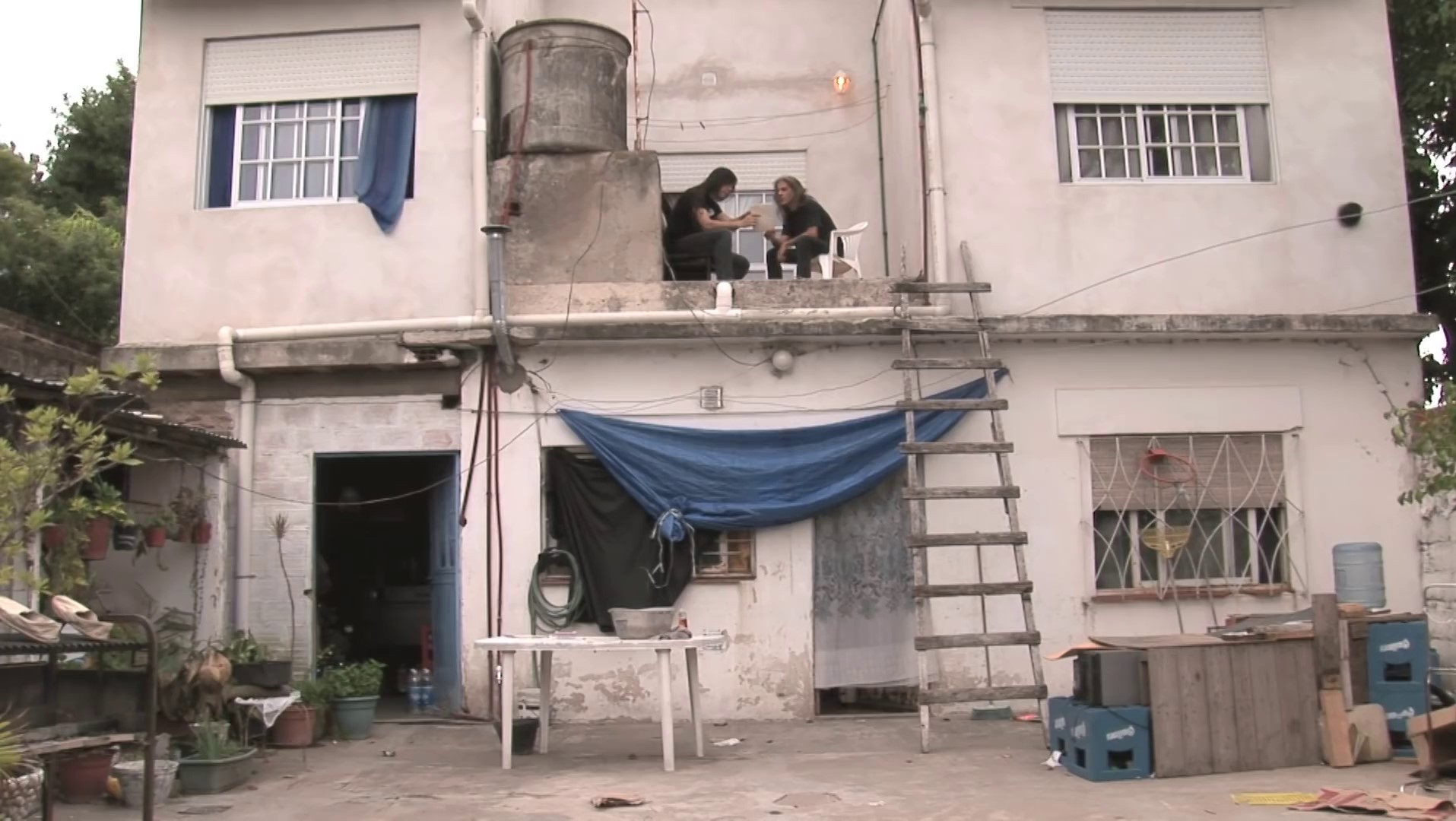
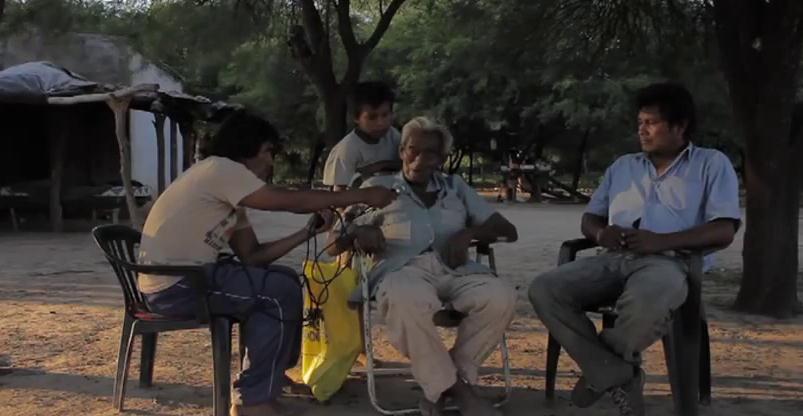
Lingiardi in his first two films makes a journey similar to that of Pedro Costa between Ossos and In Vanda’s Room: first he makes a fiction in a place in which he doens’t belong and, perhaps feeling like an impostor, or knowing that there’s a part of the community that was left out, he comes back and makes a film closer to reality. His way of filming doesn’t change that much between Las pistas and Sip’ohi (one assumed as a fiction and the other as a documentary) and that is a complete statement, or at least the demonstration that he built on the learnings of others. Both take place in a Wichí community in Chaco that tries to keep alive its stories and songs. In the first film the enemy is some sort of organization that tries to erase the Wichí but it’s not clear exactly how, and in the second film they are trying to fight against simple forgetfulness, with a radio of their own that broadcasts their stories.
Communities are filmed with people in movement: Lingiardi pays special attention to the characters as they walk from one place to another. It’s rare to see walking filmed as in a college exercise, from one side to another, with a vanishing point at one side of the frame, in a three-quarter perspective. In Las pistas the final scenes are of a path closed off by vegetation while we see a group try and follow signs written in Wichí, trying to decipher them. The influence of Invasión pushes it away from the classic space of the ethnographic film: an austere and somewhat hermetic film about the hidden corners of language, with conspiracies and secret groups fighting over a city. There is no didacticism in that fiction: you can’t see any sort of daily life. Lingiardi doesn’t ask himself what he can make of them, he asks what he can make with them.
Sip’ohi, his next film, touches more or less tangentially on some Kirchnerist concerns. Its premiere was almost simultaneous with an exhibition held at the Museo del Libro y de la Lengua on the cultures of the indigenous peoples of Chaco, conceived around the same myths as the film. And they also share an obsession with the media and its power as a medium of myths and legends, as a type of foundational stone of the common imagination. A little bit like The Fog, by John Carpenter, we organize ourselves around one voice: think about how traumatic it would be if that voice didn’t speak our language. We listen to the intricate explanations regarding the origin of fire and the adventures of Takjuaj in their original language, fragments of the radio show of the protagonist, Gustavo Salvatierra. Part of the strange shock that takes over before the tale is due to the lack of images in order to stage certain stories. Or the scarce lighting of two hands starting a small fire, or sometimes total darkness: a type of negation of Lingiardi’s own place as a director, which is already in doubt when Salvatierra appears and questions the character of the film. “I made it up to here,” Lingiardi seems to say. Anything he could add is less important than the words that are being heard now. He erases himself as an author in a context where documentaries are told more and more in the first person.
After Sip’ohi, which won the feature competition at FIDMarseille, one of the most important festivals of documentaries in the world, one might have expected that Lingiardi’s career to gain in funds, co-productions, the importance of the themes that interest him. And the opposite happened: he returned to his town, General Pico, and filmed two more movies outside all systems and obligations.
In Imagen mala, his latest film, he joins with Alejandro Rubio, a poet who belonged to 18 Whiskys, that poetry magazine that remade the Argentine scene. Thus, he reconsiders the question that was proposed in Sip’ohi regarding the power that words can have over the course of things. In fact, one starts the way the other ends: with a black screen and a voice which recites us something. In this case it’s a poem by Rubio that tells stories about Evita’s corpse and the subsequent Peronist movements. His voice, although in Spanish, is presented to us with the same strangeness in which the Wichí myths were presented. It’s language understood not as communicating act, but rather simply as an artistic event.
Lingiardi intersperses the poems (written, read, written and read) with a record of public life in the capital over the last few years. Fragments of newscasts, furious channel zapping, factories working at half speed, but more than anything the massive marches that were organized as protests against some of the measures of the government of Mauricio Macri. That is another form of poetry: the patient observation of the flags, the drums, and the faces. So many things happen in a such a large demonstration that the gaze is always insufficient, something is always missed. And poetry is the opposite of omniscience. It also has the nerve to put an important part of the last speech of Cristina Fernández de Kirchner in which she gives a lesson on civic responsibility. An attitude like that, which can be thought as a retreat from the critical spirit, is actually the establishment of a shared sensibility as a starting point.
Imagen mala is the closest that Argentine cinema got to the militant films of the 70’s but in a reflexive minor key. It arrives to politics through poetry. (The other direct link to the militant past can be found in an obscure movie by a friend of his, La destrucción del orden vigente, by Alejo Franzetti, who engages in a little bit of cinema terrorism with home videos of trains that predict disasters and are sent to political leaders). Its form is unfinished: I believe that since he hasn’t found a place for a proper premiere, he keeps editing, adding more marches that he films with his Canon camera. Inbetween the first and second time that I saw it he had added marches corresponding to the Ni una menos (not one woman less) and incorporated the words of the women who questioned the future of the movement. He’s running after a reality that’s always unreachable, and that effort is exciting.
Let’s go with Diego Kaplan. After many music videos (“Flaca,” by Andrés Calamaro, among them) in 1997 shoots his first much misunderstood film, ¿Sabés nadar? Of all those who saw it, very few remember it, and most confuse it with Nadar solo, the film by Ezequiel Acuña which was also shot in Mar de Plata. I was able to see it thanks to Fernando Martin Peña’s series on New Argentine Cinema Side B’s at the Latin American Art Museum of Buenos Aires (MALBA). The theater was empty. How different would history be if instead of seeing El bonaerense we had seen Kaplan’s film.
The film begins with a coked-out rhythm: the handheld camera is nervous and paranoid going down Libertador Avenue following a character who mumbles something about a girlfriend who left him. He gets into a taxi, hurried, disoriented. Graciela Borges shows up, as if to increase the debauchery, his mother in the story and also in the real life of the protagonist, played by Juan Cruz Bordeu. For a reason that I can’t remember (and can’t verify) he goes to Mar del Plata in winter. After the frenzy, comes the slump. The film alternates between those two moods with a particular melancholy, not without some costumbrista tics. It has the best acting of Leticia Brédice that I can remember, and in a gratuitous moment they dance to “No dejes que llueva,” by Daniel Melero.
Afterwards he filmed in the industry, which doesn’t allow those types of imbalances or whims. He tries something in Dos más dos, which is quite transgressive within the timidness of the mainstream. But with Desearás al hombre de tu hermana (Desire) he tears everything up, crosses the boundaries. It starts strange: in the first scene both protagonists watch a western on TV. A man mounts a horse and the two girls want to imitate him. One of them begins to get excited on top of a pillow, stimulating herself until she has an orgasm. The film is built from this problem: one sister, Ofelia, has an insatiable sexual appetite, and she enjoys it, while Lucía appears to enjoy it less, which causes a tremendous jealousy. Along with their husbands, they have to spend a few days together in their mother’s house, and from there, everything conceivable trouble occurs.
There a few shots that are totally crude and start to raise doubts, they sound the alarm, at least for the more prudish viewers. Pampita drinks milk from an overflowing glass, in close-up and in slow motion. We see her mouth, and the milk spills out, little by little, down to her chin. The same thing happens to her sister’s husband, who in order to impress her makes a similar face but with a grapefruit. Kaplan pays them special attention. The easiest argument to make that these proceedings actually matter is one of uniqueness: nobody films these things unironically. These moments are a sort of turning point between those who make a face at this shift away from naturalism and those who get excited to see something that looks like nothing else.
The film casts aside the duo of desire/guilt, so dear to the Christians. Sex is a pleasurable surface. Nor does the film worry about the hallway secrets or their audiovisual expression, the subtlety. This is also a chamber film and a confinement film, but imploded, without any kind of intimacy or silence. Everything is said out loud and everything is shown. Sex is also a surface which allows for betrayal. Inevitably, this debauchery also has a political side: at one moment, the character of Andrea Frigerio presents the contraceptive pill to her daughters as “The Pill of Love.” Banned in Argentina during that time, she found a way to import them. Almost looking at the camera, she says “the government doesn’t want us to enjoy ourselves,” almost the same words that Pino Solanas said in the Senate floor during the debate on the legalization of abortion.
The film, like many of that time, boasts a careful recreation of the 70’s, with its songs and idioms, which helps to fill it out: it foregrounds something that’s accessory, and everything seems to fade away into the constellation of the retro. But later Diego Kaplan has Mónica Antonópulos sing “Rubi,” by Babasónicos, at the climax of the film, when she learns that her new husband has cheated on her with Pampita. There’s a sort of revelation, something broken which allows us to see the gears in the representation: the song is clearly misplaced in time, but its sensibility belongs to the film. And in using it this way all of the imaginary of Babasónicos from Infame until, let’s say, A propósito, is revealed. Dárgelos makes sexuality malicious and tender at the same time, playing with the difference in ages.
When the betrayal is revealed, the film threatens to settle everything by having the husbands fight it out, a battle of egos between the men, but the song gives everything that follows a sardonic touch: whoever can’t play the game, whoever is not sly or a cheat, they can leave. The deceit is in the open and everyone is happy with their masks, singing a song from another time: “by your side time goes backwards, any day is the best moment…”
From a superficial look, we can think of the use of the bodies of Pampita and Antonópulos as a marketing strategy. That sustained gaze is, without a doubt, a lustful one: from admiration to objectification is one short step. Kaplan doesn’t close off that path because he enjoys seeing them, and at the same time he opens another. There is equal attention given to the abs and asses of the husbands of the girls, with the best of Brazil and Argentina, respectively. They’re all sexual objects and they look at each other as such. The film rebels against the standard sets and plots of stale pornography just as much as The Daughters of Fire, which was also on a crusade looking for new images around sex. Kaplan’s film takes our idea of porn to a paroxysm, it stylizes it and banalizes it. This film observes with detail each fold of the character’s pantyhose, showing that its sensibility is not subordinated to a dramaturgy or drama, but simply to the texture of a fabric. Without this, of course, becoming a sign of delicacy: in Desire the sheets are there to be stained, to be bitten, filled with fluids.
What Kaplan and Lingiardi do, perhaps without meaning to, is create a space of resistance inside the circle they belong to. One of them through attention and respect to the word, and the other through the survival of historicized kitsch and sex. They go against what might be expected of their careers and ignore commodification, a trick that once mastered allows them to live in relative comfort. Kaplan’s film is the first one in who knows how many years that’s been rated 18+. In that case, the implications of radicalizing are literal: a great part of the population (those who most go to the cinema, as specialists say) can’t even go in to see the film. They both make use of very old traditions that seemed impossible to update before them. And that’s why the films are not totally free: we note in them a weight specific to past histories, representations. Rebellion implies the recognition of an external power, of a demand, tacit, but a demand in the end. Because in every act of love there is a loss in the margin of action. It’s impossible to achieve those moments of intensity without at least handing over something.

Money
– I wanted to talk about my salary.
– And I about Franz Schubert.
Dialogue between Margarita Fernandez and Maria Villar
In some years more than 300 Argentine films have managed to premiere in theaters. That number, inevitably, devaluates the mythical figure of the filmmaker. Fortunately. And if to this we add the various technological changes of the era where a film shoot could be done with two or three people behind the camera, we could think that anyone has the possibility of making a film if they have enough irreverence, a few friends, and some free time. This democratization implies us that the shoot is no longer a dramatic or exclusive experience. Weekend filmmakers surge, documentarists who shoot all the time, students who have an enormous production output and make three or four shorts a year. All of them belong to the cinema of the present.
But nothing is free. In order to film something, it’s necessary that it has a physical existence. Shoots imply money to put people in a scene of a specific time period. Depending on the distance of those implied with what’s being narrated, films can cost more or less money. Sometimes you shoot with whatever’s at hand, but you always have to give, at the very least, a sandwich for the crew to eat. This distance between everyday life and a film shoot has continued to shrink until it became almost invisible. Today, in order to understand the scope of a film, it’s necessary to imagine the reverse shot of the fiction: it’s in this relation that many of the problems that you can see onscreen come to light. A relation whose nexus is the camera, a technological device that has a price. A Canon T3i isn’t the same as an ARRI Alexa.
The production models during this time have radically changed. The ones who thought about this until the bitter end where the filmmakers of El Pampero. They wrote manifestos and filmed each one of their shots with equal rigor. They tried to find the production scale specific to each film and they refused to make poor fiction in the absence of money, which is also a way to position themselves as filmmakers of the third world. This is most visible in The Gold Bug, directed by Alejo Moguillansky, which emerged from an initiative of the Danish CPH:DOX festival, which consists of joining two directors, one European and another not European. Faced with this, a group of filmmakers – the Pampero crew playing themselves – have to put up with a bunch of gringos telling them what to do, so they trick them by telling them that they’re going to shoot a film with all the third world topics while they prepare a treasure hunt, which has more of a screwball energy than any intrigue. It seems like the height of their universe and perhaps because of this they take the opportunity to say everything that they had been put away: with each action of the characters there is a reflection that takes away the irreverence, spilling over into irony.
But first things first. The first film of Moguillansky that I was able to see (he filmed La prisionera before, completely unavailable) was Castro from 2009. More conventional in terms of its production , it was shot and edited in record time. It’s difficult to talk about a story, which could be summarized by saying that Edgardo Castro, actor and character, runs away from a group of people who pursue him – impossible to know why – and who doesn’t want to work, but whose girlfriend wants him to, and so he goes out to the street to try and find some.
There is a specter in the form of a mandate that haunts the characters, repeated like a mantra: earning a living is a way of wasting it. Any banal way of thinking about the everyday is refused and how to arrive at a transcendental way of living is thought of. That, of course, has its risks: to fall into a pose. All the characters have childish traits, like children in the bodies of adults, capricious and malleable, running everywhere, and crossing in the middle of the street. The prodigious camera of Gustavo Biazzi follows them in a series of lightning-fast, impossible and uncomfortable pans right in the midst of the city’s buzz. The denial of that life which implies going from work to home and from home to work could only come from a post-Peronist age group, from children of professionals who know the exhaustion that work brings on the body and the mind. The axiom that work dignifies may have a social and general meaning but, taking another look, the effect changes and looking backwards one can only see the time that they could’ve used in more gratifying activities. In Castro, work is filmed like something abstract and ridiculous which consists of people in cheap suits taking packages from one place to another for a reason we’ll never know.
That sort of denial of the serious and scrupulous life begins to be transmitted to the filming of Moguillansky’s next movies. It’s as if he had needed to stage it first in order to start living like that. The Little Match Girl (2017) and The Parrot and the Swan (2013) are made to the rhythm of those thoughts, while still taking into account various dissimilar current events. To incorporate the logic of money into movies means making them a bit like a diary. You don’t always have money to go out and film, so the rhythm of the shoot adapts to life’s changes.
These diaries aren’t built around the first person but rather they’re collages, colored by the news, fragments from other movies, with arbitrary ideas that stick like obsessions. They register the physical changes of the people who make them but also the changes in the city. In The Parrot and the Swan the pregnancy of one of the actresses, Luciana Acuña, also Moguillansky’s partner, turns the plot upside down. That same little girl will grow up and now is the daughter of Walter Jakob and Maria Villar in The Little Match Girl, which takes place in the middle of a transportation strike and long walks in the town while in the middle of an electoral campaign. The plots of these films are less studied than Castro’s: they consist simply of people working in the art world, going through various types of economic, love and intellectual hardships. Their work allows them to have an aesthetic appreciation of their own experiences, they take pleasure in what they do but they also suffer the anxiety and uncertainty of the freelancer (independent worker).
The structure of both films is completely visible as well as the messiness of some of the scenes, inherent to his shooting method. This type of film diary inevitably refers to the domestic as well as the artisanal. But Moguillansky doesn’t ask for forgiveness for the imperfections, but rather wears them on his sleeve. Even when they unbalance the films, when the materials come to the forefront and erase the figure of the author. Everything emerges from a documentary commission. Parrot and the Swan from filming the rehearsals of Grupo Krapp, Little Match Girl from filming the staging of an opera by Helmut Lachenmann in the Colón Theater. Afterwards, like a sort of laboral rebellion, these images are used for personal use. To paraphrase a popular saying that vegans won’t find funny, they know that anything they film will end up in a fiction. This messy register can be thought of as an invitation to inhabit each space of the city with the energy of a musical, to not confuse the documentary texture with a meek acceptance of reality as something grey and undistinguished.
Another filmmaker who thought of money and its relation with cinema was Hernán Rosselli. The plot of his first film is simple and especially concrete: Mauro is someone who buys things with counterfeit bills and, believing himself an entrepreneur, tries to climb up the ladder. Mauro narrates that thorny rise with its retreats, doubts and small triumphs. Both have their weapons, their trade, and we can make a parallel between Rosselli and his protagonist. They also share a social class. Or so it seems, because of the anecdotes that we’ve heard of its shoot.
But the prolonged duration of his shoots and editing functions in exactly the opposite way as the shoots of Moguillansky. Instead of functioning like a magnet, Mauro and Casa de teatro (his latest film, from 2018) with time do away with everything that’s unnecessary. They are purified because there’s time to think in all the production stages. In general, during a shoot most people are hurrying.
His films were made over the course of several years, filming and editing at the same time: that idea of rewriting the script means being able to hear what the film asks for, understand what you have done and act accordingly. Time accommodates things and filming the old-fashioned way is to go forward blindfolded. In interviews and his own writings, Rosselli speaks of a tradition which begins with Charles Chaplin, who had so much money and power he could film the same movie the number of times necessary until it came out well. The times of digital cinema, contrary to what is generally believed, doesn’t give the possibility to have time to think: everything is filmed just in case, in different ways and different variables. Rosselli films a lot and sustains this over a long period of time but not to cover himself against possible issues in the editing, but rather seeking images that are more charged than complete, always related to the daily work, like a blacksmith or a counterfeiter, shots that call out to those who see them, that dare to rethink their distance, the information.
In relation to money, there was a lot of talk that Mauro discovered a social class that was rarely filmed in Argentine cinema. Perhaps that is true, but that is nowhere near its greatest merit, because Rosselli was already there, filming what was at hand just like the petit bourgeois of FUC (Universidad del cine). The gesture is the same. In any case, the abstraction is rigorous and specific: lower middle class of the conurbano, between trains and plazas, hit by the crisis of 2001 but a few years later, already in full economic revival, at a moment when economic growth coincides with inequality. The counterfeiting exists as a narrative motif but it’s also tangible in a whole series of elements that appear in documentary fashion, such as the knock off sport kits, the love hotels decorated with ridiculous luxury, and the reggaeton heard from low-fidelity speakers.
Family Novel
Every act is literary and that stinks. Everything begging for sincerity.
Martín Gambarotta, Punctum
There is an extended hermeneutic in Argentine cinema, centered around the writings of Nicolás Prividera, which organizes the present and the history of Argentine cinema as a great family novel. The implication of the analogy reminds us of psychoanalytic subtext, tragic and also, it must be said, somewhat aristocratic. Not only are there fathers and sons, but also uncles, grandfathers… It’s useful in order to spread out in time but it puts a barrier (that of belonging) between those who are reading and those who are part of the novel: the lineage only extends within that reduced scope. Who is the one who bestows those titles of nobility?
Everything seems to “make sense” when there is a recurring theme or actor. Like Graciela Borges showing up in the films of both New Argentine Cinemas, or the films of young people and confinement. These coincidences are water in the desert of the real for those who cling onto them, those who in elementary school made perfect synoptic tables so that the teacher would praise them. “It’s not a coincidence that…” is a phrase that gets repeated. Everything is teleological, everything goes toward a point: to prove one’s own thesis.
What this view gets correct, and it’s inescapable, is the hole in the family tree left by the systematic plan of extermination of the National Reorganization Process. It’s both a literal and metaphorical fact: an entire generation of the family tree was cut down. One of the filmmakers who takes on these stories and thinks about what can be done with what happened to them is Albertina Carri. She has a heritage but she makes up others, she puts on and off the blonde wig with which people identify her family. Her films follow a winding path that goes from the most radical negation of past testimonies found in Los rubios to the meditative, but also performative, balance in Cuatreros. She’s not satisfied with the possible intertextual relationships, and surrenders herself with her body. This first person doesn’t imply a literature of the self nor a detailed, domestic auto-narration, but rather it always unfolds in rather baroque methods.
In her latest film, Las hijas del fuego, she dares to imagine a world inhabited by women who enjoy their sexuality openly in a sort of self-sufficient community. In this fiction the weight of the past is only an example of past experiences, such as hippie and free love communities. In fact, there’s almost no relation with an real referent (or at the very least extensible to a popular experience) besides the macho attitudes and comments of the few men who appear. This Dionysian utopia which ends in an orgy while tripping on mushrooms and in a house without any geographic or class references is the counterpart, I would say, of the Apollonian part of the tradition.
But returning to criticism: this traditional manner (speaking of tradition, not of a method) of interpreting films leaves chance and accidents by the side. It conceives of art as a series of nobility movements and it leaves to criticism the task of finding heirs. Making movies ends up being simply choosing among options. To be “popular” or to be “postmodern.” As if these intertextual transactions were more important than thinking of the images, the characters, etc. What’s attractive of cinema is its level of unpredictability: in the moment in which reality meets language, in that decisive moment of the shoot, the director finds his morality there, and not before.
More than a family, let’s make a map. How can we be sure that we know everything? There’s a space, a serious of connections waiting to be discovered, some directors, some filmographies always willing to start a dialogue. Let’s bet on mapping them, without giving into the anxiety about what escape us. There’s always something to discover because what generous movies have to offer is their own resistance to the attempts at categorizing them. Our ability to shine a light on them is always precarious, like the little match girl of Moguillansky. We have little time to thread the ideas, and a short breath. Films will always have something that is unattainable. But this way, little by little, we can begin to draw out maps, more or less fanciful, more or less broken, imperfect. Stumbling we can delineate arbitrary provinces, like the ones in this text, or thinking of David Viñas, thematical spots with moving boundaries.

Imagination
To imagine is to interpret badly.
Harold Bloom
I frequently return to A Mysterious World as if it was the I-Ching. Rodrigo Moreno’s film, although it has a story that follows its enigmatic protagonist, Boris Chernenko, it can also be seen as a succession of scenes impervious to the traditional narrative, with a way of being between a short story and a poem. Between the closed literary piece and the freer impressionism. Each of those scenes has a tone and a strategy. In that sense, seeing them isolated can provide a clue on how to live (or how not to live). If we think that the film is never close to any costumbrismo nor does it have any sort of mimetic character, then it’s like finding an illegible instruction manual, ruined, useless. Sometimes I open the VLC Player to a random moment and I find an illuminating detail.
From its opening scene, the film is constructed out of misunderstandings. A couple sleeps together in bed, they’re barely covered by the heat of an electric stove. Boris gets up, brings coffee, and lays down again to read the newspaper. Ana asks him what he’s reading. Instead of answering “the newspaper,” or summarizing the article in question, he begins to read out loud what he was previously reading silently. The first misunderstanding. Next Ana asks for some time from the relationship. “What is ‘some time’? Two days, one week, two months…?” he asks. Another interpretation problem. Or better yet, of literality. It’s as if words could no longer form set phrases or imply social understandings that would allow a more or less decent communication. In A Mysterious World nothing has a prior interpretation. The film is taken up by that time of hesitation when Boris is recently separated. It’s as if this state of peculiarity in the emotional plane transferred to language and time. We never find out how much time has lapsed: no bearings are given to guide us. What we see can’t be divided into blocks (days, weeks, months) but rather it takes part of an indiscernible state.
Boris stays at the Ayamitre Hotel which, as you can imagine, sits at the crossing of the streets Ayacucho and Mitre. Between the literal and the abstract there are absurd gags that arise from linguistic turns: Boris runs into Levisman, a classmate from high school, at a bookstore and he asks him if he still lives with his parents, to which he responds: “Now they live with me”; then Levisman invites him and the bookseller to a party telling them that “the house is big but the heart is small”; once at the party everyone there plays a game where they name public figures whose last names are the same as the first name of the following person thus making up a weird series such as “Thierry Henry James Dean Martin Sheen(a) Easton Ellis Regina Spektor.”
Boris’ experience as a single man is banal and mysterious at the same time. It relies on small acts that are a bit absurd and don’t correspond to any internal motivation, but that at the same time depict a complete character. He does sit-ups while he smokes, he buys a Russian car and drives it around until he runs out of gas, he eats a loaf of milk bread with ketchup. It’s a completely particular and un-transferable experience.
We can relate this, on a somewhat superficial level, to the roaming about characteristic of the first New Argentine Cinema. Gonzalo Aguilar, in his canonical Otros Mundos, says that the characters of those movies are in a “contemporary state of permanent movements, passages, situations of unbelonging and the dissolution of any instance of permanence.” He later adds that “they can never interpret their own situations.” What in Pizza, birra, faso had a component of denunciation – the out of work underclass that can’t think about why they ended up in these situation or how to get out of it –, in A Mysterious World discovers another tone. It’s qualitatively different. The signs of the neoliberal city aren’t there, waiting for interpretation, but rather the cinematographic form turns them away and they are shot outside of any interpretative ideological system determined beforehand. It can be thought that this implies a lack of a social or historical mooring, which is somewhat right, but Moreno takes those details into account while filming: he turns them around, makes them into a gag. To give an example: when the characters find the board game Trouble (Ludo Matic published by Habano) they don’t think about playing it but rather imitating the picture on the cover. It takes the language to its maximum point of indeterminacy, in which nothing more can be narrated, in which it dissolves into misunderstandings. But that misunderstanding is one that leads to another and then another. If an ideology is a manner to make sense of things, this film invents its own: the system of identifications in A Mysterious World is none other than that of the imagination given to cinema.
The last film on this journey is also fueled by these bad interpretations: El futuro perfecto by Nele Wohlatz. Its protagonist is a Chinese immigrant barely of legal age whose parents have lived in Argentina for a few years, but she has just come without knowing the language or the customs. Her family appears to be very conservative, they don’t let her interact with Argentinians and they force her to contribute all her salary to the household expenses. But she, quite silently, begins to go out with an Indian immigrant who is a few years older while she saves some money.
The film is organized around the spoken word, said out loud, stumbling and with great difficulty. It opens with an interview which reminds of those of Eduardo Coutinho, due to the great care it has with Xiao Pin, in which she tells us her thoughts when she arrived to Argentina in a terrible Spanish; and then her learning is marked by scenes similar to those of Frederick Wiseman for their way of filming institutions like the language school where that group of Chinese students is learning. Nele Wohlatz uses these forms associated with the documentary in a deceptive manner in order to render language vague and to narrate in a confused and suspended sense. In El futuro perfecto the scenes and the characters are shot in a process of experimentation and discovery. The plot and the incidents were written from sketches that the main actress herself suggested about her own desires. The film is not seeking a documentary truth in the sense of showing some unpredictable and unrepeatable event in front of the camera, but rather its attention is put to the patient assembly of the scene, with its clumsiness and insecurities.
In the classes, the Chinese immigrants read text books that describe activities and everyday jobs and one can only laugh if they compare it to the real experience of living in Buenos Aires. There’s nothing vital in that teaching that later takes on a theatrical touch when the students have to get up and act. Between the students they have to ask each other ridiculous questions like:
‘Hello?’
‘Hi, Beatriz, I’m Emily. Do you want to go the museum with me?’
‘I can’t. I have to study.’
‘Ah. Do you want to go to the park with me on Saturday?’
‘Yes, sure.’
‘Great. See you Saturday!’
And like that they walk around the classroom, repeating phrases learned from their books about a world that never existed. All the time the events in Xiao Pin’s life are rendered ungraspable due to her lack of language resources. At the beginning of the film she sits at a bar with her salary in her pocket, very hungry, but since she doesn’t understand any of the options on the menu she leaves, embarrassed. She looks for “barbeque”, which is the only word she knows, and she doesn’t find it. She ends up eating a hot dog on the street which one supposes doesn’t have a lot of options to choose from. Language determines the scope of her possibilities. Those first rudimentary sentences that are spoken in the classes find their cinematic form in simple images: people walking, people talking, and not much else. In that sense, Nele Wohlatz doesn’t want to find a surplus of virtuosity where it isn’t there.
One of the important things that can be seen in El futuro perfecto is the insertion of Xiao Pin and the other immigrants in the Buenos Aires culture, which doesn’t seem have strong thematic or geographical marks. The places they go seem undifferentiated. The Chinese supermarkets are similar to each other and they can barely take a walk around a park or by the waterfront to eat a choripán. This confusion is logical if you think that our protagonist doesn’t have the historical or intellectual baggage to realize the importance of the Obelisk or the Cabildo. It doesn’t matter that much either, because that incredulous gaze ends up being more interesting than the over-semanticized experience of those directors who pretend to find the symbolic as if they were alienated. That gaze is not yet contaminated. That can also be said of Wohlatz. For her and for all the other directors who were mentioned in these pages, to film Argentina doesn’t mean a misfortune but rather the joy of being between tradition and irresponsibility. Although always under the contradictory freedom that precariousness implies.
When do words lead us into taking action? When something is said that doesn’t exist yet. When we deviate from the syntax and it is used outside of its descriptive function. There are many figures of speech that are exclusive to language and do not transfer to cinema. If we can only shoot physical or digital phenomena in linear time, how do we shoot conditional time? You have to break down and put the narrative together again, and find a less travelled path.
Xiao Pin is at a crossroads. On one side, she loves Vijay, her Indian boyfriend, but she’s afraid of the reprisals from her family. She doesn’t know what to do. In the language school she learns a new verb tense: the conditional. She can begin to plan, to think if one thing happens then another event could be linked as a direct consequence. The future and the past are perceptions but also grammatical forms. What would happen if she goes to live with Vijay? We begin to see these situations, narrated in voiceover by Xiao Pin, one after the other. There’s a strange element that turns the narration somewhat fantastic, it even attains a somewhat melodramatic shade, like a police thriller: her imagination also has other baggage in which cinema is included. In this strangeness the shots are populated by elements such as cats and wine, and they repeat themselves like warped motifs in the different stories. We see what would happen if Xiao Pin were a housewife, or if she ran a supermarket, or if her dad found out she was going out with Vijay. Almost all the stories end badly except the last one, in which we see her honeymoon shot with a cell phone, like a home movie. The form of her imagination is no longer abstract, it is embodied in the home movie of Xiao Pin and Vijay’s honeymoon in India. Wohlatz films something that doesn’t exist neither temporally nor spatially as if it were a documentary mode something which doesn’t exist temporally or spatially. It is but a longing, a hope.
After all that, Xiao Pin realizes that beyond the ending of her stories there was a common element: a cat always milling around here and there. In the happy ending and in the sad ending. The film ends with her “hunting” for a cat to turn into her pet. The imagination is useful to make short-term or long-term plans and to win small battles against the everyday, finding a temporary escape but, more than anything, it gives shape to our aspirations and to provide perspective: everything can always be different.
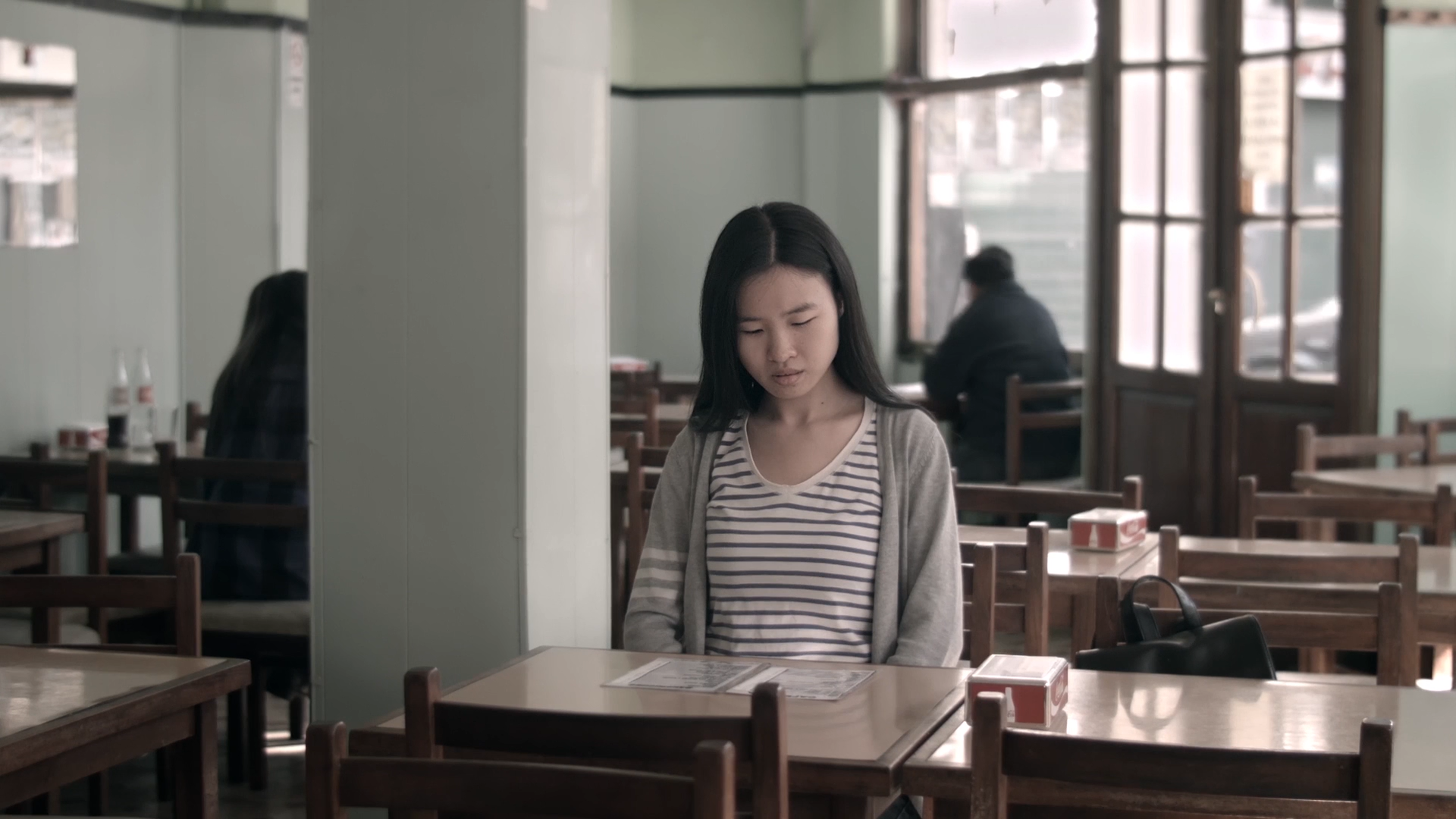
“12 años de cine argentino” was originally published in La vida útil Nº1 in 2019. Original text by Lautaro García Candela.
Translation by Jhon Hernandez and Jaime Gribalba. Thanks to the La vida útil editorial team for permission to publish this translation.

 Lucky Star
1 comment