Money Trees: Lautaro García Candela’s Cambio Cambio
How to film an economic crisis? How to show this in dramatic terms? Make it understood to an audience who doesn’t know its particulars? Or, perhaps more importantly, how to renew this experience for those who have lived it, or are still going through it? This is at the heart of Lautaro García Candela’s second film, Cambio Cambio (official English translation is Money Exchange) which premiered last year at the International Competition of Mar del Plata. The phrase “cambio cambio” is heard often on Calle Florida, where much of the film’s action takes place. It is used by the “arbolitos,” the group of people who occupy the street, illegally selling and buying dollars. They will repeat this phrase over and over again until a passerby will stop, ask the rate of the dollar, and decide to make an exchange. Due to the artificial controls on the dollar to shore up the dollar reserves and the massive devaluation of the peso, a parallel economy, a black market, has risen in order to meet the demand for dollars.
Buenos Aires on your feet
At first blush, if you know nothing about the economic situation facing Argentina, the situation in Cambio Cambio is a little inaccessible. There’s an opening montage which gives some key contextual information, but even so it goes by so fast that it’s hard to understand it let alone truly absorb it. It provides a context for the film’s action, but it does not truly explain it. You don’t need to know the details of Argentina’s disastrous relations with the IMF or the failures of Macri, or any of these things – I vaguely know some of them. What matters most of all is the feeling of this street, the Calle Florida. That’s where the main character works at the beginning of the film, passing out leaflets advertising a local restaurant. He’s on his feet the entire day, talking to people all day, doing small errands here and there. In his free time, he plays keyboards for a local punk band.

Almost of all the major dealings happen here. The main character goes from passing out the restaurant leaflets to becoming an arbolito, desperate to make extra cash. He wears a face mask pulled down to his chin, and the promise of the tourists coming back to exchange their dollars motivates him, the pandemic having driven them away.
In García Candela’s first feature, Te quiero tanto que no sé, the pleasure of filming Buenos Aires at night is palpable. The main character goes from neighborhood to neighborhood in his car, chasing a girl through her social media, hoping to bump into her. But there are many detours along the way. García Candela films various landmarks in Buenos Aires, the streets at night, with clear love and affection. The film has a fantasy side, its musical character, which marks it as a type of generational portrait. The songs from the previous generations are sung throughout but the passion that’s felt in the songs seems to be missing from the young characters. There is a strict documentary base when it comes to filming the city, and on top of this García Candela plays his own music.
But in Cambio Cambio, the feeling, the approach, is much different. The pleasure of walking through the city, joining up with a guided tour, is very far away from being on your feet all day, hustling for money. Instead of filming the entire city, García Candela focuses on a specific street and its inhabitants. And here he finds a strange ecosystem with its own rituals, its own characters. When Pablo joins the ranks of the arbolitos, he has to learn where to position himself in the street, how to advertise himself, how to speak to the customers, how to handle the phone, the calculator, the mechanics of this trade. The economic forces which control the value of the dollar remain abstract, out of frame; all that Pablo cares about it is making more money, gaining any sort of edge.
Economic Gaze
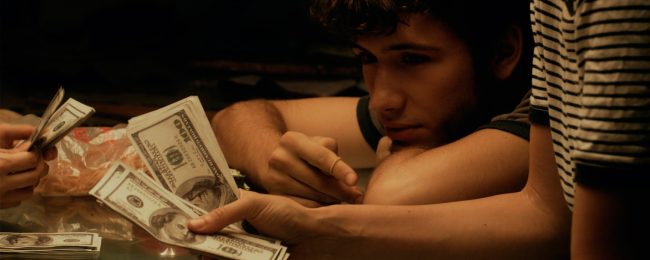
Pablo thinks constantly of money. Or, more to the point, he really has no choice. He meets a girl, Flor, and whenever they’re out, whenever they’re talking, he always opts for the cheaper option available. Flor does not. He tells her that he wants to save up to buy a nice new keyboard, and he’s embarrassed when during a middle of a gig his keyboard stops working. When Pablo becomes an arbolito, he says to his friend, Dani, that he wants to take taxis with Flor, do all the normal things. García Candela’s film works on this micro level.
There’s a key moment when Flor and Pablo are laying down on the grass and they begin to talk about a very tall building in front of them. Flor is able to appreciate the architecture and its aesthetic qualities; Pablo sort of sees this, but his mind focuses on the people inside the building, and all they have and all he does not. This is the logic the film assumes because this is the logic that Pablo sees his in own situation. He begins to run a little side hustle, selling the dollars at one rate and buying them at another one, pocketing the difference.
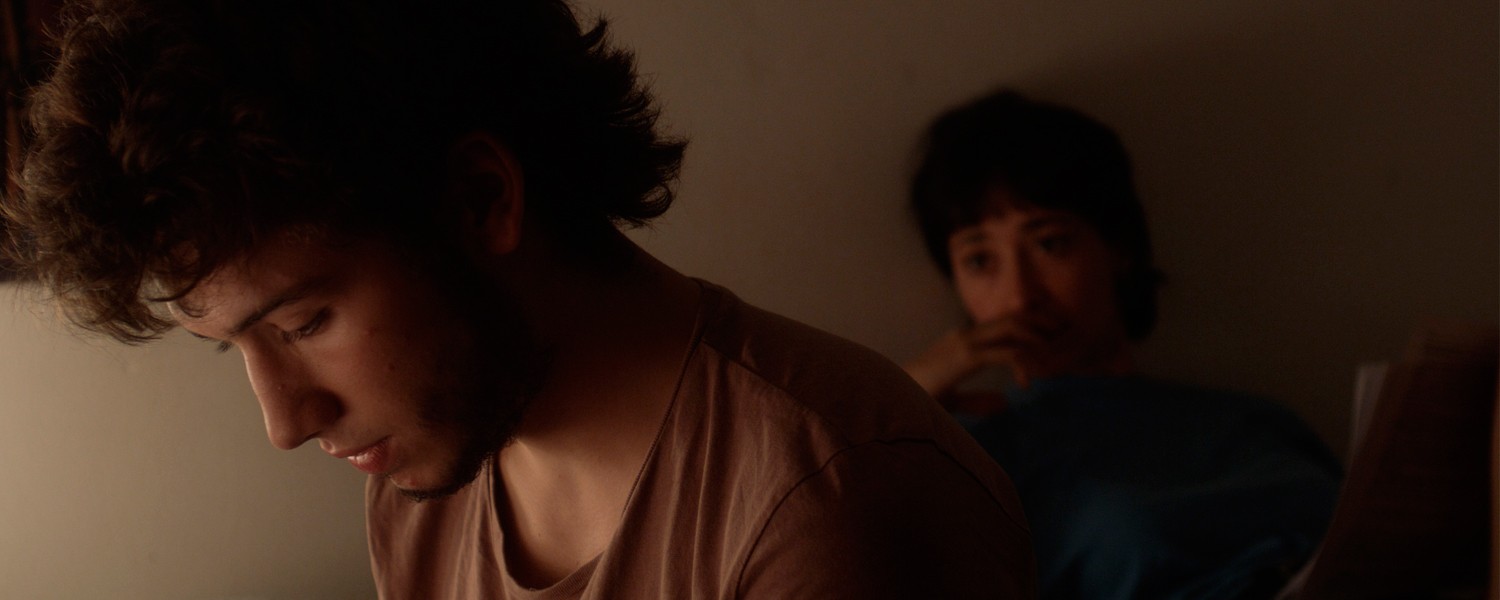
Cambio Cambio represents an attempt to marry the concerns of Te quiero tanto que no sé, with its focus on young people and their rituals, their relationship to the city, to a portrayal of economic anxiety and desperation, which verges on the thriller. Everything is transactional, every transaction teeming with a hidden violence. It’s there when he’s first introduced to the boss, who sits him down and gives him a very close shave at his shop. But this isn’t Mitre’s The Student – the gaze is much less steely. There’s genuine warmth in the relationship between Flor and Pablo, a tenderness, which is appreciated by García Candela’s camera. Perhaps it’s due to Ignacio Quesada’s baby face. He is learning to navigate this world, its violence, its frustrations. It is quietly crushing when he’s kicked out of his band because he can’t afford to pay his share of the recording fees.
If the logic of the film and the characters is essentially micro economic – we must understand the transactions of the characters, the value of the dollar vs. the peso, in order to understand their scheme – there are intimations of the macro view. The characters are affected by government dealings that they struggle to understand. The entire scheme occurs because Pablo overhears some big shots talking about what will happen with the Fed’s attempts to get a handle on the country’s dollar reserves (the value of the dollar will go up, but only to a point, and at that point, its value will go down). And, more importantly, Flor hinges her hopes of her future on a move to France, leaving Argentina behind, seemingly a country with no future.
Nobody dies in this film. But it’s safe to say some lives are temporarily ruined. From the moment that Pablo begins to run his scheme, sloppily and inelegant, there is an expiration date on his life. He gets a glimpse of the violence which is behind those dollars he is so eager to collect and quickly makes up his mind to go his own way. The final gesture of the film is an attempt for Lautaro García Candela to capture something about his city, to share it to the world. Perhaps the situation in Argentina is untenable, but there is still beauty in the streets of Buenos Aires. When Pablo films Buenos Aires, it’s a gesture of love. Please remember this city, remember these streets, remember me.

 Lucky Star