
How do you film a utopia? First, of course, you must try to define it in whatever terms you deem appropriate. Second, once you define it, then it is the matter of filming it. How to approach it? What distance to use? What lenses? How to determine the mise en scene? Because this idea of utopia is abstract, it must be given a shape, it must be given a state. Perhaps utopia can even be a place. This is perhaps an idiosyncratic way to approach a frothy TV series about a young career woman who adopts a 20-year-old as a pet, feeding him, giving him baths and taking care of him. But this is absolutely what Kimi wa Pet (You are My Pet) is about in emotional terms.
When I try to describe this series people begin to give me weird looks, like I’m describing some sort of weird fetish play. I understand this reaction. When you see Momo (played by Jun Matsumoto) get on his knees and put his hand out to Sumire (a transcendent Koyuki), like a dog giving you his paw, this is when you start to understand the high fantasy of what’s at play. The scenario itself demands a leap from the viewer – you have to be able to accept its premise, see beyond its kinkiness, or better yet, remain open to the idea that at the heart of it there’s a simple innocence, a yearning.
Kimi wa Pet is an adaptation of a josei manga by Yayoi Ogawa. Roughly, josei is a marketing term, as it refers to a subset of manga that was aimed at adult women, as opposed to shounen (aimed at young boys) and shoujo (aimed at young girls). The stories in josei manga are usually more mature. They are filled with, in theory, a realistic approach to romance (not necessarily!), depictions of sex and work, and, most crucial, they take on the emotional world of women as the primary dramatic engine of their plots.
In the Japanese entertainment industry, once there is a manga or book, there will be TV show and film adaptations. So, in 2003, even before the manga had finished its run, a TV series was released, featuring a pop singer (a member of ARASHI) and a promising young actress. It ran for 10 episodes. After a couple of months, it was off the air, replaced in the schedule by Hitonatsu Papa no E (Papa for One Summer). Perhaps a DVD and a soundtrack was released. The model treats the shows somewhat disposably. In 2011, a film version is made in Korea, but so many of the particulars of the scenario are abandoned, so much of its texture, that it becomes a very rote commercial project. In 2017, another version was made for Japanese television, longer and more faithful to the original manga, but the dynamic is all off, the characters are all wrong. My mind returns over and over again to this original version. Did they know that they had caught lightning in a bottle? Did they know they had filmed something sublime? Twenty years later, it now seems to me a summit…
The Modern Woman
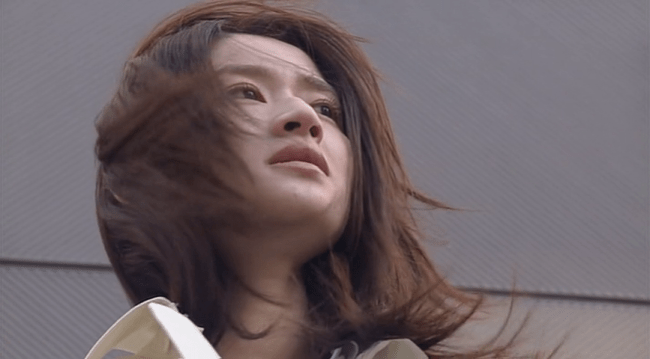
Sumire is an elite journalist at a newspaper, working in the foreign affairs department. She’s tall, good-looking, highly educated (a Tokyo University graduate who also went to Harvard), and makes good money. But when the show opens she’s having splitting headaches, her long-term boyfriend has cheated on her (he was too intimidated by her), and she punches out her boss after he grabs her butt, getting her demoted to the lifestyle department. Kimi wa Pet quickly sketches a world around Sumire full of external pressures – a woman must conform, must hide her intelligence, her prowess, in order to be palatable to the misogynistic patriarchal system.
But Kimi wa Pet is very far away from the “girlboss” discourses of our day. Sumire is, as one character puts it, a “bundle of complexes.” At work, she has zero patience for her co-workers, alienating them and making them cry. She refuses to apologize for her accomplishments and strives to put up a perfect mask. It is a world of appearances and performances. When Sumire steps out into the street, when she enters her office, she is always performing a persona, carefully put together to minimize weakness in the eyes of others – she can do it all. In her relationships, she puts up a wall, refusing to shed tears in front of her partner, refusing a certain softness. Sumire is contrasted with Fukushima, a co-worker who acknowledges her own performance, a girl who plays weak, shallow, hiding her intelligence, all in order to get a successful man. When Sumire begins to date Hasumi, a former school companion who has just come back from Brazil to join the paper, Fukushima sets his eyes on him, using all the tricks at her disposal to get what she wants. Sumire is annoyed by this, but would never let herself show it. Which way is correct?
When Sumire gets home from dates with Hasumi, she feels exhausted from trying to keep up the performance. Hasumi senses this as well – he pleads with her to try and be herself with him. But she can’t. She will always perform, she will always try to present a certain image to him. Her ex-boyfriend at one point remarks that he knows she’s actually weak and lonely. This inability to bridge this distance is fatal to her. Kimi wa Pet presents a world that we must escape from, the pressures of society, the pressures of our gender, the pressures of the opposite sex – where can we find peace?
Her Pet
I’ve begun by describing the social reality of the show because it seems important to understand the context of Sumire and her world before we introduce the element of fantasy. Let’s make no mistake. The concept of the pet in this show is a neat fantasy, a narrative device which allows our characters to spend time together, rejecting the structures of the world. But the concept of the pet isn’t frivolous. The opening shots of the show are a flashback to Sumire as a young girl petting her dog, Momo. We will later learn that the last time Sumire cried was when Momo died. What does a pet provide? A sense of comfort, unconditional love, companionship, a lack of judgment.
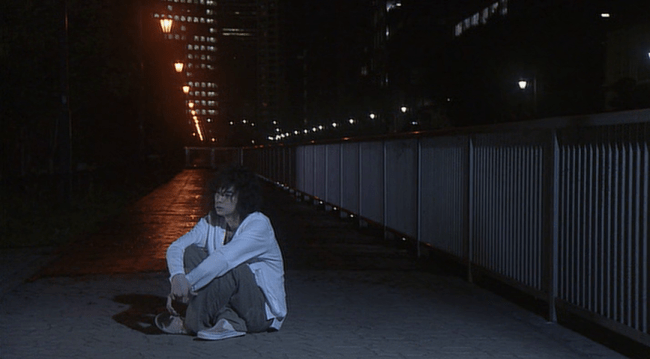
When Sumire finds a young man in a box, beaten and bloody, in front of her apartment, she has many chances to call the cops, to get help, to act rationally. And yet she takes him into her home. She nurses him back to health, she feeds him, dresses his wounds. When she wakes up, she gazes at his sleeping face and quietly smiles to herself. What’s behind this smile? The next morning she goes to work assuming he will leave. But he doesn’t. In fact, he asks her if he can stay there as he has nowhere to go. When Sumire says that he can stay as a pet it’s not very serious, it’s ludicrous. But he agrees. The show does not waste too much time trying to justify it rationally, or laboriously set up the various motivations – it’s truly a leap into the unknown.
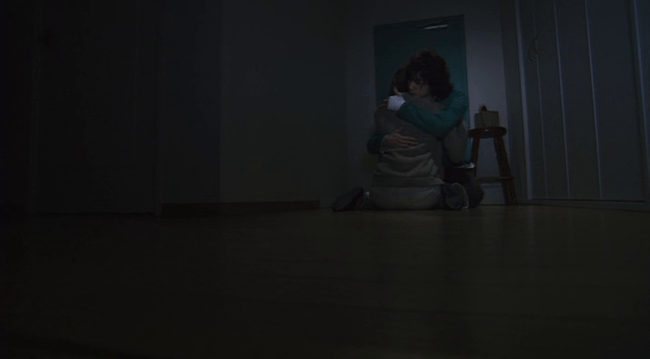
The reason why this young man, Takeshi Goda, a gifted dancer with his own life and ambitions, would so readily accept to become Momo is part of the mystery. On a basic level, yes, he needs a place to live so he’s willing to play along. But the willingness to submit, to enter a type of game, seems essential. She makes him food. She takes care of him. And when she gets home, he greets her with enthusiasm. “Are you really happy I’m home?” she asks. After a full day of getting beat up by everyone, isn’t it okay to just stroke the curly hair of the beautiful boy you’ve turned into your pet? By the end of the first episode, she breaks down in tears after speaking to her ex-boyfriend. Momo returns home and simply hugs her. All defenses collapse, there’s no distance. “It was at this moment, as I watched her beautiful tears, that I thought I would like to stay her pet a little longer,” he thinks to himself. Becoming a pet is connected to not just romantic desire, but rather a mysterious connection to another being. Becoming a pet is a narrative shortcut which establishes an immediate emotional intimacy, bypassing all sorts of annoying dramatic games, to cut to the heart of the matter. What do these two people mean to each other? What can this relationship become? Surely you can’t be a pet forever. Because, of course, this is not a traditional relationship, let alone a traditional role for a man.
Sumire quickly begins to feel the restorative powers of having Momo in her life. Although she often sees him as useless, she finds in him healing qualities – feeding him, bathing him, simply caressing his hair. And this to her is irreplaceable. Perhaps even more than the romantic feelings she feels towards Hasumi.
You can see the dramatic engine turning. Everything is heading toward an ending – the arrangement between Sumire and Momo will not last. It can’t last. Sumire says herself, “it’s wrong to stay like this forever.”
Paradis
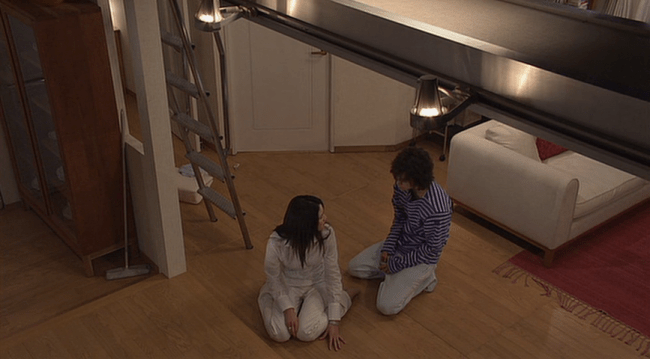
Let’s get back to this idea of utopia. This is what I will submit. Kimi wa Pet defines the idea of utopia as an almost Borzagean cocoon away from the world (like the restaurant where the lovers play in History is Made at Night, or the apartment in Street Angel) – the apartment, one of the great sets in television history, serves as a refuge from sexist bosses, would-be romantic partners (and their expectations), the demands of family, the strictures of gender. In this utopia, Sumire can shrug off the world, embrace her contradictions and live them fully; while Momo can find a place where he’s truly embraced, not for his dancing talent, but rather for his all too human qualities. Utopia can be a place, such as the apartment, but it’s also something more abstract – something which exists and is created between two people, their bodies, their minds. A relationship is its own private world, and must thus establish its own rules, its own mythology. The idea of the pet is thus an abstraction, a useful one, which the characters use to cry, to hug, to kiss…
But how to film a utopia? The series can often be hyperactive, in that early 2000’s j-drama way, with too much cutting, too many wacky angles (that is to say, it’s perfect). But when it counts, there’s such beautifully modulated drama that I can’t help but think it’s the work of a master (most likely the work of Fuminori Kaneko, who also showed a deft and spunky hand in 2016’s The Full Time Wife Escapist). There are two moments in particular that stand out. Each one creates its own utopia.
Half way through Episode 8, Sumire and Momo have a picnic in the park. He rests his head on her lap, she runs her fingers through his hair. There’s such incredible chemistry between the performers that everything flows smoothly. The camera looks down on him as he looks up at her, smiling. The camera looks up to her, framed against the sky, full of doubts and insecurities. And yet, in this moment, they are perfectly at ease, able to put aside the ending which they know is coming. Their words express this understanding. But then we cut to a distant dolly shot which slowly works its way down toward them. In the voiceover, Sumire expresses a desire that she could just stay like this; and before she finishes the sentence, Momo’s thoughts are also heard. I can’t think of a moment as beautiful as the one when the camera finally settles on them in the ground, Momo wishing that he could “lock this moment in my memory for the rest of my life.” There is a quick fade dissolve to Sumire as she looks down at Momo and then lifts her gaze, her eyes full of tears. Then another fade dissolve to Momo as opens his eyes to see her, just at the right moment that she’s no longer looking at him. And then the final dissolve to them together, the couple, united in their private desire. It brings tears to my eyes. I would throw away most movies for this moment. The filmmaking links both their perspectives, known to only to themselves, and unites it in our minds. Their shared desire, at this moment, is an utopia. It can exist in the world, whenever they are together.
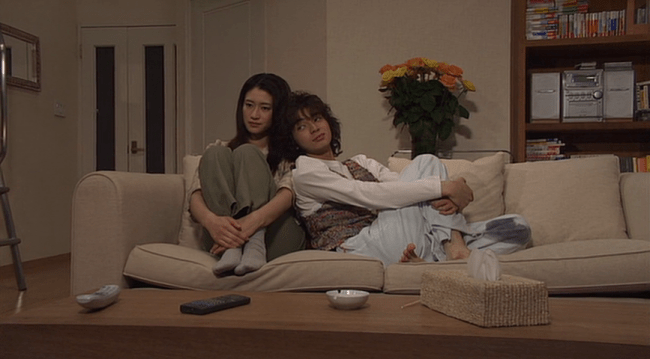
But, for the most part, their utopia is hidden away. Almost no one knows of the little world they’ve created. At the end of episode 9, Sumire and Momo sit on the couch and contemplate on how to spend the night (is it their last night?). They’re captured in a two-shot, simply talking. But two characters sitting on a couch can become an entire dramatic universe. When the first close-up of Sumire occurs, she is facing down, unable to deal with the reality of what will happen. Momo tries to keep a happy face, but even he can’t bear it. The acting here by Koyuki is nothing short of perfect – the way she finally looks at him, lifting her gaze, her eyes discovering him as if for the first time, searching his face, unsure, halting, mesmerized. Two characters looking at each other, the frame locked in tight on them, after a series of cuts which brought us closer, just for this moment; a series of formal decisions made to orchestrate this emotion… What emotion? The birth of something new, a new desire, a new gaze, a new world. When these characters share the frame, they create an
utopia in our eyes. It’s nothing short of a miracle.
This is perhaps an exaggeration. How could this frothy romcom inspire this? But I believe truthfully that it’s because we take the path of the romantic comedy, with its romantic rivals and complications, its coincidences and absurdities, that we are able to arrive at such a moment. The series is direct in its aims. The characters voice their concerns directly. But the show is never weighed down or pretentious in its approach. There will be a recap at the beginning of the episode, and no matter what the episodes will end with the energetic pop song, “Darling,” by the J-pop group V6. There will be jokes and silliness (like when Momo is beat up by a wrestler that Sumire loves, or literally anything to do with the property manager), and from them we are able to transition smoothly into a private reflection, a bit of voiceover, a moody song, a cigarette in the stall at work, tears that no one else can see. Each part of the show needs the other to exist, to take flight.
How to be in the World (Welcome Home)
There is a reversal of the formulas that have populated many other works (think of the many Korean dramas about rich chaebols and poor but plucky young women!). The woman is in a position of power from the start. She holds all the cards (money, home, sex). And the man is functionally useless. His only skill, dancing, is never tied specifically to any particular money-earning potential, but rather as a pure artistic pursuit. All he has to offer is himself.
How to be in the world? As a woman, as a man, as a human being. The journey of the show is to answer this question; to find an answer within yourself, within another, within the utopia our bodies create. Sumire’s world is one of discomfort, unease – her journey is one to find a way to project her inner self out in the world, in all its imperfect glory, because she knows waiting for her at home is someone who will accept her no matter what. In Momo, she is able to express her weakness, show her tears, take off that mask she presents to the world. Momo seeks acceptance as well. After a nasty fight between them, Momo looks for another place to stay. But after making the rounds and finding nothing, he goes back to Sumire. She welcomes him immediately. He admits that he has no place to go. Momo’s journey is to understand that it’s okay to simply desire the comfort of her arms, to submit himself to this dream.
Because the show doesn’t adapt the entirety of the manga, it must thus find its own conclusion. Because this is not a realistic work, it is able to indulge in lots of narrative games and reversals (the fate of Hasumi and the co-worker is honestly pretty funny), finding ways to give small moments of grace to its cast along the way, and most tellingly, setting aside the question of if this relationship can truly exist in the world. In a sense, the question is suspended. When we last see them, Momo and Sumire are playing along in the kitchen, forever Master & Her Pet. They become frozen at this moment, never moving forward, or resolving all the contradictions of their relationship. There are no answers here. Just two people and their strange chemistry. We won’t follow them six months later when Sumire is maybe tired of paying all the bills while Momo doesn’t do anything, or his antics get a little annoying. Or while they do/do not resolve the question of their intimacy. No, this is a fantasy and must remain so. It grounds it thoroughly in a particular social context, but everything that happens is a game of minds and bodies – Momo who is able to see every single one of Sumire’s thoughts, and Sumire who is able to surrender all the weight on her shoulders and accept all of Momo’s hugs and kisses. This lack of resolution then allows us to imagine this couple in an eternal state of becoming, forever young, filled with erotic potential, sublime in its naïveté.
Kimi wa Pet is television. But it is also cinema. In the sense that cinema is an art form, imperfect and impure, which begs to project ourselves onto its surfaces. I am Sumire and I am Momo. And in each moment I recognize in them something inside that I wish to protect, that I yearn to acknowledge, even if privately, even if for a moment, as something essential to me. It is something resolutely private, small, quite stupid, and thus irreplaceable. But Kimi wa Pet also belongs to a commercial context and it is the product of professionals who at every point find the expressive avenues of their chosen format and genre. It exhibits, due to the encounter between the camera and a performer, the chemistry of bodies on screen, irreducible to anything programmatic or exhausted. The world becomes fresher. The small formulas which populate every episode are of paramount importance – if Momo is the one who always greeted Sumire at the door with a restorative “Welcome home,” then it is the final reversal, where Sumire greets Momo, that gives a shattering weight to this simple gesture. The formula is thus needed in order to break away from it, to be able to finally manifest this utopia. What was the Bazin quote? If cinema substitutes our gaze for a world more in harmony with our desires, then Kimi wa Pet seems to me the very definition of cinema.

 Lucky Star
1 comment