
An old memory, more than a decade old by now – sitting in a drab college auditorium, listening to an alumni who had once worked as production designer on a handful of beloved films, most of them directed by Hal Hartley, but who had at that point transitioned to directing rather undistinguished music videos. A student asked, with the lack of good sense typical of question and answer segments, why he had stopped working with Hartley. The answer (paraphrased across years of hazy memory) was that, when Hartley would need a decor he would point to a blank wall, and ask for it to be painted, but not for the wall to be painted, just a small portion of the wall, and he would give the exact dimension of where that wall would need to be painted, because that would be the precise amount of space the camera would need for the shot, and the pain budget was precious. And after that what did a production designer need to do anyway?
What may be an enervating work situation for a production designer might be an exciting question for a young filmmaker – how much paint on a wall do you need to make a room? How many rooms do you need to make a neighborhood, a world?
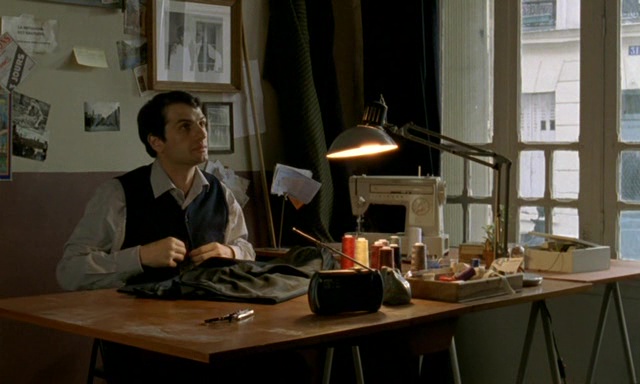
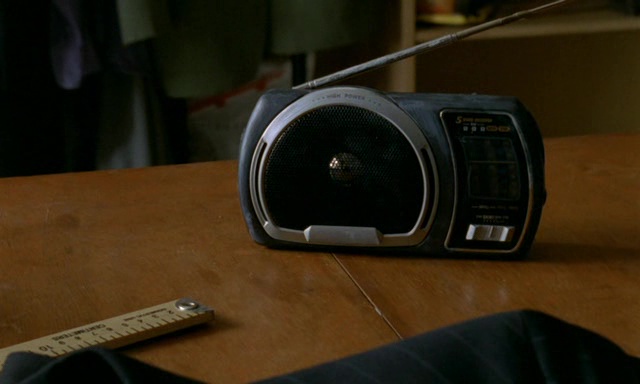
In Axelle Ropert’s Etoile Violette, her first movie as writer/director after gathering a few writing and acting credits, and a significant career as a movie and music critic, we have – a tailor shop, not even a room so much as a desk, a wall of memorabilia and clothing, and a radio, which young tailor Serge Bozon tunes to a “confessional” talk radio program as he works; he will, over the course of the movie, entertain two clients in this room. There are a few city streets, which Bozon walks in the dusk, a stoop where he eats his lunch. A classroom where a handful of adults meet for late night literature classes, the site of most of the movie’s dramatic activity. And a wooded glade, where Bozon’s character appears to speak to the subject of his night class, the writer Jean-Jacques Rosseau (played by the great Lou Castel).
A spare, even simple, group of elements, but there is something about Ropert’s design that renders the overall effect elusive. The night class, attended by eight working class students and taught by the film critic and sometimes actor Emmanuel Levaufre’s Mr. Etienne (played with the rumpled clothing and hangdog demeanor of a man used to chronic disappointment) is ostensibly about “the loneliness of Jean-Jacques Rosseau,” but quickly moves outside the realm of normal pedagogy once he requests his students to reflect on the darkness of the night sky. By the second class we have moved into the realm of something like therapy, as the students are asked to stand in front of the class and act out scenes where they imagine Rousseau castigated by the peers who have ostracized him.
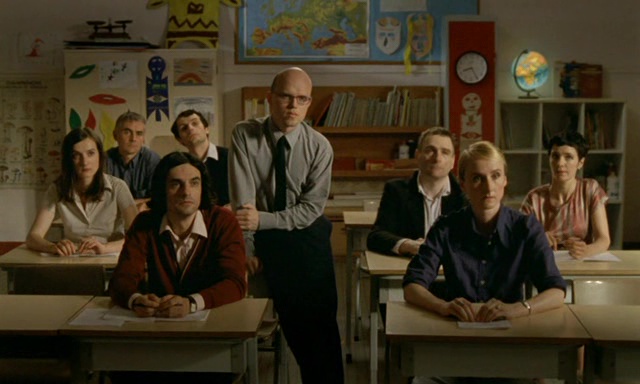

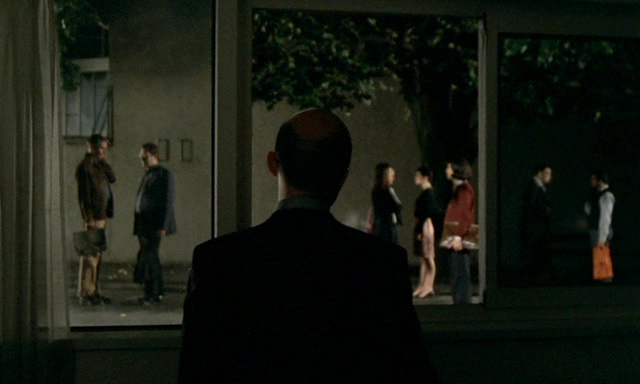
Therapy, though, for who? The classroom scenes are filmed in a series of stark shot/reverse shot compositions, and Levaufre is always isolated from the students, until these dialogues happen, when he joins the rest of the ‘audience’ perched on a desk in anticipation. In the final class of the movie, after Serge Bozon has joined a dialogue in the role of Rousseau, Lefauvre castigates the class, declaring that they have gotten it all wrong, that they have not understood what he was trying to teach them, a tirade that leaves him exhausted and spent. The class filters outside, makes small talk amongst each other, and he watches them through a window. A Devendra Banhart song plays, the camera pans across some trees at night, Levaufre opens his hand to reveal the purple flower of the title. Something has bloomed, or changed, but what, and for who?
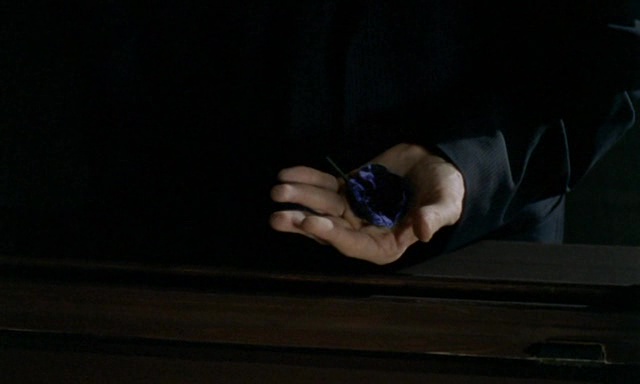
There is a specifically American part of my temperament that can’t help but ask the question – why do I not reject Etoile Violette, with its foregrounding of classical literature, its mannered performances, its unembarrassed use of 2000s Pitchfork icon Devendra Banhart, as an academic trifle, or juvenalia, something twee, affected?
I think I would put forward three answers, of varying weight. The first – that it is always moving to see the formative work of a filmmaker whose career you value. The 40 to 60 minute format adopted by the filmmakers in the broad Lettre du Cinéma affinity circle, too long to be a short and too short to be a feature, seems an ideal place for experimentation, just long enough to work through themes and ideas without the more demanding expectations of a feature. And one of the great pleasures of a debut, the chance to see the ideas will be kept (even if transformed) in the later work, and the ideas or modes that will be thrown by the wayside.
The second answer would be Hartley’s square of paint, the way a cinephile can turn something so small, so seemingly impoverished in means, into something both dense and in its own way expansive. Ropert’s later movies will remain small, even by the standards of French auteur movies, but never as small as this.
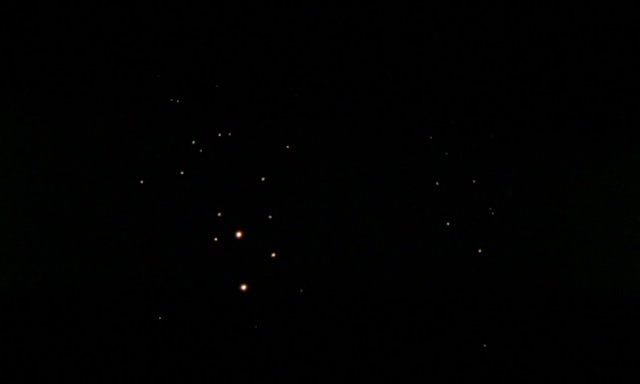
Would the older Ropert attempt something like the early sequence in which Levaufre’s teacher directs the attention of his students towards the window and the night sky, and turns off the lights in the classroom, allowing the tiny pinpricks of light to shine through, in her later work? Or more appropriately, would a gesture this bold in its simplicity have anywhere near as much of an impact in a movie with more moving parts, with more elements, more noise? One of the peculiarities (perversities) of the Lettre du Cinema world is that this tendency seems equally descended from MacMahonism and late Oliveira, and not married to either.

The third is something that I have more difficulty articulating – a haunted quality that moves through Ropert’s work as a writer/director like a counter-melody. This might seem over-determined, as if we were working backwards from the 3rd act attempted death by suicide in the great Petite Solange, her most recent film to date, but this would discount the sense of slippage and dissolution in The Wolberg Family and Tirez la Langue, Mademoiselle, or the one of the climactic actions of The Apple of My Eye, the closest she has made to an outright comedy, one of the climactic action is a blind woman running into oncoming traffic to prove a point about the man she loves.
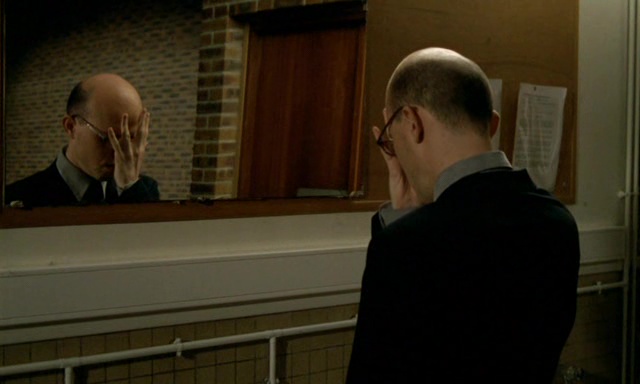
Etoile Violette is full of this – the fear of being alone, of being a dull person, at once under the scrutiny of the world and condemned to isolation. In Bozon’s downcast gaze, the voices he hears on his shop radio, the almost manic anxiety of Levaufre’s professor, the nighttime shadiness of the classroom, the night sky outside. The movie’s most repeated gesture is a hand across the face, palm against the nose and fingers reaching up towards the brow, something both blatant, stylized (I have never seen someone make this gesture in the outside world, and assume I never will) and slightly irreducible, apart from a vague sense of shame and the reminder that not all emotional states can be explicated in words.

The key would seem to be in the section where Serge Bozon and Lou Castel, as Rousseau in exile, walk through a glade together in a loose approximation of “old time clothing,” a gesture that at once might have doomed this movie to preciousness and is required to lift the movie away from the merely controlled (and I should add – one of the beauties of this small movie is that everything is required, nothing can be removed without the edifice crumbling, or at least becoming less than). And it is less related to the dialogue, where the flower is introduced (it only blooms at night, when there is no one to see it) than the space, not the literal space of the forest and its light, but the private space, a private space irreducible to metaphor or meaning. The sequence is introduced by “My Bonny Miner Lad” by Shirley Collins as the camera pans across the objects, photographs and memorabilia adorning the wall of the tailor shop where Bozon works by day, and exits to “Milk and Honey” by the tragic and still obscure Jackson C. Frank as Bozon and Castel walk slowly backwards into the forest and darkness.
There is a secretive quality to this movie, a quality that Ropert , knowingly or not, certainly cultivates in many of her other works but is most pronounced here. This is the Ropert movie I have returned to the most, and it always seems to shift with each viewing – cool and analytical on one viewing and then warm on the next; the space of it can seem to expand or contract. It is not a movie I choose to put on for comfort, although something in its size and shape makes the possibility of making film as art graspable in a way other movies do not, and is both a comfort and a challenge, and something to celebrate.
In an old Film Comment interview with her, the first time I think I was able to read her own words in English, she relates her enthusiasm for the Gary Marshall romantic comedy Frankie and Johnny, and describes it as “like a song you would find on a jukebox.” Which sounds charming until you think about what kind of songs you can find on a jukebox, and what emotions might draw you to play them on late on a Monday night.
 Lucky Star