
Secret Violence
All of Axelle Ropert’s features revolve in some way around family and the bonds that family has on us. In the previous films discussed, The Apple of my Eye and Miss and the Doctors, these relationships become entangled with other romantic ones. Two of her films, however, focus squarely on the pain of family – the pain of being in one, the pain of leaving it, the pain of staying. Those films are 2009’s La famille Wolberg and her latest film, 2021’s Petite Solange. They attack the issue of family from two different vantage points – La famille Wolberg takes the side of the father as he feels the bonds which unite him to his family slowly begin to disintegrate; Petite Solange takes the side of the young daughter as her small world, which to her equals her family, is irreparably shattered. Both films are painful, mortifying, because they give no place to hide – they offer no distance from events. Indeed, their sense of poetry only brings us closer, closer to emotions, to the characters. We should always cherish, at least a little bit, those films which bring us to tears, like the Northern Soul songs in the soundtrack which haunt the film.
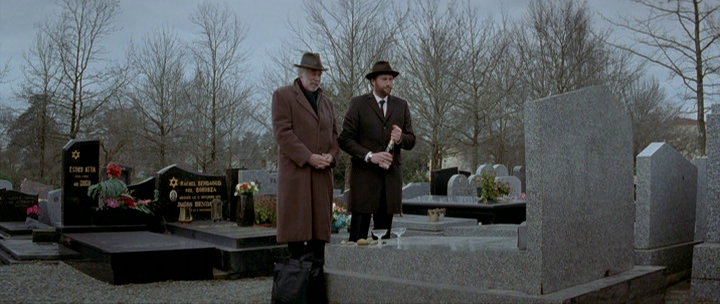
La famille Wolberg begins in a cemetery. A character places a rose on a grave in the quiet of morning, and then leaves to get his day started. We must start with this gesture because it will color the rest of the actions of its main character. From death we make our way toward love – but love is finite, just as life is. For François Damiens’s small town mayor, Simon, in La famille Wolberg, nothing is more important than his family. He is devoted to his daughter, to his son, to his widowed father, and to his beautiful wife. But his love is suffocating, dangerous, it is desperate. He tries to cling to his family, as a lifeline, a last resort. His wife, Valérie Benguigui, loves him but is distant from him (she had an affair in the past). His daughter, Leopoldine Serre, is planning on moving away with her boyfriend after her 18th birthday. Every development threatens the bonds he has with family, their connection to him, and by extension the world that he knows. He is also very sick but does not tell anyone.
Starting a family is another way to stave off death. We renew ourselves, our lease on life, through our children, through their smiles, seeing them grow before us. For Simon, his family is his connection to life. Later in the film, his son echoes his father’s words, “Daddy says that family encompasses everything, the whole world. And he says it’s happy, not sad!” Her daughter thinks differently, “family isn’t sexy.”
Being a father, like being the mayor, is an identity for Simon. It’s what he does, therefore it’s who he is. It’s the path that he’s chosen in life. But his daughter and wife can picture themselves existing outside of their family, away from Simon’s love, which is almost a burden. But what is correct? Is it wrong to devote yourself totally, madly, to your family? Part of the idea of the film is to push this devotion, this love which I think on some level all of us can understand, to a place where it begins to lash out, it begins to betray us, and those we love.
One of the more interesting characters in the film is played by Serge Bozon. He plays Simon’s brother-in-law, a bohemian musician-type who shows up to visit and whose presence inevitably puts into question all the choices that Simon has made, and what he values (privately, Bozon urges his sister to leave Simon). Simon’s son tells his uncle that his father says that he’s not on “the right side of life.” Bozon then uses chalk to draw a line on the ground and says that the fun part of life is not staying on one side, but rather going from side to side. But Simon has made a choice. And this choice is unwavering.
In essence, Simon demands total commitment from his family, and anything besides this is a form of betrayal. His wife’s affair leads to him thoughts of murder, his daughter’s farewell for him is a sort of death – the bonds of our family, built on love, lead us to violence, toward ourselves, and others.
In both films, La famille Wolberg and Petite Solange there is this common idea of there being a world of adults, and one of children. Simon’s wife tells him, “We each have our own private world.” For Simon, his private world must encompass his family. He wants to know everything about them. Even if it hurts. Ropert films this rather crazy and romantic notion, this headlong rush into the limits of the bonds of the family, with a very even-keeled vision. The relationship to melodrama is tangential – she does not seek to elevate or transcend, no, it is much more grounded. She seeks to tame almost the wild vision of her character, and to give him a plausible context within his family (it’s true that a lot of crazy behavior can seem reasonable when seen within the context of a tangled family relationship). But we can understand Simon. And there might not be anything more devastating than the final lines between father and daughter. She goes off in her adventure, blissfully unaware of what she says and its impact on the father. All he can do is walk off into the darkness. The words are full of love, but there’s only heartbreak.
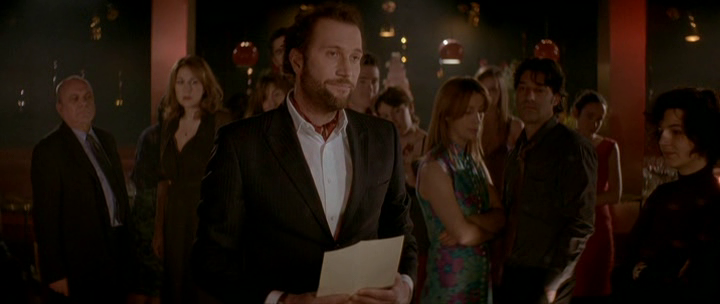
Who is at fault when things go wrong? When a wife cheats, when a husband cheats, when there are arguments, when the children are caught in the middle? With La famille Wolberg, Axelle Ropert filmed a family that loves each other, but is nonetheless coming to a breaking point, no matter what any of them do. We experienced this through the lens of the father. With her latest film, Petite Solange, she films the end of a relationship, through the eyes of the daughter. She is not part of the arguments, she does not know how they start, how they end, she only catches glimpses, clues, hints. Everything is seen at a remove. She cannot enter. There is the world of adults, and there is the world of children.
For Solange, the world is very small. She goes to school, she does presentations on Greta Thunberg (!), she maybe nurses a small crush on a boy with long hair who plays the piano, she hangs out with her father at his music shop, she helps her mother get ready for her theater performances. And soon, the father begins to sleep on the couch, she sees his father’s assistant wearing his clothes, her mother begins to cry in front of her.
Let’s be clear. The divorce drama is based on a cliché. The statistics are what they are. So in essence these experiences are quite simply very basic, very common, almost banal. The challenge of the film is how to attack it. To begin, most films take the point of view of the adults – there is a relationship ending, we understand the arguments, the drift between couples, the violence of the end. Children are mostly collateral damage to the severing of the bond between the married couple. Axelle Ropert thus moves the other way and films everything from Solange’s point of view. She never knows anything throughout the entire movie. The reasons behind the eventual separation are never clear, we don’t really hear specific arguments, Ropert films things at a remove (some things are overheard, some scenes are barely glimpsed). The adults keep things from the children. They never have the complete picture. Why would they? The divorce is thus something that’s quite abstract to Solange. But Ropert does not wish to film abstraction, or to get lost in cliches. She turns to melodrama.

I have read reviews of Petite Solange which describe it as banal and boring, and also have read reviews which label it close to camp! Which is it? The former critics are channeling of course the divorce narrative. And it’s true that the film does not have any surprises in store. The film moves toward a predictable path, in a very direct line, toward its conclusions. It does not pretend that there are great new insights toward how a child is affected by divorce. The latter critics are keyed into the heightened emotions on display. Solange does not know that what is happening to her is very common, banal. For her, it is the end of the world. And the film responds in kind.
Everything is out of Solange’s control. She is systematically stripped of the things she loves and understands. She gets detention at school, she tries to shoplift a comically oversized bra, her brother abandons her and tries to run as far away as possible from the situation going to Madrid to study. She finds no comfort in any of the things she used to know and love. Because the marital conflict remains hidden, there’s no one to blame, no key piece of information that will unlock how to deal with this pain. The film goes and goes and goes and Solange has no defense for what life has in store for her. The film reaches its limit – the family will sell the home, the shattering of her world is complete.
She sits and waits at a café, no money to her name, lying to the owner that she’s just waiting for her brother – she is utterly and desperately alone.

Melodrama is built from gestures and through the mise en scène these gestures regain their power. What does this mean in practice? Let’s talk about Solange’s scarf. It’s a gift from her brother, nothing special, but she happily puts it on when she goes out with her family. But after her sojourn through the night we end up at a small canal, her scarf floating away, with it all innocence, all happiness. The gesture of throwing the scarf away, her precious gift from her brother, is absolutely futile, powerless. But it’s here where the full force of Ropert’s direction is felt, as it is a culmination of a series of camera moves and interventions which make this the film’s crescendo, in musical terms. The effect is quite frankly overwhelming. The scarf is engulfed in the darkness of the water, swallowed up. For Solange, nothing has even been more painful.
If we extinguish one world, then surely another must be born. What has Solange learned? Those final scenes, an inexplicable ellipsis, full of anguish and pain, left off-screen. I wonder if the pandemic also led to this ending, this ellipsis. Solange returns to her empty childhood home (does she look older?), but it’s different – the soft glow of the earlier scenes is gone, she’s hardened. When her family gather around the table to wish her happy birthday, she shuts down the words of her father. Each day, each year, marks a loss. When her parents see her, what are they seeing – their little girl, or the young woman she has become? How much pain does Solange go through to say those final words, to give that final look to the camera? When Ropert films her families, she does so with love, like a family member that is well aware of the many blows they’ve received from them and how they returned them in kind, never forgetting the pain that this love also brings.

What are we supposed to do with a filmmaker like Axelle Ropert? Current cinephile culture cannot easily accommodate her – the engagement with contemporary French cinema begins and ends with whatever gets programmed at the main competition at Cannes, etc. Ropert gets shown at Locarno, but the films don’t really travel beyond that in North America (besides the token French film showcase in New York). It’s a sad state of affairs. In North American cinephile culture she’s mostly well-known for being the writer of Serge Bozon’s films. But her approach is rather different than what’s found in his films – the cuts in his films can often be quite abrupt, brusque. In Ropert’s films, everything for the most part flows smoothly. Even the more eccentric of her gestures can be integrated into the program of her film’s chosen genres.
Let’s end this text with a little bit of polemics. In her interview with Cahiers du Cinema (posted on this website), Axelle Ropert confesses that she thinks she won’t be able to work the same way or make the same type of films after Covid-19. It remains to be seen exactly what this will look like. But it’s hard to not feel pessimistic about the state of things. Especially when a film like Petite Solange is completely ignored in the United States.
In March 2023, Axelle Ropert will be the recipient of a retrospective of her work at BAM in New York. Her films have been picked up by distribution by a new company called Several Futures. This company was started by a cinephile and director called Graham L. Carter. I bring this up because none of the traditional film distributors – your Cinema Guilds, Grasshoppers, etc. – seem interested in her work. It’s up to the cinephiles like you and I to try and spread the word about her work and to take extraordinary steps, such as starting their own distribution companies, to bring Axelle Ropert’s films to more people. I identify strongly with such a gesture because starting Lucky Star perhaps come from the same place – to talk about what is ignored, to share our passions. Ropert makes her films from a similar idea – “I am making the films that I feel are not available to me as a moviegoer… I always think of my films as a viewer: what do I want to see on screen right now?” It’s up to us then to ask ourselves what kind of cinephile culture we want? One that embraces Axelle Ropert? Or one that does not?


 Lucky Star