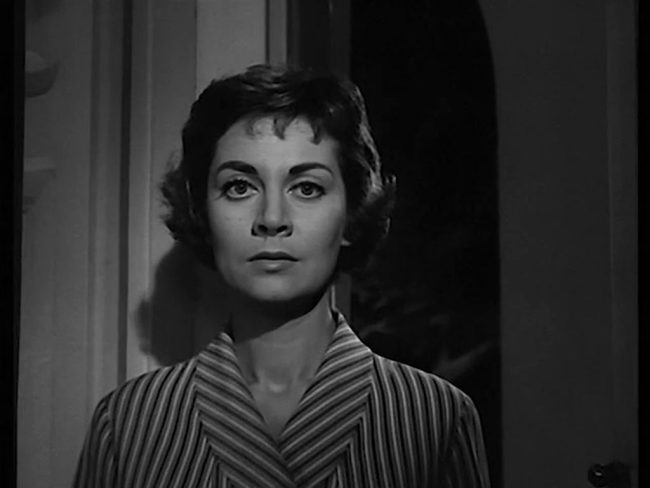
Vittorio Cottafavi, flame that never dies
By José Miccio
It did not go well for Vittorio Cottafavi at the 1949 Venice Film Festival. Four years after the end of the war, with fascism near at hand and neorealism at its most influential moment, a story like The Flame that Never Dies, the film he presented in competition, with its heroic name and its sacrificed carabinieri, was difficult to process, to say the least. For Italy, these are turbulent times. As far as cinema is concerned, everything is under construction: the films, the critics who fight over them, and the history that will soon after give them a certain intelligibility. The basic agreement, established at the same time against the official will, which wants a light cinema, and against what is happening in theaters, which are filled with Hollywood films, is the following: there is a break between two different periods that from Ossessione or Rome Open City are definitely separated. Very early, in August 1945 (a month before the release of Rossellini’s film), from Film d’Oggi, Cesare Zavattini sent all the cinema produced under Fascism to the stake: “Twenty years of an uniquely protected cinematography, much freer than is genuinely believed, did not produce a single film.” Less than a decade later, this statement already had a set of notable titles that could confirm it as these things are usually confirmed: not only rejecting what came before it but offering in exchange something new and vigorous, capable of instituting that cinema as surpassed. In the 1950’s history could already be made. In his Il cinema italian (1953), Carlo Lizzani, choosing a lustrum and not the entire Fascist period, wrote that between 1938 and 1943 everything was “a cold cast of commonplaces,” “a squalid and monotonous recipe book, “Camerinism,” “Hungarian comedy,” “soulless shadows”: “absent and empty” cinema. In his 1954 monograph, Cinema italiano (1903-1953), Mario Gromo (president of the jury at Venice 1949) reduced everything to “mediocre filmed theater” or “popular weekly magazine literature.” Neorealism swept away the past. Even its own polemics contributed to this, as the fight over its meaning confirmed its status as a fundamental interpretative key. So victorious was this way of understanding things in the literary sphere that in a 1979 essay, shortly after the Pesaro festival reopened the discussion on the pre-neorealist years, Lino Micciché defined the cinema made under fascism as “the dead man in the closet” of Italian cinema, and noted that the vast majority of the films made at the time were not accessible to anyone who wanted to see them.
Now, well, this drastic cut between two periods could not be made from nothing; logically, those who made the films that erased the past came from the past. Thus, neorealism handed out awards and punishments. With Rome Open City Rossellini left behind his three films of the Fascist period. With Bicycle Thieves, which confirmed the social interest already manifested in 1943 with The Children Are Watching Us, De Sica definitely redeemed his status as a star of light comedies. For having filmed Four Steps in the Clouds, considered a forerunner of neorealism (and surely for other reasons, not so proverbial), Blasetti accessed the new time with authority, showed that aura in his participation in Bellisima, and benefited from a facelift so remarkable that in the years after the war there circulated a version of 1860 that removed its original ending, in which the veteran soldiers of Garibaldi exchanged greetings with the Mussolinian youth. Transitional times are tangled like that. And in one way or another, unfair. Cottafavi was younger than all these directors. When the war ended, he was 31 years old, compared to Blasetti’s 45, De Sica’s 44 and Rossellini’s 39. He had only filmed, in 1943, I nostri sogni, an intelligent adaptation of Ugo Betti’s play in which rich and poor move within the same masquerade, and had participated in the direction, without being credited, of Lo sconosciuto di San Marino, attributed to the pole Michal Waszyński. But after 1945, not only did he not go through the neorealist baptism nor did he accredit antecedents, but it occurred to him to present in The Flame that Never Dies the carabinieri as heroes of the fatherland and the Nazis, not as monsters, but as ceremonious men who, hours before shooting Italians in retaliation for the death of two Germans, grant a motorcycle to the protagonist when he asks for it and resignedly accept that he offers himself in sacrifice. In the post-war deal of the cards, Cottafavi was stuck with continuity, not the cut. Some called him a neo-fascist.
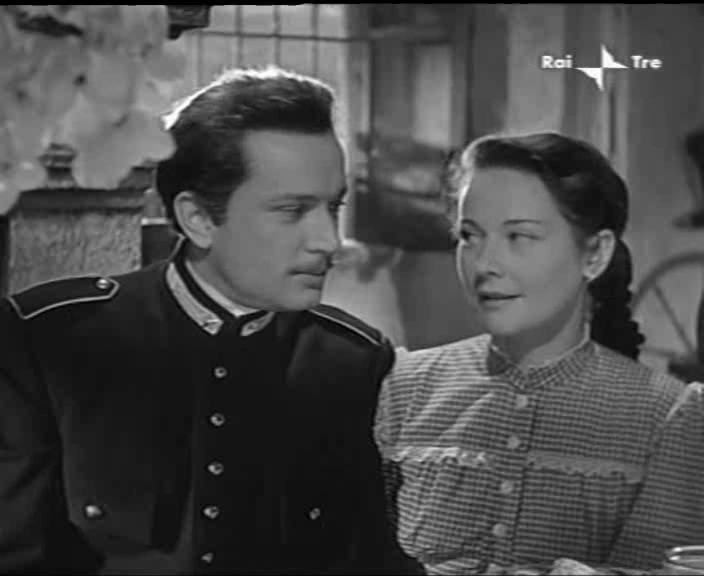
The Flame that Never Dies is divided in two parts, one corresponding to each world war, and the time of peace the precedes it. In the first, the father dies without knowing the son. In the second, the son dies following the father’s example. These two stories are contained in a larger story and connected by a force that reason does not exhaust. The larger story appears in the painting that the father chooses for his matrimonial home, that the mother hides to keep the son away from the uniform, and the son hangs up after finding it in the dust: a depiction of the Pastrengo charge of 1848, showing a group of carabinieri on horseback, charging against the Austrians. The mysterious force permeates the entire film, but has its dramatic manifestation in the moment when a carabinieri dies, doing his duty, in the arms of the son, and the son then feels the presence of the father, as if the breath from one passed to the other through the mouth that loses it. Cottafavi’s film is therefore not only the story of two men but the story of a spirit (the flame that does not die is invoked in its name), and not one of spirit among others, but of the very spirit of the homeland, which always incarnates in humble men tied to the land, and rewards them by sending them to fight for Italy: against the Austrians in 1848, against the Germans in 1948, as part of the African imperial adventure in 1940, in favor of a people under Nazi rule in 1943. In the end, after the firing squad, father and son are reunited in the sky of the carabinieri, where together with others they charge on horseback, as in the painting of Pastrengo, against whoever history dictates.
It’s true: with the war barely over, there was no lack of reasons for the film to be irritating. Cottafavi sang the honor of the carabinieri, servants of the people, who in peace fight for the law, against common criminals, and in war for Italy, regardless of the circumstances in which they are called upon to act. Who can be surprised that the criticism was generally devastating? In Stampa Sera, Leo Pestelli acknowledged the merits of the film but questioned the image (“sweetened,” as he pointed out) it offered of the Germans: “How would they have gone about massacring so many innocents if they had been this ceremonious and chivalrous?” Others were less thoughtful. In L’Elefante, Giulio Cesare Castello attached to the title the attribute “innominable” and noted the “inflamed patriotic rhetoric,” Paolo Jacchia spoke of “revalorization of the fascist war,” of “infamy to the Resistance,” and of the will to “justify the Nazi murderers.” And he concluded his article by exclaiming: “A disgrace, an infamy!” For his part, in La voce adriatica, the most important Italian left-wring critic, Guido Aristarco, described Cottafavi as an “anonymous director” (Jacchia called him “mestierante”) and spoke of an “apology for fascism.”

All this belongs to the usual field of criticism. Like the sudden change of opinion of some (Mario Gromo, for example), who at first applauded and then later gave in to repudiation, lest anyone should doubt their political identity. Like forgetting Cottafavi’s (uncredited) participation in the script of Il sole sorge ancora (1946), Aldo Vergano’s film about the partisan resistance, in which Aristarco, De Santis and Lizzani, that is, his adversaries after Venice, also collaborated on (the appearance of the Germans in Il sole sorge ancora is a good example of the criterion against which the appearance of the Germans in The Flame that Never Dies was measured: as soon as they reach the village, one shoots and a child falls dead). Today it is inevitable to say: no one seems to have noticed Cottafavi’s talent from moving from comedy to drama, from prose to lyricism, or for resolving scenes such as the communication of the father’s death, an extraordinary moment. But we all know that certain themes impose themselves when they are socially urgent, and that it is therefore useless to judge the passions of 1949 from the distance of 70 years later, as if the words spoken about The Flame that Never Dies could be artificially separated from the context in which they were uttered. That is their justification and their limit: they are history. The point is that the reaction to the film went much further. This unsigned note published on September 3, 1949 in L’Unità shows it well:
“Venice, September 2nd. Thirty Italian journalists and writers (…) today lodged a strong protest against the scandalous presentation of the film The Flame that Never Dies at the Venice Film Festival. Here is the text of the letter addressed to the president of the festival, Giovanni Ponti: ‘The undersigned Italian journalists and film writers, after viewing The Flame that Never Dies, and having unanimously identified elements for a revalorization of the fascist wars and for a misrepresentation of the liberation struggle, which have served as a signal to part of the public to stage, during and after the screening, demonstrations of a neo-fascist character, protest against the inclusion in the Mostra Internazionale d’Arte Cinematografica a work of this genre, which seriously compromises the prestige of the nation that presents it. They ask, therefore, that the film not be admitted for consideration by the jury and that the authorities examine whether it does not contain elements of the crime of apology for fascism.”
For a good part of the Italian left or center-left critics, Cottafavi had made an unacceptable film. That much is clear. What is remarkable is not the rejection but the leap that the signatories of the letter make into the void: they do not remain in the field of discussion but promote a small purge. At some point, Cottafavi understood that this reaction decided the fate of his career.
*
It is difficult to measure the real influence of Venice. Shortly after the director’s death, in an exchange of letters with Bertrand Tavernier published in l’Unità in December 1998, the Italian critic Tulio Kezich relativized the fact by saying that it was impossible that the letter of the left-wing intellectuals had produced such an impact. Kezich had already revised his view of Cottafavi, and during a dinner in Florence, in the context of the festival France Cinéma, in a jocular and complicit manner (as he says), he had knelt down in a gentlemanly manner before Cottafavi to apologize for that episode. But beyond the punctual importance of Venice, it is unquestionable that, after the festival, Cottafavi’s cinema followed paths that did not easily coincide with those that his film-scandal seemed to announce. In the 50’s and early 60’s, before devoting himself fully to television, instead of becoming an auteur in the manner of Visconti or Rossellini, Cottafavi became a refined director working far from the production spaces of prestige. No awards, no big budgets, no magazine covers, no monographs in his honor. While the discussions around neorealism went on, and some saw in that insistence signs of vitality and others no more than a retentive passion, Cottafavi made cloak-and-dagger films (Milady and the Musketeers, Il cavaliere di Maison Rouge), melodramas (A Woman has Killed, Nel gorgo del peccato, in amore si pecca in due, Traviata ’53, Una donna libera), and peplums in the broad sense (The Warrior and the Slave Girl, Legions of the Nile, Messalina, Goliath and the Dragon, Hercules and the Conquest of Atlantis), as well as a delicate episodic film (Avanzi di galera), and a great Brechtian medieval adventure film (I cento cavalieri), always for minor companies. Indeed, neither the Titanus logo, nor the names of De Laurentis, Rizzoli, Ponti or Lombardo appear before any opening scene: Novissima Film, Romana Film, Itala Film appear. Cottafavi went to the B. From there he defined his place in Italian cinema: an aesthete working in genres that did not grant recognition and in which he achieved some extraordinary accomplishments. Much of the charm of his films comes from this unsought encounter between a cinema without prestige and a remarkable ability to turn the camera into an instrument of inspection of space, the face and, at times, the interiority of the characters.

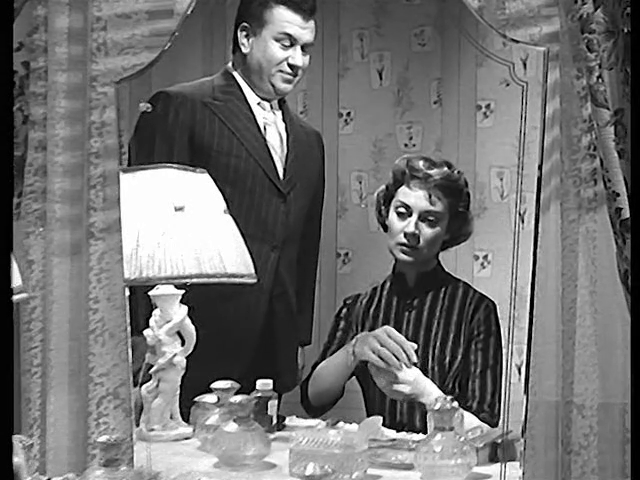
On this point, two of his five female melodramas are especially notable: A Woman has Killed and Una donna libera. They are extremely stylized films, which defy the cliches of the genre by assuming them, a bit like Douglas Sirk, who in the same years was shooting in Hollywood the films that would later fascinate Fassbinder. In fact, in Cottafavi, this critical closeness to the genre is even more remarkable. In A Woman has Killed the narrative frame works pedagogically: on a train, one woman tells another the story of a third so that she does not make the same mistake that landed the latter in jail. The mistake is precisely melodramatic love, that is, the story that the film tells, not just once but three times: with the bourgeois woman who leaves her home to follow the English captain who mistreats and abandons her, with Madame Butterfly, whose aria “Un bel di vedremo” causes the protagonist so much discomfort that she is forced to leave the theater, and with the woman on the train, who in the end throws her gun on the tracks and thus breaks the chains of sacrifices: murder and prison in Cottafavi’s central story and suicide in Puccini’s work.
Una donna libera is similar. Instead of falling in love with an allied captain, the protagonist falls in love with a musician who convinces her of something she is already convinced of because she knows her mother’s life: how terrible the bourgeois marriage awaiting her can be for her. The man is a successful conductor and a frustrated composer, aware of his inability to create anything that stands on its own (the scene where he tries to compose and can only disguise Chopin is brilliant). He is also the perfect fantasy object for women who don’t want to reiterate their mother’s lives because it offers them a tale against propriety and a season in self-determination. If his poor spirit deserves credit, it is because he makes no romantic promises. Unlike the captain in A Woman has Killed, who conceals his intentions, he is a seducer with all his cards on the table, and length is not among them. But even taking this into account, his selfishness is irredeemable, because even knowing that the way of life he practices is not possible for his conquests in the same terms in which it is possible for him, every time he tells them: you are free. He pushes them into a drama that does not involve him. In the bourgeois society that the film stages with admirable precision, freedom can be tragic for women, but not for men, who in any case must endure common neuroses. This distinction – or, rather: the intensity and scope of this distinction, since melodrama has always assumed it – is one of the keys to the film. In fact, its main story unfolds within a web of couples. At one end, that of the parents, traditional and sadly affectionate. At the other, that of her writer friend and the painter, which works because it is mediated by irony and a certain bohemian spirit. In the middle, two that involve herself: the year of marriage to a good man she does not love, and the (rejected) possibility of becoming the mistress of a famous architect, who proposes to her little less than being his fine whore. But where neither resignation, nor irony, nor self-deception, nor business have a place, in the romantic absolute, things are quite different, and lead to a drastic alteration of values, to such an extent that freedom produces in the woman who tries it so much unrest that when her sister shows herself ready to repeat her story she ends up defending what she wanted to escape from. What neorealist film went so deeply into this theme? None, of course. Pasolini? He did not, although he did an equally radical job with maternal love in Mamma Roma. And Antonioni? Not even him. Cottafavi fulfills the pathetic obligations of melodrama while making that fulfillment one of the themes of his film. As in A Woman has Killed, gender is in the foreground. It is noticeable in the dialogues. In the climactic moment, the man says: “We are in the middle of a melodrama,” and he starts playing the piano to musicalize the scene in which he loses his life. But from the very beginning, when the painter and the model talk about the portrait, he says like a modernist: “I like the model to look like the portrait,” and she answers like a classicist: “It could be that the portrait looks like the model,” it is clear that the film is also about itself. The protagonists of Cottafavi’s melodramas are victims of melodrama, and in these two, which are the most self-conscious, the task they accomplish before their final defeat is the liberation of another woman, by direct intervention (the crime), or deferred (the story), as if the chain of suffering can only be suspended, because ending it does not end, with a shot and a sacrifice. Cottafavi’s mastery consists in confronting the genre of tears with forms that make their functioning evident without denying them, without drying them up. Few tasks are so difficult and fascinating. The director himself left a possible image for these films: “a modern house with antique furniture,” as the protagonist of Una donna libera says after refurbishing the property of her future husband.
*
Cottafavi carried out a similar operation with peplum, which for a few years (1958-1963, basically) was the most popular cinema in Italy. The main function of these films, which triumphed mainly in peripheral theaters, was entertainment, for which they received the obligatory nickname of escapist, like cloak-and-dagger cinema before and then gothic, spaggheti western and giallo. But at the same time, they offered a few references to political themes of the past (the dictatorship, the resistance) and of the present (the influence of the United States, the atom bomb). Cottafavi did not miss this chance. In Hercules and the Conquest of Atlantis , which has some of his most beautiful images, the hero confronts a queen who wants to produce a superior race from the one drop of Uranus’ blood that fell to earth after his children defeated him. The creatures are all the same: white and extremely blond men, with beards and no moustache. The plot and iconography refer to fascism and Nazism. In fact, the queen’s palace coincides with Mussolini’s taste for ancient monumental classicism and, in addition to the Aryan delirium, in Atlantis there is a concentration camp that when Hercules and his companions open it effortlessly recalls the liberation of Auschwitz. But in addition to allusions to the past, it is also possible to to find in the film a fable about the present, and with it, a conception of heroism different from the one that appeared earlier in The Flame that Never Dies and from the one that will appear later in I centi cavalieri. Hercules acts on behalf of the people of Atlantis, against the oppressive state, and then returns home to Thebes, so that instead of functioning as a hero in the style of the carabinieri he functions rather as the foreigner who puts an end to illegitimate power. A sort of one-man allied force. Or else: a western demigod (the final atomic apocalypse strikes the dark note here). Politically, by the logic of the actions rather than the parleys, the film presents him as a left-of-center democrat fond of leisure in times of city-states. As soon as he arrives in Atlantis, he defeats Proteus. A minute before leaving, he defeats the blood of Uranus. That is to say, the alchemic-anarchic and the One-totalitarian, as if he were the envoy of moderation: a figure that ensures both variation and equilibrium.
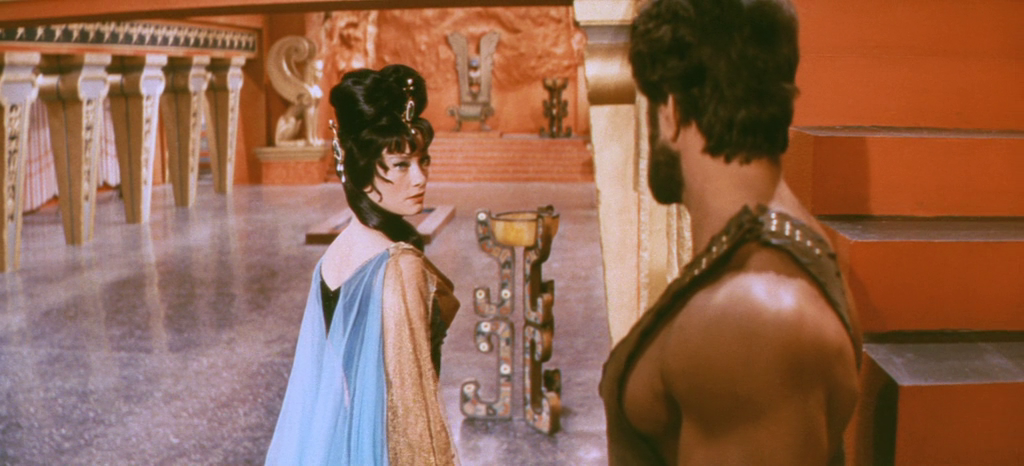
In one way or another, with its extreme political simplicity, Hercules and the Conquest of Atlantis (a trickly title as it turns out) answers the old and ridiculous accusation of neo-fascism against Cottafavi, and demonstrates the delicacy for camera movements and framing similar to that of melodramas. In Goliath and the Dragon there is also an illegitimate king (it is commonplace in peplum), and in Messalina, a sexual tyrant. More complex are The Warrior and the Slave Girl, in which there are no mythological heroes but two ordinary men, a Roman tribune and an Armenian gladiator, fighting first reach other and then together against an usurper, and Legions of the Nile, which combines circus humor, long dialogues of palace politics, war spectacle and a very delicate portrait of characters, among whom shine Augustus, a Hegelian leader in search of a poet capable of assuming him glory, and his dramatic opponent, Curridio, who does not accept that History redeems the disasters committed in his name. Augustus says: “I am the will of an era,” and by accepting this role, he also accepts the meaning of all suffering. Curridio – “too tender for History,” according to Augustus – cannot do so. That is why he ends the film in the desert, like Tomas Milian and Lee Van Cleef a few years later in The Big Gundown, announcing the search for a different country, where “there will be no talk of wars, no massacres, no emperors.” There are moments of excellence in Legions of the Nile. But the greatest film that Cottafavi shot in the 1960s is the last one he made for the cinema: I cento cavalieri. It is a story set in medieval Spain at the time of the Arab occupation, in which Cottafavi revisits some of the motifs of The Flame that Never Dies. They are two, fundamentally: the revenge of the invaders, who kill 24 local men as punishment for the 12 Arabs killed in a revolt, and the final charge of the cavalry, which obligatorily quotes the one in the painting of Pastrengo. In drawing attention to the possible closeness between the two films, these coincidences merely point out all that separates them. The fundamental thing is this: this time there is no transcendent spirit that unites the men in whom it embodies Italy and each other, but rather a rogue heroism, immanent, absolutely contextual; those fighting against the Arabs are composed of common people, bandits and storytellers, whose aspirations are peace and pleasure of the senses, not soldiers devoted body and soul to the homeland, an idea that for I centi cavalieri is a laughable abstraction. In other words: instead of uniforms, heroic transcendence and praises to sacrifice, common people, picaresque morals and affirmation of everyday life. Given all this, it is logical that the treatment of death is radically different. In The Flame that Never Dies, the father and son die for Italy and thus fulfill their destiny of glory and death. In I cento cavalieri, the father and son fight together, and when the former dies, he dies in surprise, without understanding what is happening, because heroic destiny is a tale for idiots (a note about this: in an extraordinary moment in The Warrior and the Slave Girl, when the Armenian receives the arrow that will cause his death, he looks at the enemy who threw it at him and discovers him dying, wounded just like him, also an actor in an absurd play. The scene makes it clear that Cottafavi is a filmmaker reluctant to simplify, and that he distinguishes between generals and soldiers. That is why the gladiator mirrors a nobody, and in The Flame that Never Dies the German offers an apple to the carabinieri). At the end of I centi cavalieri, after the non-model good guys defeat the non-infernal bad guys (an Arab marries a Spaniard, to make this clear), and the time of peace returns, we hear these words: “And they all lived happily and contendedly, as much as one can in this land. That is to say, little.” This conclusion, added to the militant anti-heroism, the impish materialism, the passage to black and white in the great battle scene, the fabulous setting of the story, represented and concluded by a painter-comedian as he turns it into the fresco of a church, showcases the remarkable influence of Brecht’s epic theater, which makes the film an extraordinary popular experiment. As if to say: a Dumas or Walter Scott story filmed by Brecht for Dumas or Walter Scott readers. If turned out to be too much. I cento cavalieri did not go to Venice, as Cottafavi would never go again after 1949. It went to Cannes, where it was shown in a fringe performance for a dozen of the director’s friends, including Freda and Pasolini. The premiere was a failure, and Cottafavi never returned to the cinema. It is our task now to give him the place he deserves.
“Vittorio Cottafavi: llama que no se extingue” was originally published in Calanda on September 21st, 2021. Original text by José Miccio
Translation by Jhon Hernandez. Thanks to José Miccio for his permission to publish this translation.

 Lucky Star